


The Ecommerce Email Sequence That Converts: How to Structure the Five Message Types Across Your Flow
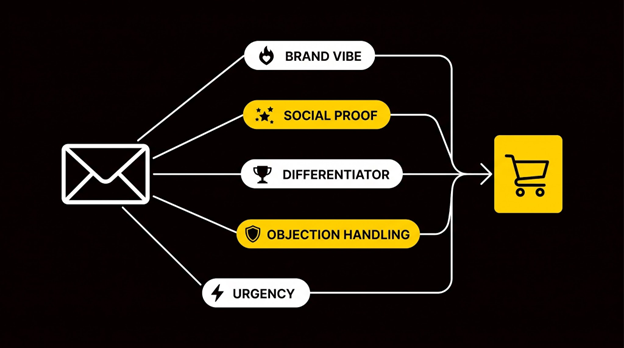
Most ecommerce brands send emails when they feel like it. A promotion here, a product announcement there, a "just checking in" message that doesn't quite know what job it's doing. The result is inconsistent revenue, unpredictable open rates, and a subscriber list that slowly tunes out. The fix is a structured ecommerce email sequence: sending the right messages, in the right order, with a clear purpose behind each one.

Building a message-driven ecommerce email sequence means moving away from reactive campaigns and toward a deliberate system, one where every message earns its place by advancing the customer relationship in a specific direction. Rather than iterating endlessly on small tweaks to existing content, brands should identify the three to five things an ideal customer needs to hear in order to believe in the brand and purchase. Once identified, these messages can be repeated across channels and collections without reinventing the wheel each time.
From Arbitrary Timing to a Message-Driven Growth System
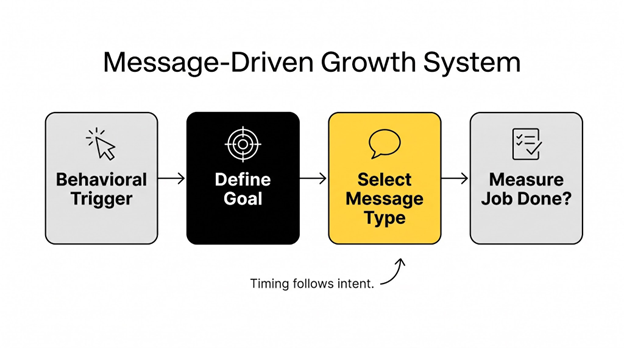
Timing matters in email, but timing without intent is just noise. Real power comes from knowing what each email is supposed to accomplish before a word gets written. A message-driven system starts with diagnosis: identifying the behavioral trigger, then defining the goal, before any copy is drafted. What does the customer need to believe after reading this email? What hesitation is being cleared?
Flows built this way respond to real behavior rather than arbitrary intervals. A new subscriber enters a sequence designed to build trust systematically. A buyer completes a purchase and triggers a flow designed to encourage a logical next step. Every action becomes a signal, and every email becomes a response with intention behind it.
This also sharpens performance measurement. When each email has a defined job, brands can evaluate whether it's doing that job. Opens, clicks, and conversion data become diagnostic tools rather than vanity metrics, answering "did this email accomplish what it was designed to do?" rather than just "did this email work?"
The Five Messages Every Ecommerce Sequence Needs
Brands that win in email have figured out how to move a customer from curious to convinced, and it rarely comes down to design or send frequency. That journey has five distinct message types, each handling a different layer of the buyer's decision-making process, working together across flows to build belief incrementally. Duncan Ferguson, Strategy Lead at Pilothouse, breaks it down in DTC Podcast, Ep 595: 5 Messages That Scale DTC Growth.
Message 1: Brand Vibe
Before a new subscriber will buy, they need to feel something. The Brand Vibe message establishes the brand's emotional truth, not its technical specs. It's about the sensation or identity the brand provides and how it fits into the customer's life, as Pilothouse's Taylor Cain and Aves explore in Ep 579: How to Nail DTC Merchandising in Q1: From Scroll to Sale. Increasingly, this is about ritual building and human connection, the thing that separates a brand from generic "AI slop" competitors. Often the value lives entirely outside the product itself: Liquid Death doesn't just sell water, it offers an identity for people who want a cool non-alcoholic option in a room full of drinkers.
Founder-led emails are highly effective here. A personal note sharing the "why" behind the business builds a habit of engagement through authenticity and ritual, rather than a straightforward ask for a sale, a point Jordan Gordon, VP of Retention and CRO at Pilothouse, makes in Ep 583: Counter Intuitive Ways to Maximize Net Present Value from Your Email List. The most effective versions share relatable struggle, like building a business on a maxed-out credit card, so subscribers start looking forward to the "show" rather than bracing for the sale. The sharpest framing focuses on how the brand helps the customer become the better person they want to be: a better rock climber, a more organized parent.
Message 2: Social Proof
Once a customer feels connected to the brand, they wonder whether others trust it too. The Social Proof message shows that "other people like them" back up the brand's claims. Rotating customer reviews, PR logos, and "as seen in" mentions build legitimacy here, as Aves details in Ep 47: 5 Different Static Styles To Try In Your Meta Account Now. Customer quotes and formal PR play different roles: reviews carry peer credibility, while "as seen in" logos anchor legitimacy through the middle and bottom of the funnel.
Specificity matters. A review from someone who shares the subscriber's pain point or lifestyle carries far more weight than a generic "love this product!" quote. The best social proof feels like recognition rather than interruption, where the subscriber sees a review or image and thinks, "that's exactly what I was wondering." Video does this dynamically: an unboxing clip where a real person notes the package arrived in three days delivers subtle but powerful proof of reliability.
Message 3: Differentiator
Consumers typically visit three to four competing sites before buying, so the Differentiator message has to explain why this brand wins (Ep 579: How to Nail DTC Merchandising in Q1). The goal is highlighting the specific factor that sets the brand apart. It helps to think in terms of memory structures: salience isn't just being different, it's about how and when people remember you. A brand might aim to "own the rain" so customers think of its waterproof shoes the moment it starts pouring.
Generic language like "premium" or "authentic" doesn't do the job. Mapping specific features to real-life benefits does, for example, framing a "leak-proof" lid around the relief of tossing a mug in a diaper bag without worry, a mindset Tyler Mazur, Head of Amazon at Pilothouse, applies in Ep 607: Rufus Reads Your Images. Don't just say a jacket is waterproof; explain that it will protect you on hikes in heavy rain. Repositioning can be a growth lever in itself: one brand found success shifting from a "denim brand with athleisure features" to an "outdoor lifestyle brand" that happens to use denim.
Message 4: Objection Handling
Even customers close to buying carry quiet anxieties about price, quality, or shipping. Objection Handling is a tool for resolution, not persuasion: modern consumers aren't looking to be convinced, they want a specific friction resolved.
If price is the friction point, focus on quality or a "freedom to try" guarantee, like a "100 mornings of coffee" promise that lets a customer return the product if it ever leaks in that window. For functional concerns, visual proof, like B-roll of the product in a stressful, real-world context, demonstrates that it works, as Aves covers in Ep 48: Unboxings, B-Roll, and 3 More Video Styles That Scale and Ep 52: When You Find a Winner: Four Ways to Iterate on Creator Content. Show the travel mug being shaken upside down or thrown into a bag full of expensive tech. For functional-focused buyers, "boring" reassurances like an extended warranty or shipping protection can remove the last bit of friction.
Message 5: Urgency
The final message provides the punctuation for action needed to get the customer off the sidelines. Urgency gives them a reason to buy now.
"Infomercial" tactics work well here: "But wait, there's more," exclusive email-only offers, or scarcity messaging like "Sold out 5 times, back for a limited restock" can meaningfully drive click-through rates, a set of plays Aves lays out in Ep 43: Sell Like It's 1999 and Ep 47: 5 Different Static Styles To Try In Your Meta Account Now. Specific data beats vague claims, so "sold out in 2 hours, back for a limited restock" lands harder than "limited stock." The "but wait, there's more" move works well paired with a surprise gift with purchase or a code-specific landing page that delights the customer right as they're about to buy. Email-only promotions do double duty: a big exclusive offer rewards loyal subscribers with something they can't get on the main site and re-warms a low-engagement list. If the first four messages built genuine belief, this push lands as a favor rather than a pressure tactic.
Applying the Five Messages Across Email Flows

The five message types aren't built for a single flow, they're a framework applied across every major sequence. The context shifts, but the underlying logic (build belief, address doubt, create momentum) stays constant. A simple mapping exercise helps here: identify the trigger, define the goal, select the message type, set the timing, and define the exit condition before writing any copy.
Welcome Flow: First Impressions That Build Belief
The welcome flow offers the most concentrated opportunity to run all five messages in sequence. A new subscriber just opted in, meaning interest is high, but that window doesn't stay open forever.
Brand Vibe leads immediately, often built around a "ritual" tied to the product. For CPG brands, that might mean showing how the product fits into a daily routine, like a serene morning coffee moment (Ep 50: Blind Boxes, Busy Parents & Building Subscription Brands). Social Proof and the Differentiator message follow, and by the time Objection Handling and Urgency arrive, the subscriber has spent meaningful time with the brand and has real reasons to consider a purchase.
A related trigger, the post-browse abandon flow, calls for a different emphasis: the customer is already warm and aware of the brand but hit a conversion barrier. That flow should lean almost entirely on Objection Handling, answering quiet anxieties like "will this work for me?" rather than repeating top-of-funnel brand stories.
Post-Purchase Flow: Guiding the Logical Next Purchase
After a purchase, the job changes. Newness fatigue is a real risk, so rather than bombarding new customers with unrelated launches, the goal is guiding them toward a logical second purchase that matches their original intent (for example, a customer who bought the "Red Widget" should be guided toward the "Blue Widget" accessory, not an unrelated new collection) (Ep 617: How to Fix a Pooched Email Account).
The five messages still apply: Brand Vibe reinforces community after purchase, Social Proof highlights products popular with similar customers, the Differentiator now supports a complementary category, Objection Handling addresses care or usage questions, and Urgency ties to a relevant replenishment cycle or bundle. Post-purchase flows are often underdeveloped, but the customer already trusts the brand, making the barrier to a second purchase far lower than the first.
Why Subject Lines Deserve So Much Attention
All five messages mean nothing if the email never gets opened. Subject lines sit between the message and the inbox, and they carry the largest effect on revenue per session in the entire ecommerce email sequence, since every recipient who engages with an email must first engage with its subject line.
The most effective subject lines do two things at once: they feel immediately relevant, and they leave enough open to create curiosity. Over-explaining kills opens; generic phrasing fails to earn a click. Ongoing testing, small copy changes, tone shifts, personalization tokens, is what compounds performance over time.
Building Around High-Intent Behavior, Not Over-Segmentation
A common pitfall in ecommerce email strategy is over-segmentation. Brands create so many micro-audiences and conditional branches that the system becomes unmanageable, and individual AI-driven segments can shrink to the point of reducing inbox placement for the broader list.
In practice, roughly 25% of an email list tends to drive around 75% of its revenue, as covered By Jordan Gordon from Pilothouse in Ep 601: 25% of Your List Drives 75% of Revenue. That's why flows should be built around behavioral signals, someone who views a product page repeatedly, abandons a cart, or returns to a category multiple times, rather than demographic categories alone. Those actions indicate purchase intent more reliably than who a customer is on paper.
Segmentation still has its place, but the priority should be acting on strong intent signals, keeping the architecture simple, and resisting complexity for its own sake, since over-segmenting can choke a program's overall reach.
Common Mistakes That Dilute a Five-Message Sequence
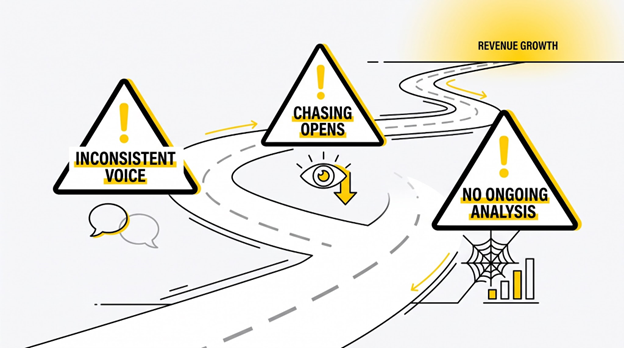
Beyond over-segmentation, a few recurring traps quietly drag down otherwise well-intentioned email programs.
Inconsistent voice
If the Brand Vibe email sounds warm and story-driven but the Objection Handling email reads like a legal FAQ, the customer experience fractures. Every message should feel like it came from the same brand.
Chasing opens over outcomes
Opens are a poor predictor of future site visits; clicks and placed orders are the metrics that connect directly to revenue and LTV. A healthy account keeps open rates in the 28-35% range by keeping segments tight and excluding false "Apple Privacy Opens" (Omnisend). Sending occasional non-performance, pure content emails can dip short-term metrics but grow list size and long-term engagement, which makes future promotional sends more effective. Pilothouse's work with The Rag Company is one example of how tightening flow strategy around the right metrics translates into measurable revenue gains.
Neglecting ongoing analysis
Email flows aren't a build-it-and-forget-it project. Regularly reviewing which messages drive opens, clicks, and conversions, and adjusting flows as the audience and offer evolve, is what keeps a five-message sequence performing over time.
Let Pilothouse Build Your High-Converting Email Sequence
Why Brands Choose Pilothouse
Executing a five-message sequence well, in a way that consistently drives revenue, takes real command of copywriting, automation logic, behavioral triggers, and ongoing optimization. Pilothouse Digital brings that combination to ecommerce brands as a full-funnel performance marketing agency trusted by DTC names including Benchmade, Hestan Culinary, Big Blanket, Chamberlain Coffee, and General Mills.
Three things set the approach apart: message-driven content built around what customers actually need to hear, an emphasis on establishing genuine emotional truth rather than generic brand messaging, and flows architected around high-intent behavior instead of arbitrary timing.
Get Started
If an email program feels scattered or flows are outdated, it's time to bring in a team that builds sequences designed to convert. Conact Pilothouse to get started.


%20(1).jpg)







.png)



.webp)


.webp)