The Five-Message Framework: Why DTC Brands That Plateau Are Missing These Facebook Ad Types

Most DTC brands don't plateau because their product stops working. They plateau because their ads do. Somewhere between the first $1M and the $5M mark, organic momentum fades, the aesthetic content that felt fresh starts blending into the feed, and suddenly the creative that used to pull returns isn't pulling anymore. It's tempting to blame the algorithm, the economy, or ad fatigue, and those factors can certainly play a role. But one possible explanation worth considering is that the brand has been running the same type of message on repeat, mistaking visual variation for true creative diversity. If that's the case, it may not be purely a creative problem. It could point to a deeper strategy issue.

The $5M Vibes Plateau: Why Aesthetic B-Roll and Organic Momentum Stop Scaling
There's a growth stage that feels deceptively good. The brand has found a visual identity. The product looks clean on camera. Organic content is converting. That energy gets repurposed into paid ads and, for a while, it works because the audience is still warm and curious. Then it stops.
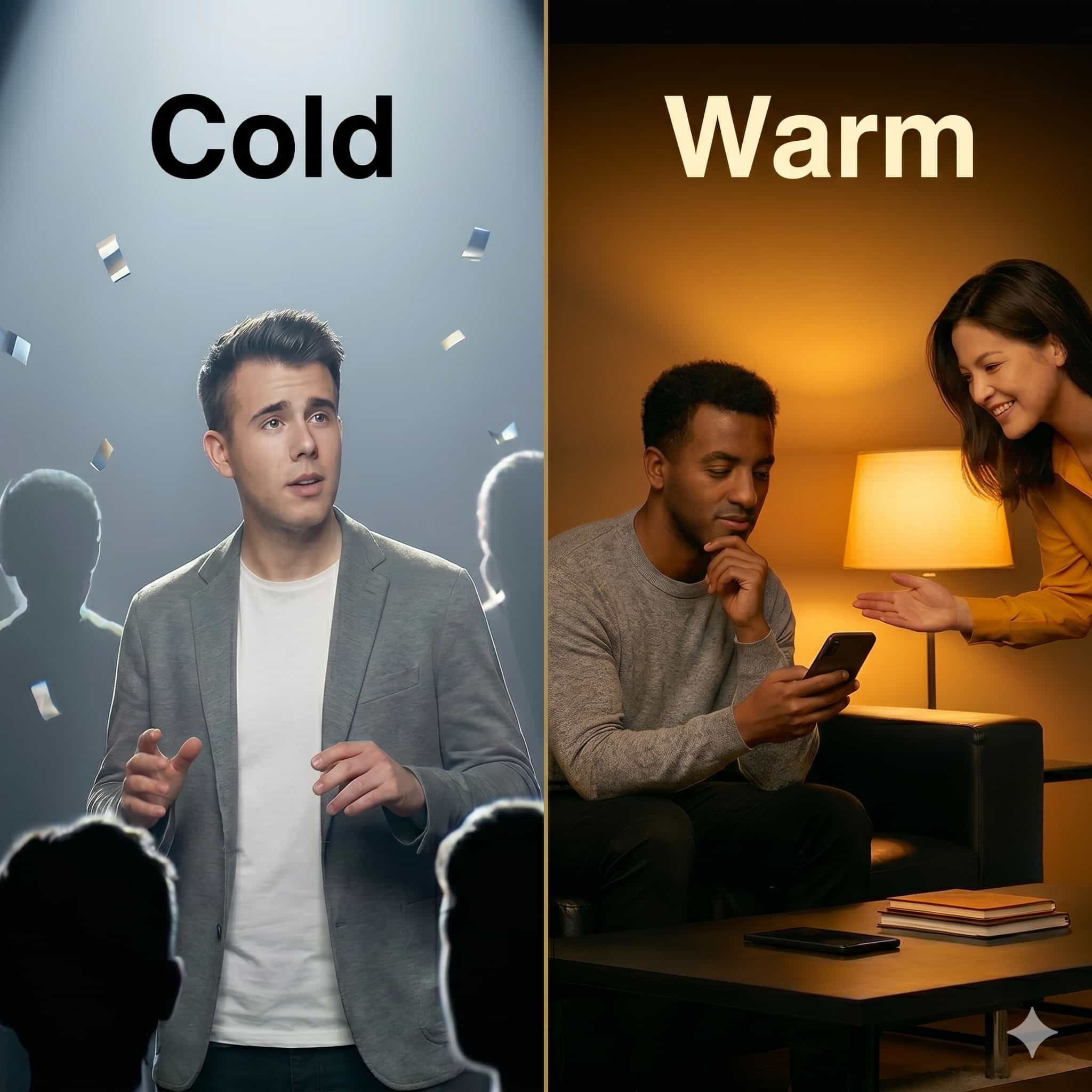
Aesthetic content built around brand atmosphere earns attention in a low-resistance environment. It works when the audience is already primed and searching for a reason to buy. In early paid scale, brands are often still fishing in warm waters. Push spend further and they reach colder audiences who need more than vibes. They need answers.
B-roll of a product looking beautiful doesn't explain why someone should choose it over a competitor. It doesn't address the price concern sitting in the back of their mind. It doesn't tell them that thousands of real customers loved it. When a brand runs nothing but atmosphere content at scale, it's doing one job and ignoring four others. That gap is where growth stalls.
Why Meta's Andromeda Algorithm Rewards Idea Variety Over Design Variety
Meta introduced Andromeda in late 2024 and completed the global rollout by October 2025. The system prioritizes predictive performance and creative concept differentiation over surface-level variation. The practical implication for DTC advertisers is significant: the algorithm doesn't reward visual variety. It rewards conceptual variety.
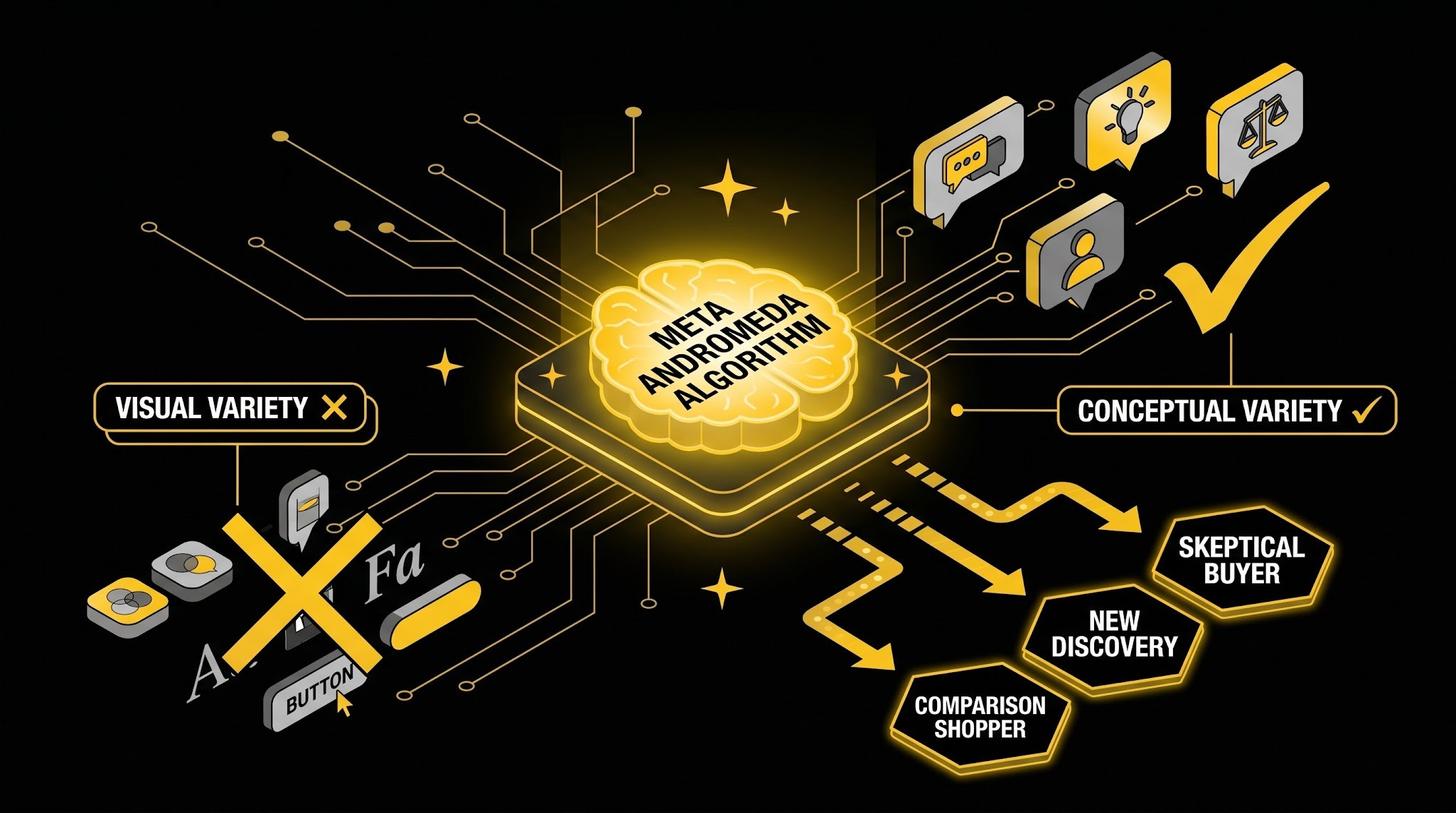
Two ads can use completely different visual treatments but carry the same underlying message. Andromeda enables more granular personalization and context-based matching, evaluating distinct messaging approaches rather than surface-level design variation. Swapping colors, fonts, or button styles does not signal novelty to the system. Only distinct messaging approaches do. This also reflects a broader shift in how targeting works. Rather than manual audience targeting defining who sees what, the algorithm now matches ad creative to a user's context and preferences - a shift practitioners describe as moving from broad categories toward intent-based matching, where the creative itself signals who should see it. Creative-first signals now define the audience.
At its core, this means the algorithm rewards an ad that matches a real moment in the buyer's thinking. Someone skeptical about price needs to see something different from someone who has never heard of the brand. Serve everyone the same vibe and most of those intent moments go unaddressed. Without a library of distinct answers to different buyer anxieties, brands become effectively invisible to the right audiences at the right conversion moments, regardless of spend.
Introducing Pilothouse's Five-Message Framework: Every Facebook Ad Type Needs a Job
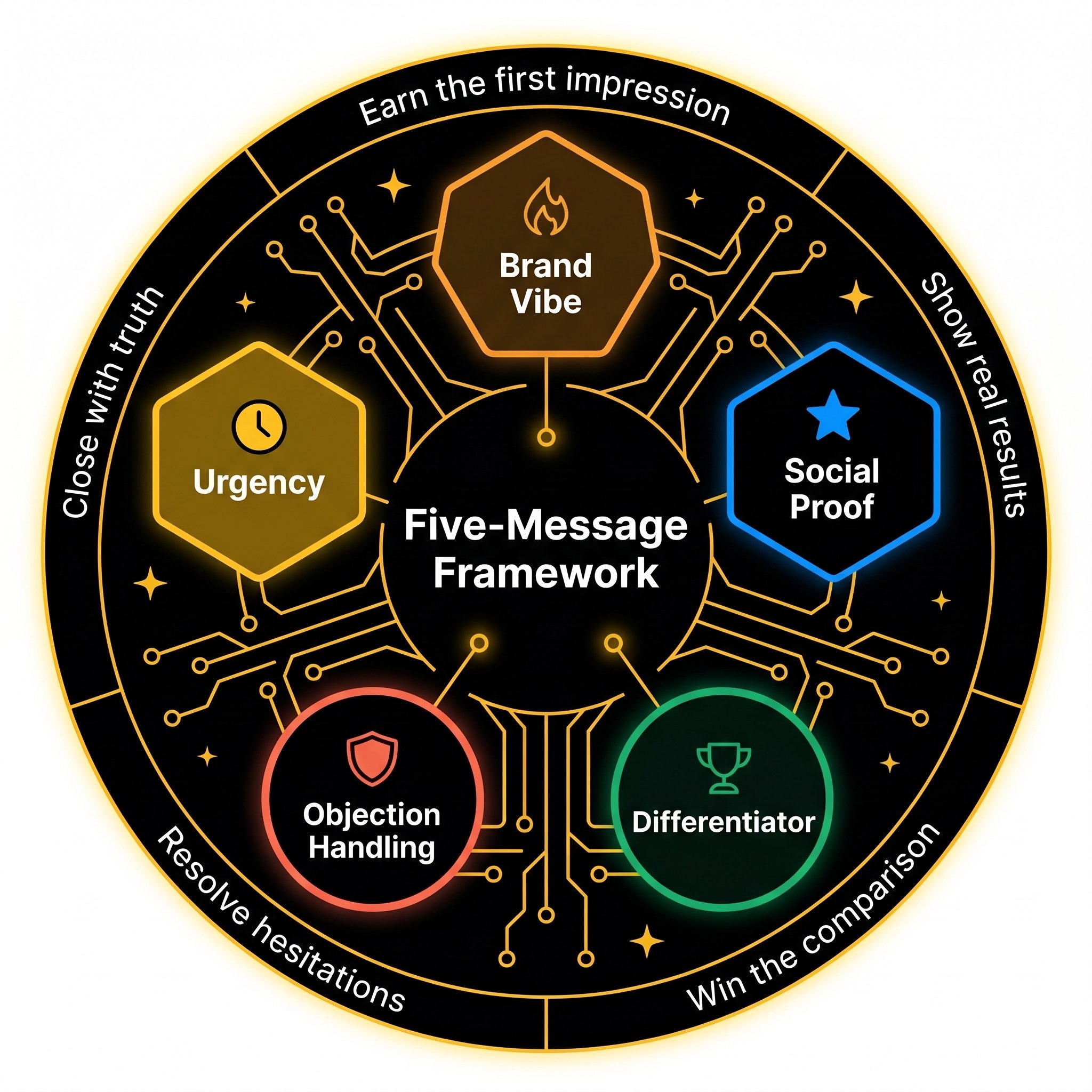
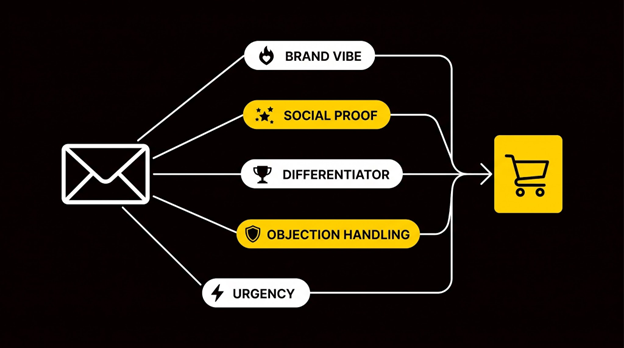
The Five-Message Framework is how Pilothouse structures creative strategy for DTC brands serious about scaling past the plateau (originally outlined by Duncan Ferguson from Pilothouse in DTC podcast, Ep 595: 5 Messages That Scale DTC Growth). It's not a content calendar hack or a design template system. It's a coverage model. The premise is straightforward: there are five distinct psychological jobs that ads need to perform, and a healthy Facebook ad mix includes at least one creative asset actively doing each of them.
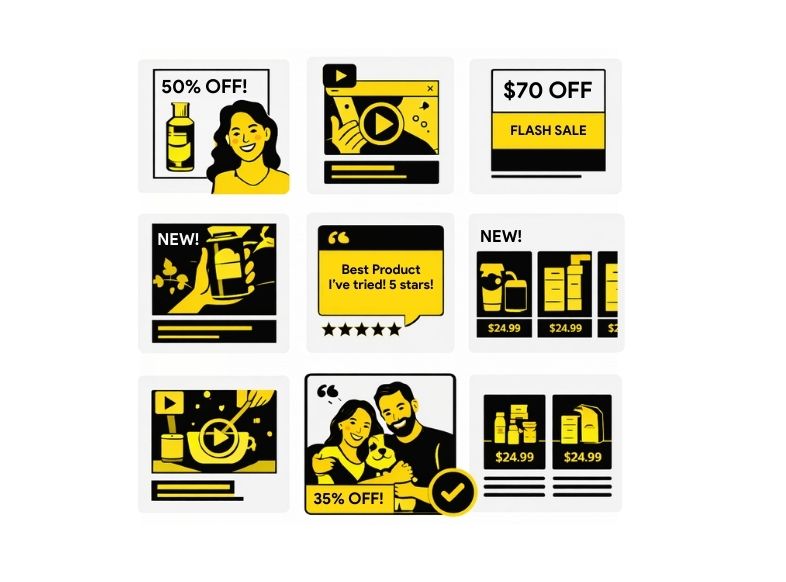
The framework doesn't prescribe format. A video, a static, a carousel, or a UGC clip can execute any of the five messages. What matters is that each asset has a clear, defined purpose rooted in a specific moment in the buyer's journey. The five messages are: Brand Vibe, Social Proof, Differentiator, Objection Handling, and Urgency.
Message 1: Brand Vibe
Brand Vibe content does a specific job: it introduces the brand's personality and emotional register to someone who has never encountered it before. It earns the first impression. This message type is built for awareness, not conversion. It should feel like a brand that has something to say, not a product trying to sell. The mistake most brands make isn't creating Brand Vibe content; it's expecting that content to carry the full conversion load. Assign it its job, run it with that expectation, and let the other four messages do the rest.
Message 2: Social Proof
Social Proof is one of the most reliable message types in the Facebook toolkit, and it consistently outperforms polished brand content in cold audiences. It doesn't ask the audience to take the brand's word for anything. It shows them what real people experienced. This message covers a wide spectrum: customer review screenshots, UGC video testimonials, before-and-after walkthroughs, aggregated rating displays. When building this layer of a creative library, prioritize specificity. A testimonial that says "this changed my morning routine" outperforms "love this product" because it paints a scenario the viewer can actually step into.
Message 3: Differentiator
There's a specific stage in the buying journey when a consumer knows they want a solution but hasn't decided where to get it. This is the comparison moment, and it's one of the highest-leverage points in the funnel. Most DTC brands let it happen without any dedicated creative.
Differentiator ads address this head-on. They isolate what makes the brand the better choice and communicate it directly. This is not a feature list. A Differentiator ad speaks to the gap between what competitors offer and what the brand delivers, framed around the outcome the buyer actually wants. The most effective approach is often contrast-based: name the category convention you're breaking and give the viewer a clear reason to stop comparing and start deciding.
Message 4: Objection Handling
If there's one message type DTC brands consistently neglect, it's Objection Handling. Most brands know their product well enough to anticipate the common hesitations, whether price, shipping timeline, fit, or return policy, and they address those concerns on the product page or in email flows. Almost never in the ad itself. Yet this is the most commonly absent message in plateaued brands' rotations, and its absence is a direct driver of ROAS drag. Warm audiences who have been exposed to Brand Vibe and Social Proof but still carry an unresolved concern will not convert. They leave, and that spend evaporates.
The most effective Objection Handling ads don't feel defensive. A weak version might say: "Yes, we're more expensive, but we think it's worth it." A stronger version says: "Most of our customers tried two cheaper alternatives first. Here's why they switched and never looked back." The first is apologetic. The second reframes price as a feature of the outcome. This message type is particularly powerful in cold audience delivery, where it can resolve objections before a prospect ever reaches the product page.
Message 5: Urgency
Urgency has a bad reputation because it's been used badly. Countdown timers on every product page. "Limited time" banners that never actually expire. Buyers are sophisticated enough to tune out manufactured pressure. That doesn't mean Urgency is dead. It means it has to be real and earned.
The fifth message functions as a strategic closing mechanism, designed for audiences who have already been exposed to the brand and carry genuine purchase intent. Done well, Urgency ads don't feel pushy. A seasonal drop with a genuine sell-out history, a promotion tied to a real calendar event, a bundle available for a specific window of time. These close because they're true.
Manufactured urgency accomplishes exactly one thing: eroding the trust the other four messages spent budget building. In a balanced rotation, Urgency should run alongside the other four, not replace them. Urgency without awareness is noise. Urgency after a buyer has moved through Brand Vibe, Social Proof, Differentiator, and Objection Handling content is the final step in a logical sequence.
The ROAS Cost of Running an Unbalanced Facebook Ad Mix
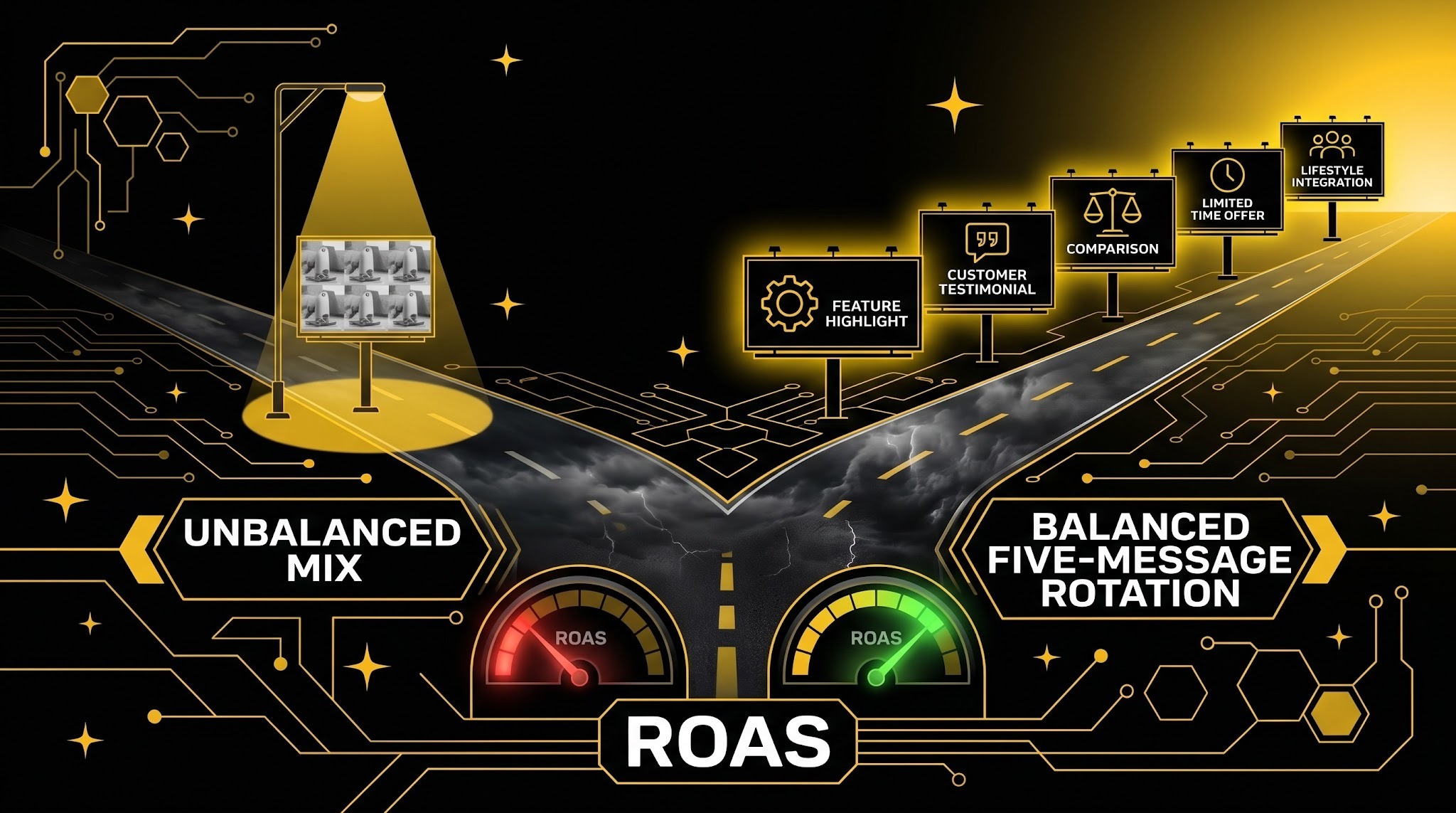
Running only one or two message types at scale doesn't just leave conversions on the table. It actively hurts ROAS. When an ad account lacks message variety, the algorithm has less signal diversity to work with. The learning phase stalls. CPMs rise as the same creative competes for the same psychological territory. Andromeda requires distinct creative concepts to effectively match messaging to user context and intent, and a lack of idea variety reduces its ability to serve the right message at the right moment (Engineering at Meta, 2024).
The structural cost is equally damaging. When a Meta advertising strategy leans entirely on Brand Vibe content, brands build awareness without a funnel to catch it. Prospects encounter the brand, feel something, move on, and never receive the follow-up message that would have converted them. A lopsided rotation heavy on Brand Vibe and Social Proof with no Objection Handling or Urgency leaves brands stuck at the precipice, generating intent without closing it. Brands that systematically add underrepresented message types to cold audience rotations give the algorithm genuinely distinct concepts to test, and the right message starts meeting the right buyer intent.
How to Audit Your Facebook Ad Rotation for Intent Alignment
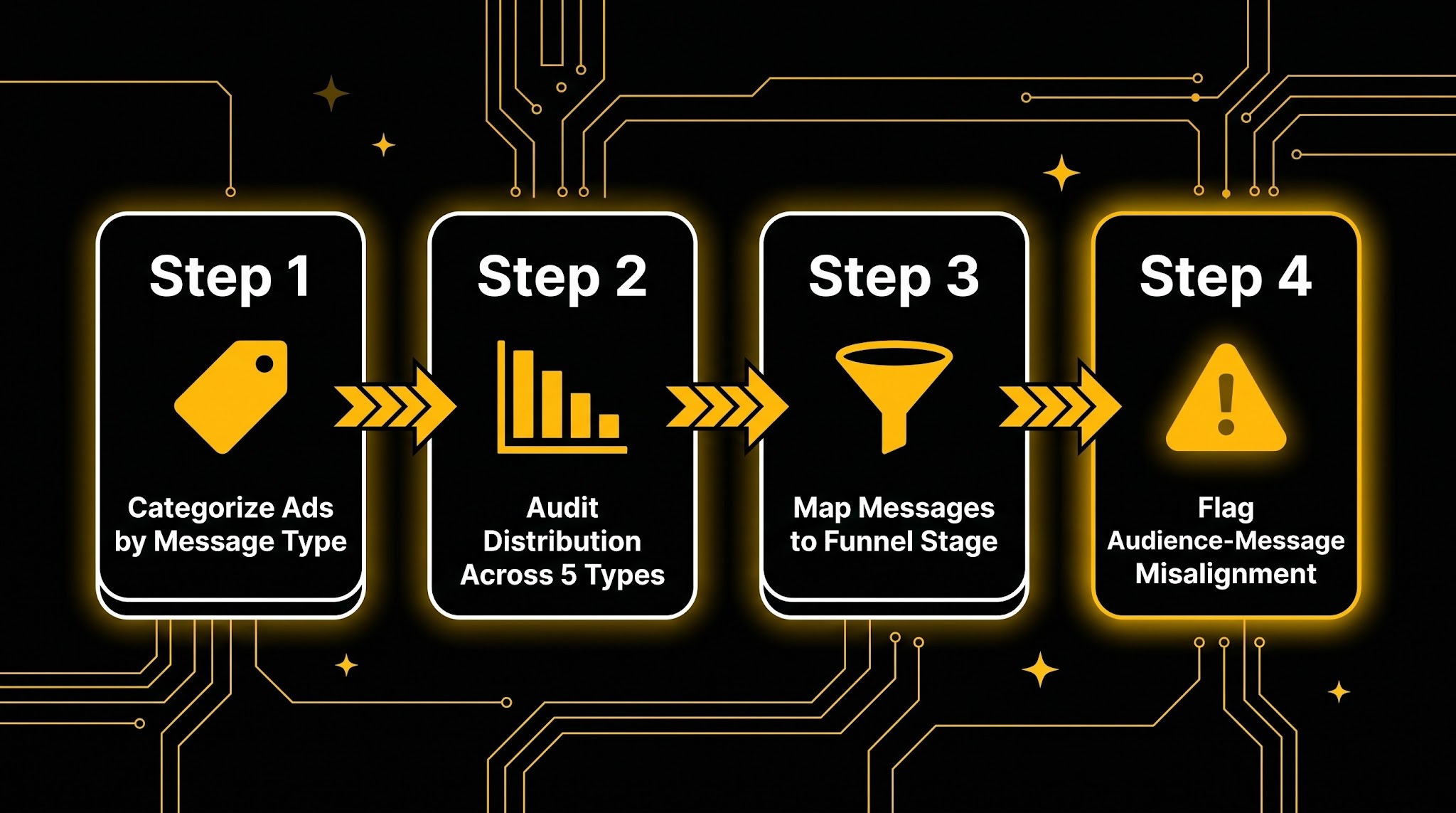
The first step in auditing a Facebook ad mix is categorization, not performance review.
Step 1: Pull every active ad in Ads Manager and assign each one to a message type: Brand Vibe, Social Proof, Differentiator, Objection Handling, or Urgency. If an ad doesn't clearly fit one category, that's diagnostic. Ads without a clear job are usually performance liabilities. Also check frequency for net-new prospecting campaigns; if frequency exceeds 1-point-something over 30 days, the campaign is hammering the same ads to the same people instead of finding new audiences.
Step 2: Look at distribution across the five types. Most brands at the plateau stage find that 70% to 80% of their active creative falls into Brand Vibe and Social Proof. Differentiator ads are thin. Objection Handling is nearly absent. Urgency exists only during promotional periods.
Step 3: Shift to intent alignment. Map each message type against the target persona's psychological state at that funnel stage. Cold audiences generally need Brand Vibe and Social Proof to establish relevance and credibility. Warm audiences are strong candidates for Differentiator and Objection Handling ads.
Step 4: Flag misalignment between creative message and campaign targeting. Urgency messaging running to cold audiences, for example, skips the trust-building sequence and typically converts poorly. When the wrong message type runs against the wrong audience, the damage extends beyond wasted impressions to disrupting the trust sequence entirely.
Building Your Five-Message Creative Library Without Overwhelming Your Team
The most common pushback on a framework like this is capacity. Five message types sounds like five times the creative workload. It's not, if the library is built with systems rather than sprints.
Start With What Already Exists
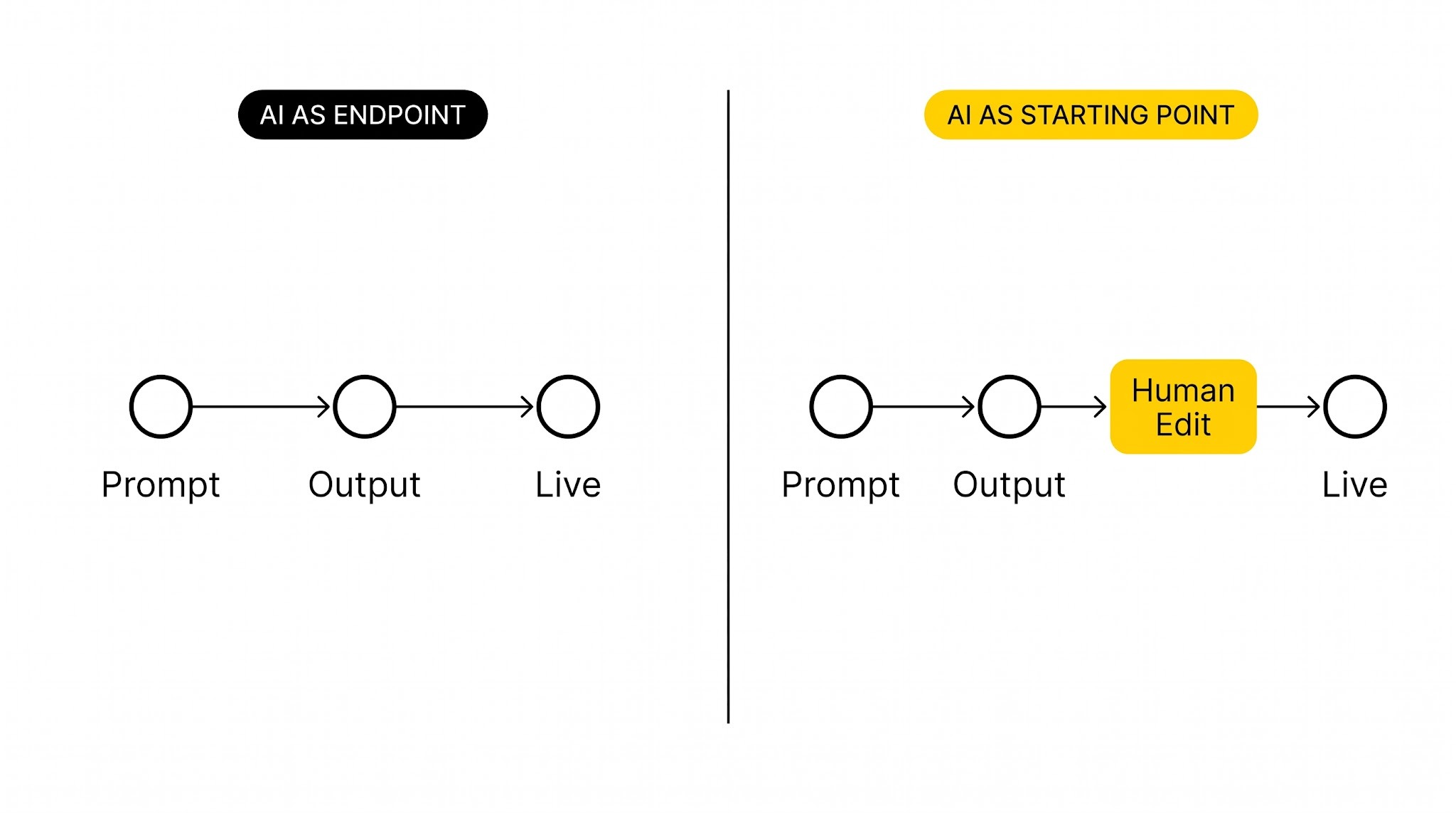
Map existing assets to the five categories before producing anything new. Most brands already have content that can be repurposed with minimal reediting. A customer testimonial video sitting in a folder might be the best Objection Handling ad available with the right copy overlay. A product comparison made for a sales deck might become a Differentiator ad with minimal production work. The goal is to fill the highest-impact gap first, typically Objection Handling or Urgency, based on what funnel data shows is leaking conversions.
Build New Creative Against the Gaps
When every piece of content has a defined job before production starts, briefs get tighter and feedback gets easier. Two formats that DTC marketers consistently underuse are dynamic retargeting and direct-response formats that enable conversational objection handling. Direct-response formats that enable conversational objection handling allow brands to address concerns at the moment of highest intent. Dynamic retargeting lets brands surface the most relevant message type based on where a prospect is in the funnel, automatically serving Differentiator or Urgency creative to warm segments without manual audience management.
Build for the Long Term
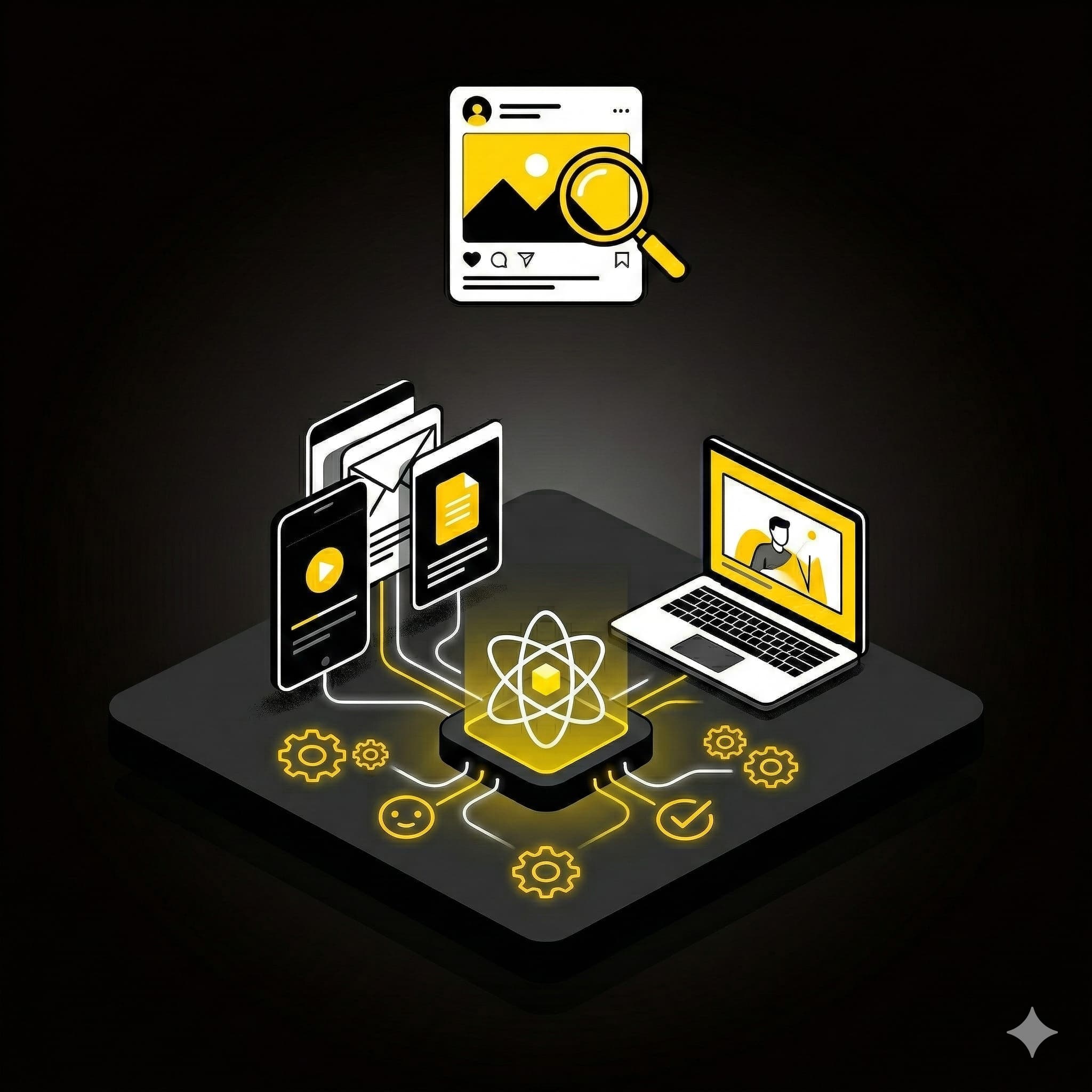
Over time, the goal is a living creative library organized by message type, audience stage, and performance tier. This shift from reactive creative production to a structured five-message system is often the single biggest unlock between the $5M plateau and the next stage of scale. The brands that win on Facebook aren't always the ones with the biggest budgets or the most polished production. They're the ones that figured out every message has a job, and built a system to make sure all five jobs are getting done. For DTC brands ready to build that system with expert support, Pilothouse Digital specializes in structured creative approaches that compound over time.


%20(1).jpg)






.png)



.webp)


.webp)