Facebook Ad Fatigue: The Signals Pilothouse Uses to Know When to Kill an Ad vs. Let It Run
Most brands don't realize their ads are fatigued until the damage is already done. By the time ROAS tanks and CPAs spiral, the creative has been quietly losing its grip on the audience for weeks. Reading the early signals clearly enough to act before performance collapses is the skill that actually separates good media buyers from reactive ones.

At Pilothouse Digital, deciding when to kill an ad versus letting it run is one of the most frequent and consequential calls in day-to-day media buying work. Facebook advertisers heading into 2026 often don't have clean answers to these questions, and that ambiguity costs real money.
One note on terminology: the platform is now Meta, but most advertisers still search and think in terms of Facebook ads, so we use both here. Facebook when we mean the reader-facing platform and the fatigue problem, Meta when we mean the ad system, algorithm, and attribution.
What Facebook Ad Fatigue Actually Means (It's More Specific Than You Think)
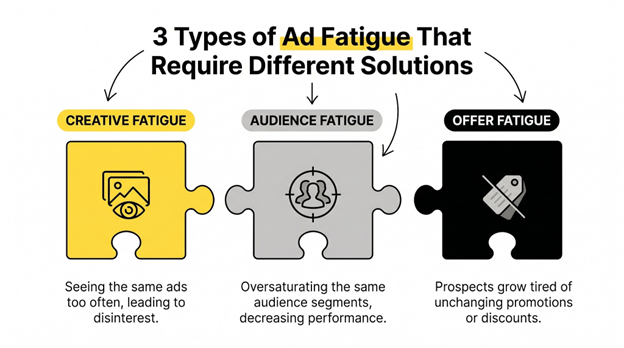

Ad fatigue isn't a single problem. It's three distinct problems that often get lumped together, and treating them as one is how brands end up making the wrong move.
Creative fatigue vs. audience fatigue vs. offer fatigue
Creative fatigue is what most people picture: the same visual or hook showing up so often the audience stops registering it. Audience fatigue is different, a targeting problem where the same pool of people is reached too repeatedly regardless of whether the creative changes. Offer fatigue is subtler still: the promotional message itself has become so familiar it no longer creates urgency or differentiation.
Each type demands a different fix. Swapping creative when you actually have audience fatigue won't solve anything. Expanding targeting when the offer is broken just spreads a broken message further. Identifying which type you're dealing with shapes everything that follows.
How Meta Andromeda evaluates ads at the asset level and what "bucketing" means for your campaigns
Meta's Andromeda system runs on the NVIDIA GH200 Grace Hopper Superchip and optimizes at the individual user level. It evaluates ads at the individual asset level, not the campaign level. Your headline, visual, and body copy are each assessed separately. When an asset accumulates enough negative signals through low engagement, high hide rates, or hostile comments, it gets bucketed into lower-quality delivery tiers.
Barydon Germain, Content Manager from Pilothouse, shares his operating rule: if an ad isn't sufficiently differentiated from existing winners in the account, Andromeda will flag it for creative redundancy and CPAs will climb as the system treats the assets as interchangeable (Ep 589: 9 Static Ads in 2.5 Hours by DTC Podcast). Once that bucketing happens, even strong budget support won't rescue it.
The Frequency Signals That Tell Pilothouse an Ad Is Losing Its Edge
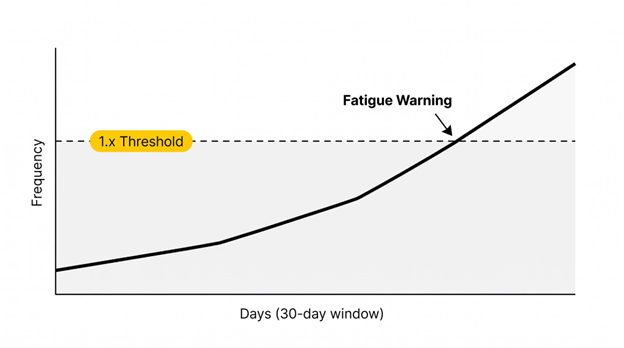
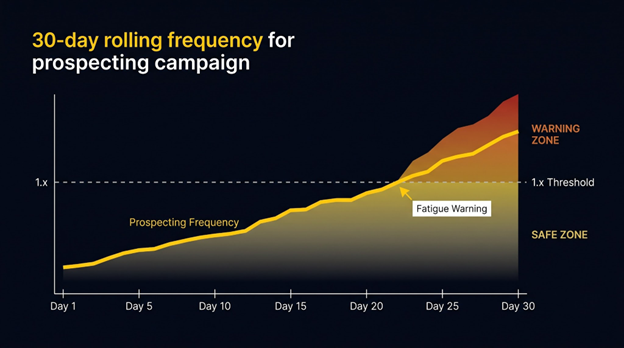
Frequency is still one of the clearest early indicators of Facebook ad fatigue, but raw numbers without context are almost meaningless. The measurement window and campaign objective both change what those numbers should actually tell you.
The 1.x frequency rule for prospecting: why a rising 30-day window is your top-of-funnel warning
As Abby Kohler, Strategist from Pilothouse, points out on DTC Podcast, for prospecting campaigns, a rising frequency within a 30-day rolling window is the most reliable early warning (Ep 587: Meta Andromeda Strategy: 5 Creative Testing Shifts for $5M+ DTC Brands). When frequency begins rising noticeably for cold audiences within that window, the targeting pool isn't refreshing fast enough relative to delivery pace, meaning the same people are seeing the ad repeatedly before they've had time to re-engage. This is a Pilothouse diagnostic trigger, not a universal Meta benchmark. At the top of the funnel it's particularly damaging: repeated exposure without conversion builds irritation, not consideration.
Retargeting fatigue thresholds: when 40–100 touchpoints signals a failure to resolve conversion friction
In retargeting, the benchmark shifts significantly. Reaching a high volume of touchpoints without conversion is usually a friction problem, not a creative one. Something in the purchase journey is not resolving hesitation. At that point, the ad has done its job getting attention. The failure is downstream.
Comment Sentiment and Engagement as a Deliverability Signal
Most advertisers look at clicks and conversions when evaluating creative. Fewer look at comment sentiment, which is a mistake, because Meta's algorithm reads comments as a proxy for content quality and audience reception.
Why positive comments are "cheap data" that trains Meta's algorithm in your favor
Positive engagement, especially comments reflecting genuine enthusiasm or curiosity, reinforces the algorithm's confidence in your creative. When people comment favorably, Meta interprets that as a signal the content is relevant and welcome, improving delivery placement and actively lowering CPMs over time. Content people want to respond to isn't just a community management win. It's a media efficiency play.
How negative or "ruthless" comment patterns are a leading indicator of creative death
Negative comment patterns are a leading indicator, not a lagging one. When dismissive or hostile comments accumulate and hide rates climb, the algorithm registers that the audience is rejecting the content. That sentiment feeds directly into Andromeda's bucketing logic. A pattern of negative comments across impressions often signals the creative is on borrowed time before ROAS metrics catch up to that reality.
The Attribution Trap: Why Your ROAS Might Be Lying to You
This is where brands make their biggest mistake in 2026: evaluating ad fatigue against a ROAS number already distorted by attribution model changes.
How Meta's attribution shift creates a phantom ROAS drop
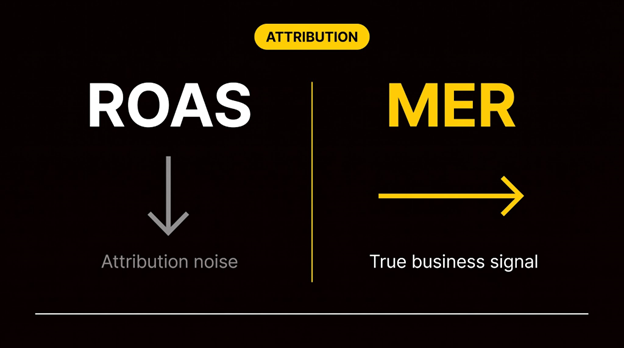
Meta's March 2026 change moved engagement actions (likes, shares, saves) out of click-through reporting into a renamed "engage-through" category with a 1-day window, meaning some conversions disappeared from reported totals entirely for accounts where those interactions occurred outside the 1-day engage-through window, with no real sales decline underlying the reporting change. As Chris Richards, Account Strategist from Pilothouse, states, in some cases Pilothouse observed drops approaching 40%, but the experience varies by account depending on how much conversion volume had previously been attributed to non-link engagement actions (Ep 605: Meta Attribution Change – Why ROAS Dropped 40%). Pausing ads based on that number, without understanding the attribution context, means stopping ads that are actually working.
Using the Marketing Efficiency Ratio (MER) as your profitable north star
MER, total revenue divided by total ad spend, cuts across channels and attribution models to reflect what's actually happening in the business. When ROAS looks soft but MER holds steady or improves, the ad is still contributing meaningfully to the overall system. Platform-reported attribution just isn't capturing it cleanly (Ep 605: Meta Attribution Change). Pilothouse pushes clients toward MER precisely because it removes the noise that attribution changes inject into decision-making.
The TSR Rule: Don't Kill an Ad Just Because ROAS Is Soft
The Thumb-Stop Rate (TSR) is one of the most underused signals in fatigue diagnosis. TSR typically declines 3–7 days before downstream metrics deteriorate, giving you an early window to act. An ad might show soft ROAS while maintaining a high TSR and low CPM, which signals it's still effectively serving an awareness function at the top of the funnel.
If TSR remains stable but backend conversion drops, the problem is post-click friction. The ad should keep running while the landing page gets fixed, not get killed prematurely.
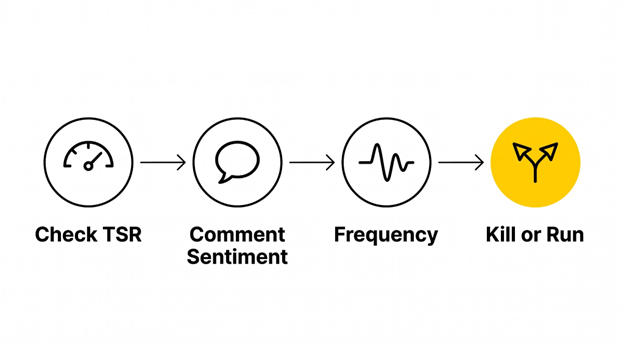
Kill vs. Let It Run: The Pilothouse Signal Framework
Before making any kill decision, run the ad through this framework. These are Pilothouse diagnostic triggers, not official Meta benchmarks.
Why Micro-Iterations Accelerate Fatigue Instead of Fixing It
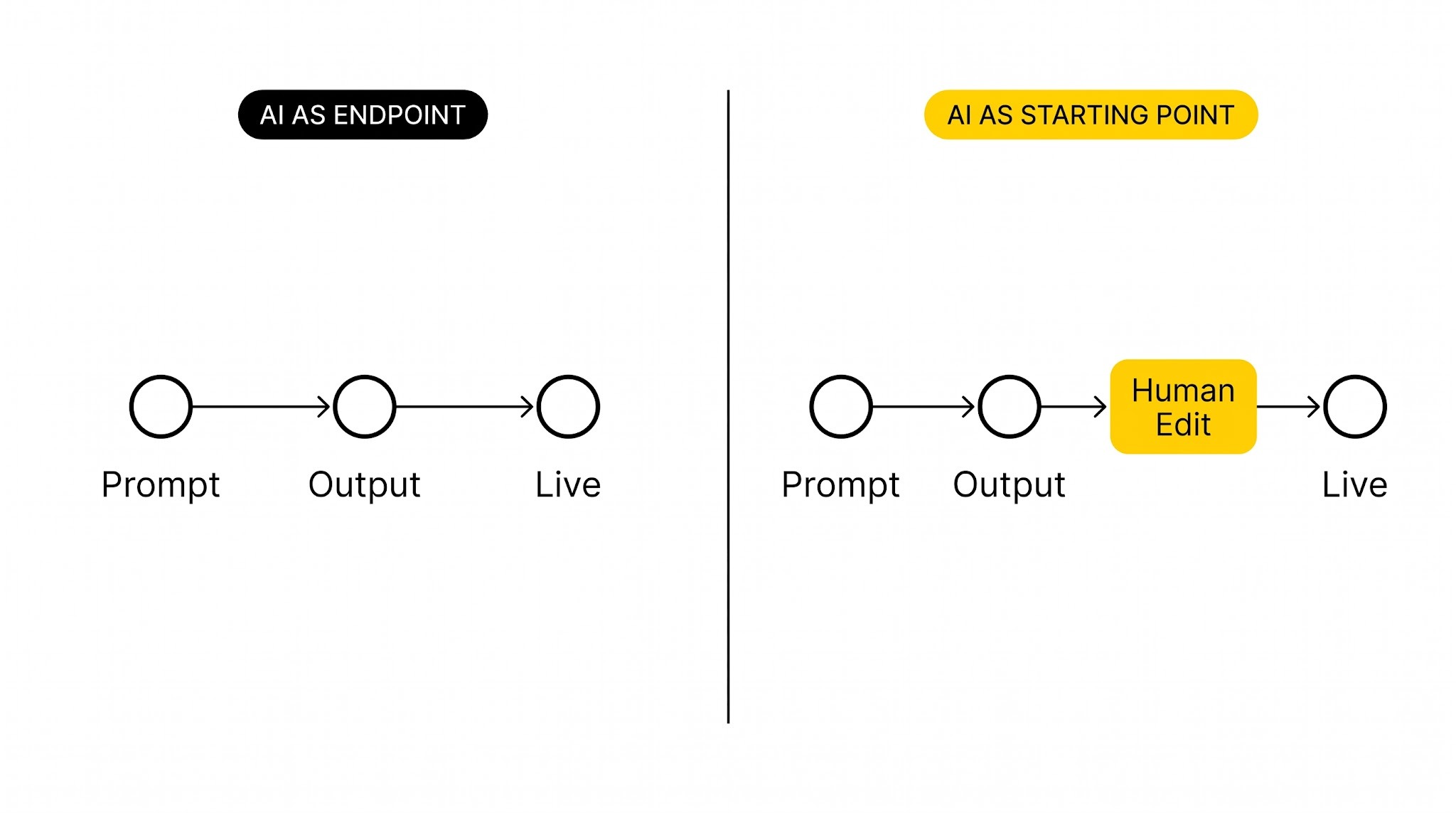
When an ad starts to slip, teams often make small tweaks: change the thumbnail, adjust the headline, swap the first two seconds. These micro-iterations feel productive. They usually aren't.
Meta has already formed a clear performance history around the original asset. Minor changes don't reset that history or create a meaningfully different experience for the audience. Under Andromeda's bucketing logic, assets that aren't sufficiently differentiated from existing winners are treated as redundant, so a button-color swap or single-word headline change won't create the idea variety the algorithm rewards. You end up with testing noise, a muddier read on performance, and a creative pool that looks varied but performs uniformly flat.
When an ad is genuinely fatigued, the fix is a substantive creative departure across the hook, format, angle, and psychological intent. Not a series of small patches that delay the inevitable.
How Pilothouse Extends Winners Before They Burn Out
The smarter play is proactive extension before fatigue sets in, rather than a reactive refresh after the drop has already happened.
Testing creator content at 1.5x speed and cut-to-cut edits with AI voiceovers
One practical technique is testing creator content at 1.5x speed. This changes the pacing and feel enough to register as a fresh experience for both the algorithm and the audience without requiring a completely new shoot (Ep 52: When You Find a Winner: Four Ways to Iterate on Creator Content). Paired with cut-to-cut editing and AI voiceovers, a single piece of source material can generate meaningful creative variation. The underlying idea and offer stay intact, but the delivery format shifts enough to appeal to different viewing contexts.
Targeting different psychological intent clusters to reward idea variety
Another approach involves mapping creative to different psychological intent clusters rather than defaulting to a single message for a broad audience. Someone in research mode responds to different signals than someone nearly ready to buy. Testing creative variations that speak to genuinely different psychological states (rather than just visual variations of the same message) extends a campaign idea's productive lifespan and slows the rate at which any single concept burns through its audience. Pilothouse's operating guideline is roughly 8–12 conceptually distinct concepts per campaign with 2–3 variations each, refreshed every 7–14 days.
Creative Is the New Targeting Lever: What a Performance Drop Is Really Telling You
When a campaign loses momentum, the instinct is often to adjust targeting, expand audiences, or shift budgets. In Meta's current environment, though, algorithmic targeting is highly automated and broad audiences frequently outperform over-segmented ones. Creative has become the most powerful targeting tool available. According to Nielsen research cited by Meta, creative quality drives 56% of sales lift in digital campaigns, making it the variable with the most direct impact on outcomes in a paid media system.
A performance drop usually points to one of a few things: the message no longer fits where the audience is in their consideration journey, the format no longer earns attention in the current feed context, or the audience has simply exhausted the concept. Identifying which is actually happening separates brands that find their way back to growth from those that burn through budget solving the wrong problem.
Ad fatigue is ultimately a systems challenge, not a campaign-level one. It requires reading signals across frequency, comment sentiment, attribution, and TSR simultaneously, then making decisions that reflect the full picture rather than any single metric. That's the diagnostic work Pilothouse has refined across 160+ brand partnerships, including engagements like VSSL, where relentless creative velocity to keep audiences from fatiguing helped drive a 41% year-over-year sales increase on flat ad spend, developing the pattern recognition that makes Facebook ad fatigue a predictable, manageable variable rather than a recurring crisis.



%20(1).jpg)









.png)



.webp)


.webp)