The Creative Triangle: How Pilothouse Generates Ad Angles Before Briefing a Single Creator
Most ad campaigns don't fail in production. They fail in the thinking that happens before a single frame is shot or a line of copy is written. The brief lands in a creator's inbox already broken, built on assumptions shaped by gut instinct and stripped of any real strategic foundation. Content that looks fine but performs poorly is the natural result, because the idea behind it was never really an idea at all.

At Pilothouse Digital, producing 5,000+ creative assets monthly for brands like General Mills, Benchmade, Sheertex, and Big Blanket has made one thing obvious: the creative ideation process is where campaigns are won or lost. Get it wrong before the creator is ever involved, and no amount of production quality will save it.
Why Most Ad Creative Fails Before a Creator Is Ever Briefed
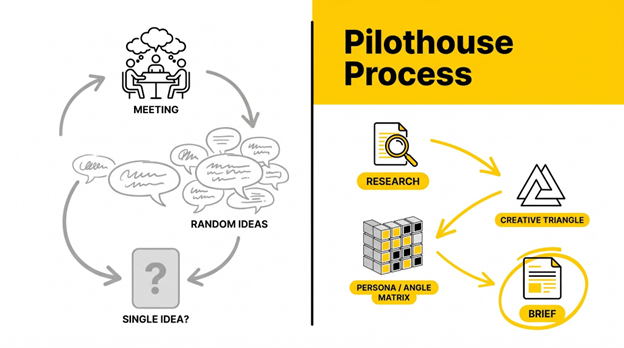
The root cause of most creative failure isn't talent. It's structure. Teams skip ideation and move straight to execution, confusing activity with strategy. A creator gets briefed on a product, maybe a tagline, and a rough format. What they don't get is a clear understanding of who they're talking to, what psychological state that person is in, or why any of this should matter to them right now.
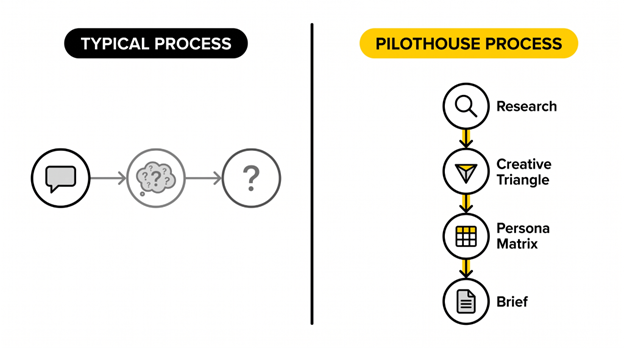
The typical agency process goes something like: have a meeting, throw out ideas, pick the best one. That's improvisation, not ideation. Without grounding concept development in data, consumer psychology, and a clear funnel framework, teams are essentially asking creators to guess. Sometimes they guess right. More often, they don't.
An angle is the strategic reason an ad connects with someone. Hooks, claims, and formats are all downstream of it. Building a brief without a defined angle means the creator is responsible for strategy they were never given.
The Creative Triangle: An Upside-Down Framework for Ad Angles
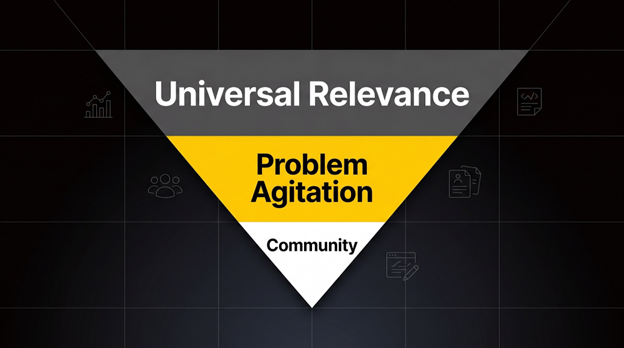
The Creative Triangle is how Pilothouse structures idea generation before any brief is written. Avery Valerio walks through the full framework in Ep 22 The Try-Angle Method for Smarter Ads on the Ad-venturous Podcast. It's an inverted pyramid, wide at the top and narrow at the bottom, designed to reflect how consumer relationships actually develop. Broad, universal appeal comes first. Specific problem-solving comes next. Deep community connection comes last.
This isn't just a creative framework. It's funnel logic applied to idea generation, with every angle carrying a clear role at a specific point in the customer journey.
Layer One: Universal Relevance for Cold Traffic
Cold traffic is the hardest audience to reach because they don't know the brand yet and don't care. Angles at this layer tap into universal themes, emotional experiences broad enough to stop a scroll, values the viewer already holds. The concept is resonance before relevance: leading with something the viewer already feels rather than product features or brand history. That emotional entry point earns the next two seconds of attention.
Layer Two: Problem Agitation for the Middle Funnel
By the middle funnel, a consumer has shown some interest. At this stage, the angle shifts from broad connection to specific friction. Problem agitation content names the exact pain the consumer is experiencing and positions the brand as the path out. Generating angles here means deeply understanding what solutions the customer has already tried, why those failed, and what a credible resolution looks like.
Layer Three: Community-Building Content for Those Already Inside the Fold
The bottom of the triangle is for people who already trust the brand. Angles at this layer include user-generated stories, behind-the-scenes content, loyalty narratives, and social proof. These reinforce the purchase decision and convert customers into advocates. This layer is better suited to organic, email, and community channels than performance ads, but the ideas it generates feed brand equity at scale.
The Four C's: How Pilothouse Researches Before It Ideates
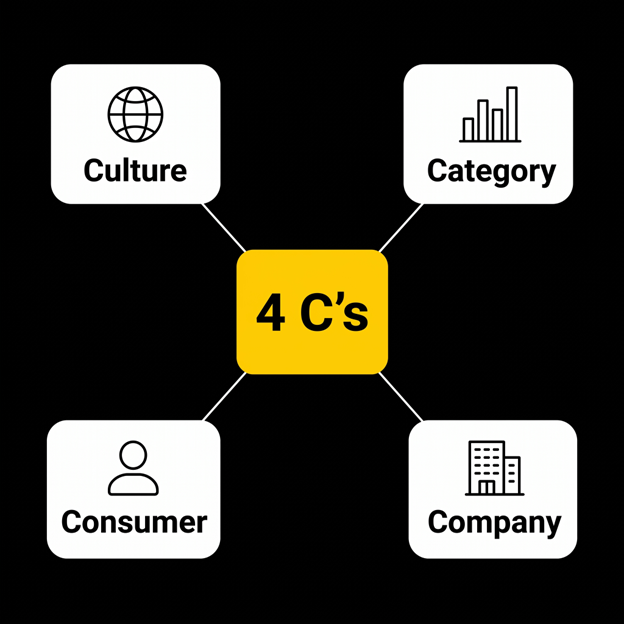
Before any ideation session begins, Pilothouse runs every brand through research built around four inputs: Culture, Category, Consumer, and Company, a framework the team unpacks in Ep 587 Meta Andromeda Strategy: 5 Creative Testing Shifts for $5M+ DTC Brands of the DTC Podcast. Without it, even strong angles are disconnected from the market reality the brand actually operates in.
Culture and Category: Finding the White Space
Cultural analysis means understanding what's shaping how consumers see the category: what values are rising, what narratives are tired, what anxieties define how people talk about the problem a product solves. Category analysis adds competitive context. Where are competitors crowding? If every brand in a category leads with clinical authority, the angle that leads with warmth and humor is the one that gets remembered. Angles generated without accounting for what's already saturating a category will produce more of the same.
Consumer and Company: Uncovering Unique Differentiators
Consumer research goes beyond demographics. It means understanding the psychological state of the buyer: what motivates them, what their decision process looks like, and what language they use when skeptical. Company analysis runs parallel. What does the brand genuinely deliver that competitors cannot credibly claim? When consumer needs and company strengths overlap, that's where the strongest angles live, the ones that are true, different, and emotionally relevant all at once.
Using Search Intent Data as a Proxy for Consumer Anxiety

Search behavior is one of the most honest windows into consumer psychology available. Unlike surveys, it isn't filtered through social desirability. A query typed at midnight is a direct expression of a real need, fear, or uncertainty.
Pilothouse uses search intent data as a proxy for consumer anxiety during ideation. By analyzing the language people use when searching for solutions in a given category, recurring emotional themes surface that wouldn't appear in a traditional brainstorm. These themes become raw material for ad angles, especially at the problem agitation layer.
Raw search data at scale is difficult to interpret without structure. By feeding query datasets into an LLM with the right prompting framework, Pilothouse groups searches into psychological intent clusters: buckets of questions that share the same underlying anxiety or motivation. Queries that look different on the surface, such as "why isn't X working," "X alternative," and "how long until X shows results," might all map to the same cluster: skepticism and expectation mismatch. That cluster becomes its own angle, telling the creative team exactly what doubt to address and what reassurance to offer.
Building the Persona/Angle Matrix: From Insight to 20 Ideas
Once the Four C's research is complete and intent clusters are mapped, Pilothouse builds the persona/angle matrix: a grid that maps distinct consumer personas against distinct angles to generate a full set of ideas before any creator is briefed. The goal is at least 20 genuinely distinct angles per brand per cycle, not variations on a theme, but approaches addressing different people, different funnel moments, and different psychological motivations.
Identifying Gaps: Which Personas and Angles Are Missing
The matrix doesn't just generate ideas. It reveals what's missing. When current and past creative is laid against the persona/angle grid, patterns of absence become visible. A brand might have strong cold-traffic content for its primary buyer but nothing that speaks to a secondary persona approaching the category differently. Or the problem agitation layer is well-covered while community content is entirely absent.
These gaps are where the next round of ideation should focus. Generating new angles without auditing existing ones means the team keeps covering the same ground while leaving entire audience segments underserved.
Mapping Angles to 'Why Buys'
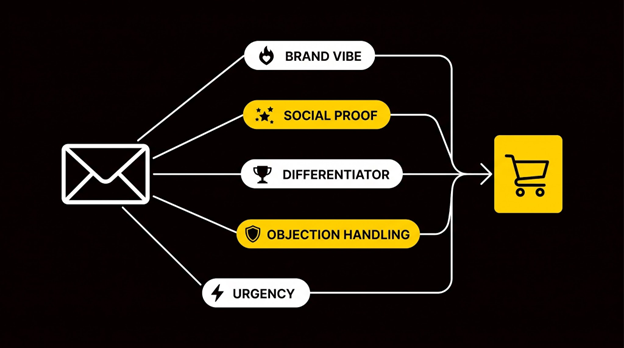
Each angle in the matrix gets tagged to a "why buy" trigger: the specific motivational mechanism that will drive the viewer to act. Urgency works when the consumer is warm and needs a reason to decide now. Scarcity applies when limited availability is genuine and verifiable. Social proof layers in third-party validation. Product news is one of the most underused triggers, especially for brands that launch regularly but don't treat new features as creative events. Mapping angles to these triggers keeps ideation connected to conversion goals, so the creative team knows not just what to say, but why a consumer would act on it.
In the Andromeda Era, Creative Variety Means Idea Variety
Meta's Andromeda algorithm now rewards variety at the idea level, not just format or visual variation. Posting ten executions of the same core message with different thumbnails no longer builds reach. The algorithm, and the audience, responds to genuinely different angles addressing genuinely different needs. This means creative ideation directly determines distribution performance.
When an ideation session produces three real angles and the team creates fifteen executions from those three, that's creative repetition at scale, not variety. The persona/angle matrix ensures idea variety precedes production variety, so assets entering the ad account are testing different angles rather than confirming the same one repeatedly.
How Pilothouse Runs a Creative Ideation Session Step by Step
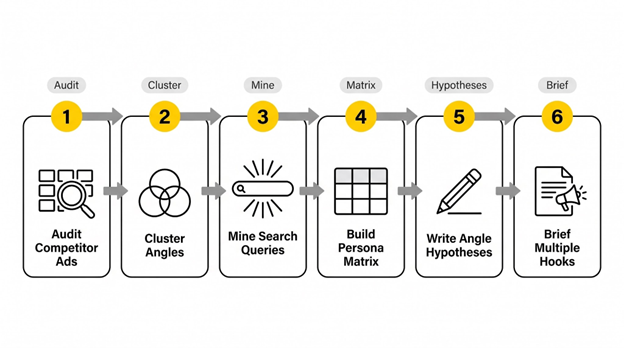
The ideation session at Pilothouse follows research; it doesn't precede it. The output is clearly defined angles that move directly into briefs, not vague directions that need more thinking before they become actionable.
- Pull in-market competitor ads and tag each by angle, problem framing, and evidence type (clinical study, founder story, comparison, third-party validation).
- Group into four to six angle clusters and flag which are overused versus missing.
- Mine customer questions and search queries; use an LLM to cluster them into psychological intent groups.
- Build the persona/angle matrix, assigning each insight to a funnel layer and a "why buy."
- Write two to five angle hypotheses first, then brief multiple hooks per angle. A hook is not a separate strategic idea; it's an execution of one.
- Keep testing focused on one core variable at the angle level so results are readable and compounding.
When a brief is built from a pre-defined angle rather than written from scratch, the creator receives the strategic context they need: who they're speaking to, what psychological state that person is in, what the angle is, and what "why buy" it serves. Briefs built this way are simply more useful, and the work reflects it. The Four Sigmatic case study shows what this looks like when scaled, and Pilothouse's broader case study library reflects over $1B in attributable revenue built on the same disciplined foundation.
The Creative Triangle is a repeatable engine that compounds creative learning across campaigns. Each ideation cycle produces sharper research for the next one. For brands ready to replace instinct-driven creative with a system that actually scales, that's the conversation worth having.



%20(1).jpg)








.png)



.webp)


.webp)