


Meta Creative Testing Framework: The 3-3-3 Approach to Finding Winners
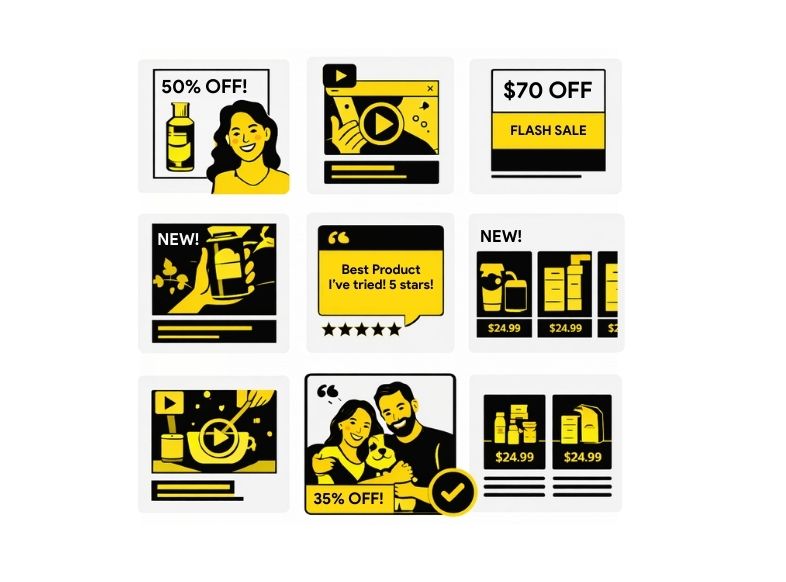
Meta's algorithm has completely changed how it evaluates and serves ads. The platform no longer relies on audience targeting to determine performance. Instead, it reads your creative assets as targeting signals, using visual and messaging cues to find the right people. The 333 approach gives you a systematic way to identify winning creatives without burning budget on redundant concepts that Meta's Lattice system will actually penalize you for.

Why Meta's Andromeda Era Demands a New Creative Testing Framework
Meta's advertising world has entered what people inside the company call the Andromeda era. This marks a complete shift from how the platform used to handle ads. The algorithm now puts creative quality and differentiation above almost every other signal. Your audience parameters? They work more like guardrails than the main drivers of who sees your ads.
How the Algorithm Now Treats Creative as the Primary Targeting Lever
The platform analyzes every single visual element, text overlay, opening frame, and messaging angle in your ads. It uses these signals to predict which users will engage and convert. Meta examines your creative components and matches them against behavioral patterns it's observed across billions of users.
Your creative now does double duty as both persuasive content and algorithmic input. A product demo video tells Meta something completely different than user-generated content shot on a phone. Static images with bold text overlays signal a different intent than clean product photography. Each variation helps the algorithm understand which user segments to go after.
The system learns way faster when it gets distinct signals. Similar creatives actually confuse the learning phase because the platform can't tell the concepts apart. This wastes budget and delays optimization. Pilothouse Digital, a performance marketing agency that reports having driven over $1B in direct revenue for its clients, emphasizes that brands testing a variety of creative concepts tend to achieve more efficient growth.
Why Creative Redundancy Gets Penalized in the Lattice System
Meta's Lattice infrastructure uses Entity IDs to cluster ads that look similar. When you have multiple ads that look alike or deliver nearly identical messages, the algorithm spots the overlap through visual recognition technology. It consolidates these assets, making them compete for a single auction slot rather than treating each as a unique opportunity.
This redundancy creates a situation where you're competing against yourself. Two video ads with the same hook and matching product angles will cannibalize each other's performance. Meta sees them as basically identical and splits impressions between them, driving up your CPMs and restricting learning. The platform's visual recognition treats slight text overlay changes on the same image as identical.
The Lattice system rewards differentiation. When your creatives occupy distinct positions across messaging, format, and visual style, Meta distributes each to its ideal audience without internal conflict. This maximizes your testing budget because every dollar yields unique learning rather than a redundant signal.
Breaking Down the 333 Meta Creative Testing Framework
The 333 framework organizes creative testing into three dimensions, each with three options. This creates 27 possible combinations, which gives you enough variety to satisfy the algorithm while keeping scope manageable. You avoid both under- and over-testing, which drains budgets.
As described by Taylor Cain, Senior Account Strategist at Pilothouse, the 333 approach provides a clean structure to ensure an ad account has enough "range" and "diversity" to find winners without over-complicating the setup. (Ep 554: Q4 Meta Strategy in the Andromeda Era: What's Changed and How Adapting).
The 3 Funnel Levels: TOF, MOF, and BOF Messaging
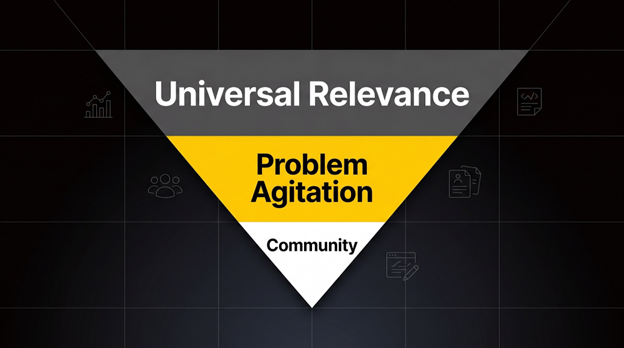
Your messaging needs to match where prospects are in their buying journey. Top-of-funnel content introduces the problem and the category, assuming zero brand awareness. A skincare brand might lead with "tired of products that promise results but never deliver" rather than jumping into specific ingredient benefits.
Middle-of-funnel creative assumes some familiarity. Prospects understand their problem, and they're evaluating solutions. Your messaging should differentiate your approach, highlight specific benefits, and start addressing objections.
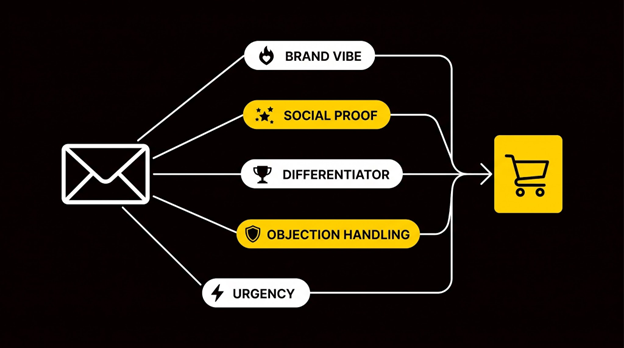
Bottom-of-funnel ads target ready buyers with limited-time offers, social proof, guarantees, or competitive comparisons. Messaging becomes direct and action-oriented. You're focusing on closing rather than educating.
The 3 Distinct Angles: Solving Different Consumer Pain Points
Within each funnel level, you want multiple angles that address separate pain points or desires. A single product often solves three to five distinct problems for different customer segments. Your creative testing should isolate these angles rather than trying to communicate everything at once.
Think about productivity software. One angle might focus on time savings for busy professionals. Another could emphasize team collaboration for growing companies. A third might highlight cost savings compared to hiring additional staff. Each angle resonates with different prospects even though you're selling the same product.
Testing distinct angles allows Meta's algorithm to identify distinct micro-audiences within your broader target audience. The platform becomes more efficient when it can match specific messaging to specific behavioral patterns. Brands implementing this approach have seen 30% improvement in outbound CTR year-over-year (Ecom CMOs: How Pilothouse Used Meta’s Update to Drive 30% Higher CTR with Fewer Campaigns).
The 3 Creative Formats: Static, Video, and Product Catalogs
Format selection impacts both performance and algorithmic learning. Static images work well for bold statements that quickly communicate value. Video ads allow for storytelling, demonstration, and emotional connection. Product catalogs (DPA) enable dynamic creative optimization, which is particularly helpful when you have a large number of SKUs.
Each format teaches Meta something different about your audiences. Testing across formats reveals not only which creative wins, but also which buyer journey converts best. Here's how the 3-3-3 framework applies across dimensions:
TOFU
Awareness-building narrative
Hero image with brand story
Founder video testimonial
Dynamic product showcase
MOFU
Pain point solution
Benefit-focused graphic
UGC problem-solution demo
Carousel with comparisons
BOFU
Urgency/conversion driver
Offer with CTA
Quick UGC review + buy now
DPA with pricing urgency
High-Leverage Testing Tactics for Maximum Impact
Certain tactical decisions dramatically influence your ability to identify winners quickly and scale them profitably. These high-leverage tactics set sophisticated advertisers apart from those who learn through expensive trial and error.
The First 3 Seconds Rule: Why Visual Hooks Determine Success
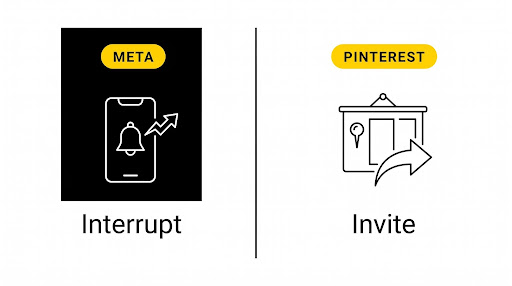
The opening moments determine whether prospects keep watching or scroll past. Creatives that fail to capture attention within the first 3 seconds rarely recover. Your hooks need to be visually distinct, immediately understandable, and compelling enough to interrupt the user's current activity.
Strong hooks use pattern interrupts, such as unexpected movement, contrasting colors, or intriguing visual questions. Text overlays should be large, readable on mobile, and pose a question or make a bold claim that creates curiosity. Generic product shots or slow narrative buildups fail because they don't earn those critical seconds.
The first 3 seconds require four distinct elements: text overlay hook, sound hook, visual hook, and vibe. All four must be distinct to signal differentiation to Meta's visual recognition systems.
The Rule of AOV: Spending Enough to Find Your Audience
Your average order value directly informs how much you need to spend during testing to gather meaningful data. Most creative tests require at least 30 to 50 conversions per variant to distinguish true winners from statistical noise. You should allocate at least your AOV in spend per concept to give the algorithm sufficient budget for audience matching.
Underspending produces false negatives. Ads that could perform well at scale never get enough distribution to show their potential. This leads you to shut down viable concepts prematurely while keeping mediocre performers that happened to get lucky early.
Setting Up Your Technical Sandbox: ABO to ASC Graduation
The technical structure of your campaigns determines whether creative tests get fair evaluation. Meta's optimization systems work differently depending on campaign type and budget distribution.
Using ABO to Force Spend Across All Concepts
Adset Budget Optimization (ABO) gives you manual control over budget distribution across creative variants. In testing environments, this control is essential. Campaign Budget Optimization (CBO) used too early funnels spend toward early winners before other concepts have sufficient data. This creates biased results.
ABO campaigns assign equal budgets to each creative concept, forcing the platform to spend on all variants regardless of initial performance. This prevents the algorithm from prematurely optimizing toward concepts that may have just gotten lucky with early impressions.
Your testing budgets should account for 5-10% of the total budget. Set up separate ad sets for each creative variant within the 3-3-3 framework with identical targeting and equal budgets. Run them simultaneously for at least five to seven days or until you hit minimum conversion thresholds before evaluating which concepts graduate.
Graduating Winners to Advantage+ Shopping Campaigns
Once you've identified creative winners through ABO testing, migrate them into Advantage+ Sales Campaigns (ASC) for scaling. ASC removes manual targeting constraints and lets Meta's algorithm find the full breadth of potential audience. The platform uses your winning creative as the primary signal for targeting.
ASC campaigns perform best when you feed them proven assets. The graduation threshold typically occurs at 10-12 purchases per concept (DTC Podcast: Where Should That Click Go?). Launching untested creative directly into ASC wastes the campaign's potential because the algorithm has no proven signal to amplify.
Authenticity Wins: EGC and Real-World Results
The advertising landscape has shifted toward authentic, unpolished content that feels native to social platforms. Creator-generated content often outperforms traditional studio production because it matches how users naturally consume content.
Employee Generated Content (EGC), such as warehouse footage or real staff using products, signals authenticity and creates stickier impressions than polished studio content. Test both highly produced and authentic content within your creative testing framework. Polished brand content often performs well in the bottom funnel, while creator content excels at the awareness and consideration stages.
Building Your Meta Creative Testing Framework for Long-Term Success
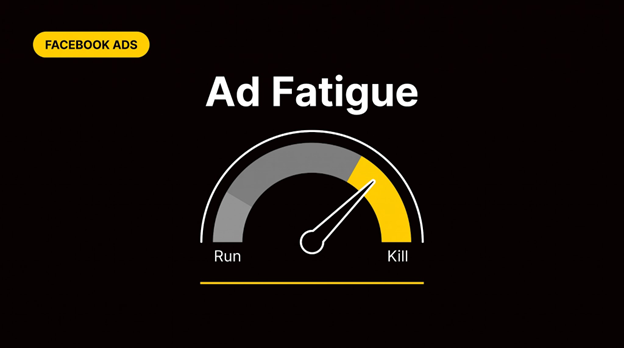
Sustainable performance requires treating creative testing as an ongoing discipline rather than a one-time project. Winners you identify today will eventually fatigue as audiences become familiar with your messaging and competitors copy successful approaches.
Build a creative calendar that systematically rotates through the 3-3-3 framework. Each cycle should introduce new concepts across different combinations of funnel levels, angles, and formats. Document your learnings rigorously. Track which visual styles, messaging frameworks, and formats perform best for different objectives.
Start with one complete cycle through the framework. Test three funnel levels with three angles each using three formats. Analyze the results, announce the winners, and begin the cycle again with fresh concepts informed by your learnings. This rhythm builds momentum while keeping your campaigns ahead of creative fatigue and competitive pressure.
Pilothouse Case Studies: 3-3-3 in the Real World
Partner with teams that understand both creative production and performance marketing mechanics, not just one or the other. Companies like Pilothouse Digital, a performance marketing agency that reports having driven over $1B+ in direct revenue for clients, structure their services around this integration. Their Meta team blends media buying, creative strategy, and production so every asset is built to both feed the algorithm and convert real customers.
Pilothouse’s case studies show how a disciplined creative testing framework translates into outcomes across verticals. For GrowOya, they leaned on “meticulous ad strategies” and “insightful angle tests” to systematically unlock sustainable Meta growth, mirroring the funnel × angle discipline in a 3-3-3 approach. Circulon’s record Black Friday–Cyber Monday results, with a 332% surge in net sales, demonstrate how differentiated concepts and ongoing iteration help Andromeda-era Meta reward brands that avoid creative redundancy.
Ready to put the 3-3-3 framework to work instead of running one-off creative experiments? Use it as the brief for your next testing cycle or start a conversation with a performance partner like Pilothouse to map it onto your current Meta structure and growth targets.



%20(1).jpg)








.png)



.webp)


.webp)