Meta Advantage+ for DTC: When to Let the Algorithm Choose (And When to Keep Control)
%20(1).jpg)
Most DTC brands approach Meta Advantage+ one of two ways: they hand everything over to the algorithm and hope for the best, or they resist automation entirely out of habit. Both extremes cost money. The smarter path sits somewhere between them, and finding it means actually understanding what Meta Advantage+ is, what it does well, and where human judgment still beats machine learning.

Meta Advantage Plus Is a Matching Engine, Not a Media Buyer
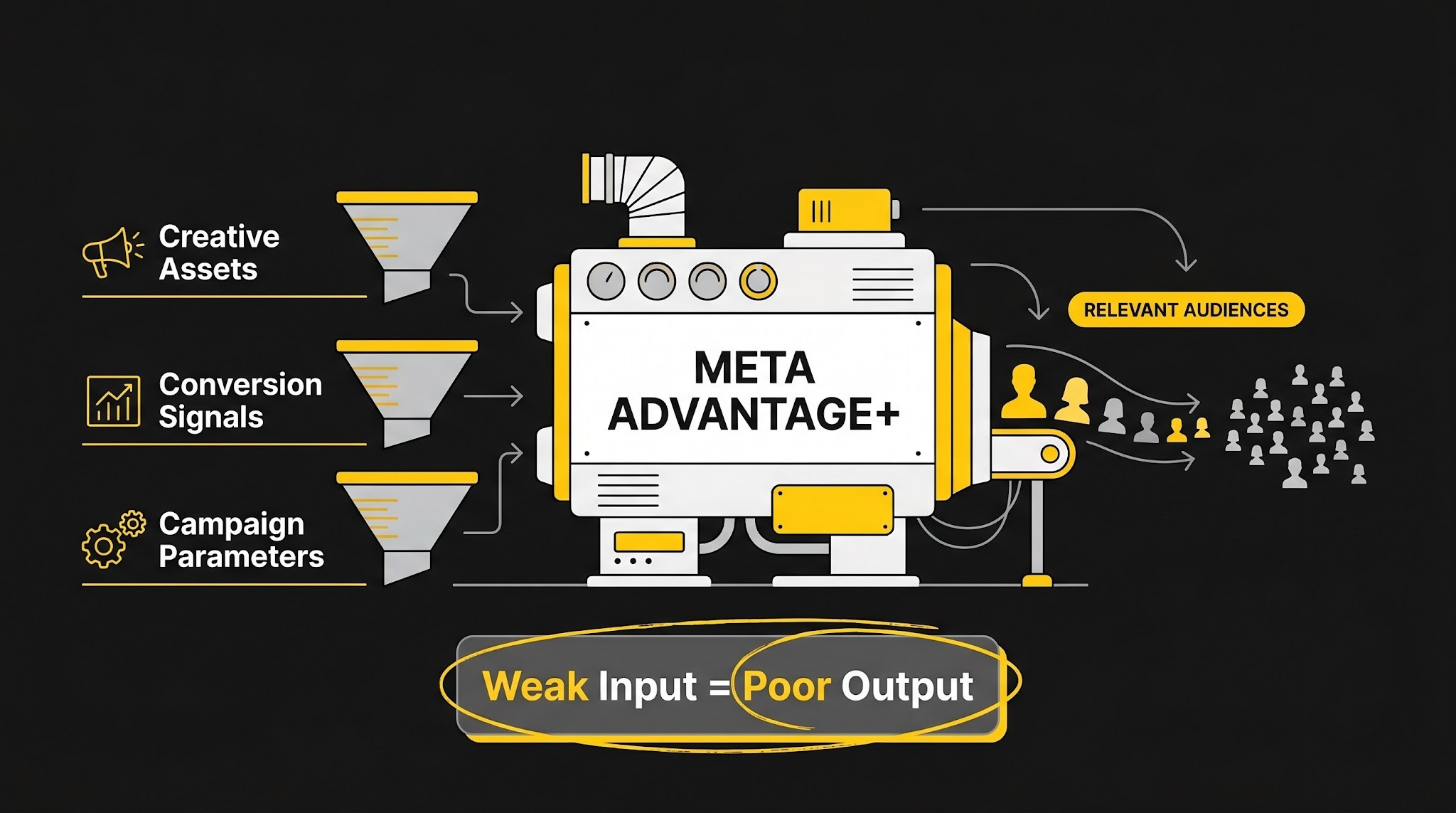
Let's be clear about something: Meta Advantage+ is not a media buyer. It has no opinions about your margins, your seasonality, or how you're positioned in the market. What it does exceptionally well is pattern matching at scale. It takes your creative assets, conversion signals, and campaign parameters, then connects ads with the people most likely to take the target action.
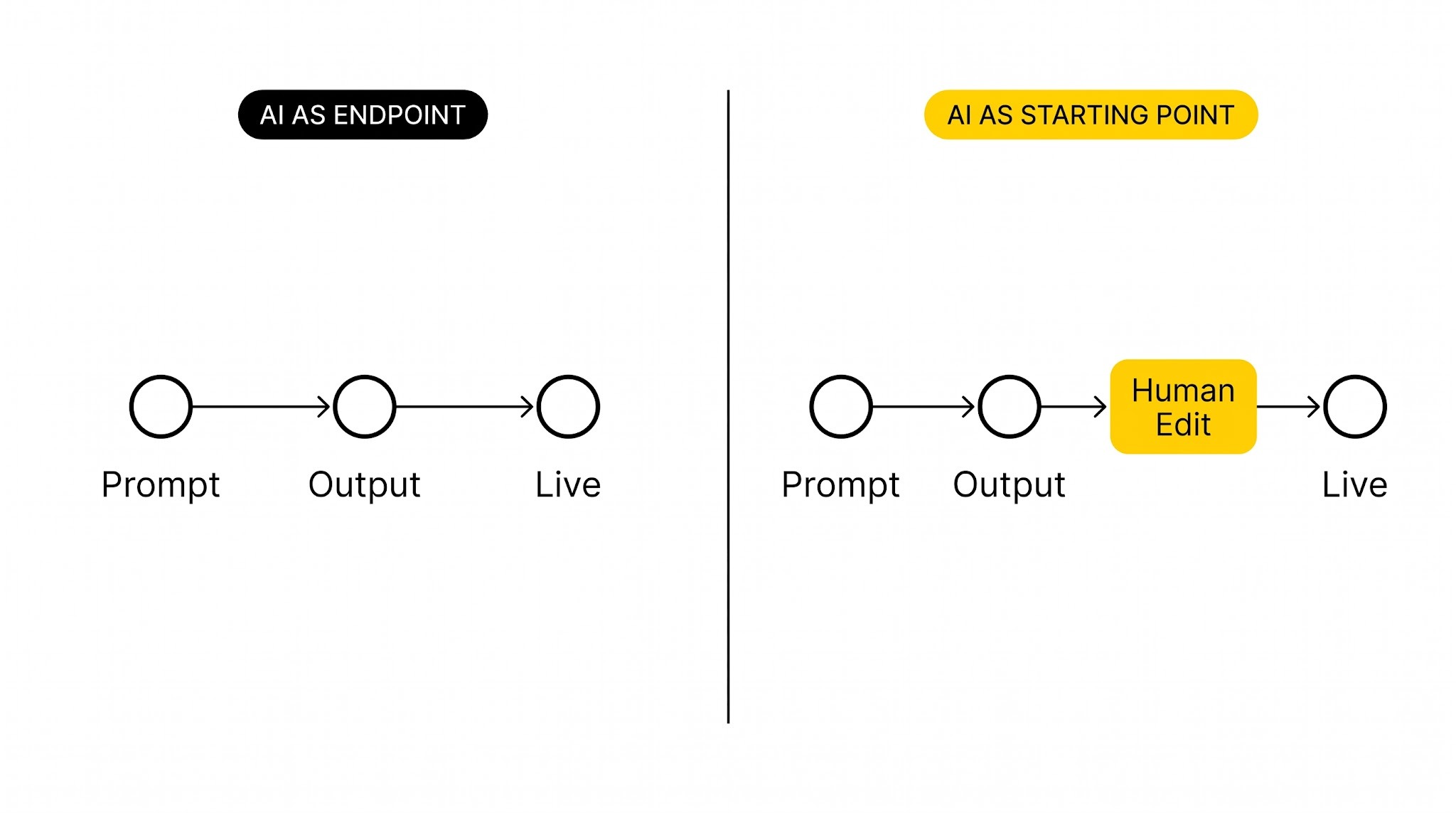
That distinction matters more than most brands realize. Brands that treat Meta Advantage+ as a strategy replacement tend to get burned. The algorithm is a powerful distribution engine, but it needs strong inputs to produce strong outputs. Weak creative, murky signals, or an underoptimized funnel will be faithfully distributed to a very large audience, very efficiently.
Why Creative Is Now the Targeting Mechanism
Before automation took over ad platforms, targeting was the primary lever. Meta's shift toward AI-driven delivery has effectively flipped that logic. The creative is now the targeting.
An ad that speaks to a specific pain point, or uses a distinct format like a talking-head testimonial versus a product demo, sends signals the algorithm uses to route delivery accordingly. A video showing how a supplement supports post-workout recovery attracts a fundamentally different cohort than a lifestyle shot of the same product sitting on a kitchen counter.
Brands that hand audience responsibility entirely to the algorithm while producing a single hero video are asking the system to solve a distribution problem with nowhere near enough inputs. What actually works is creative volume with intentional variation, not more targeting layers.
The Black Box Problem: What the Algorithm Still Can't Do Without You
Meta Advantage+ creates real efficiency gains and a real transparency problem at the same time. The system doesn't explain its decisions. It won't tell you why it shifted spend toward one creative, why CPAs crept upward over two weeks, or why a previously strong ad quietly stopped delivering. You have to infer that from the data yourself.
Context-specific variables are completely outside the algorithm's awareness: a product launch next month, a competitor cutting prices, a best-selling SKU going out of stock in three days. Automated campaigns will keep optimizing toward a reality that no longer exists unless a skilled operator stays engaged.
Recognizing AI Slop and Creative Fatigue Before They Drain Budget
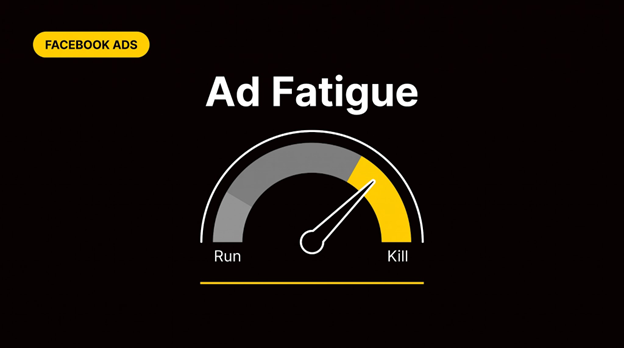
Creative fatigue compounds quietly inside automated campaigns. The algorithm will keep serving an ad that's technically still converting, even as frequency climbs and engagement drops. By the time performance metrics show a clear decline, budget has often been burning on stale creative for weeks.
"AI slop" is what happens when brands rely on auto-generated or templated creative with minimal strategic input. It looks like ad content, but it lacks specificity, brand voice, and genuine customer value. Algorithms distribute it; audiences disengage fast. The solution is proactive monitoring: track creative-level frequency alongside engagement rates, not just ROAS and CPA, and treat your ad creative like a living inventory with a real content calendar behind it.
Creative Similarity and Andromeda Bucketing
Meta's Andromeda system groups creatives into buckets and allocates budget based on predicted performance. The problem surfaces when creatives within the same campaign are too similar. The system consolidates delivery across a narrow bucket, which limits reach diversity and pushes CPA upward over time.
As Braydon Germain, Content Manager at Pilothouse, put it on the DTC Podcast (Ep. 589), the working rule of thumb: unless new creative is roughly 70% different from existing assets in format, message, and visual treatment, Meta's algorithm tends to bucket it as a single variant rather than testing it as a distinct input. Minor variations like tweaked headlines or adjusted copy do not qualify as distinct inputs under this logic. The brand gets a quiet performance drag rather than a clear signal it can act on.
The budget implication is direct: creative diversity is a structural lever, not just a creative team preference. Varying creative by format, hook, customer persona, and journey stage tells the system to find multiple audience pockets rather than optimize harder into one. Minor variations like tweaked headlines or adjusted copy don't qualify as distinct inputs under Andromeda's bucketing logic.
Scaling With Advantage Plus vs. Staying Manual: Knowing Which Situation Calls for What
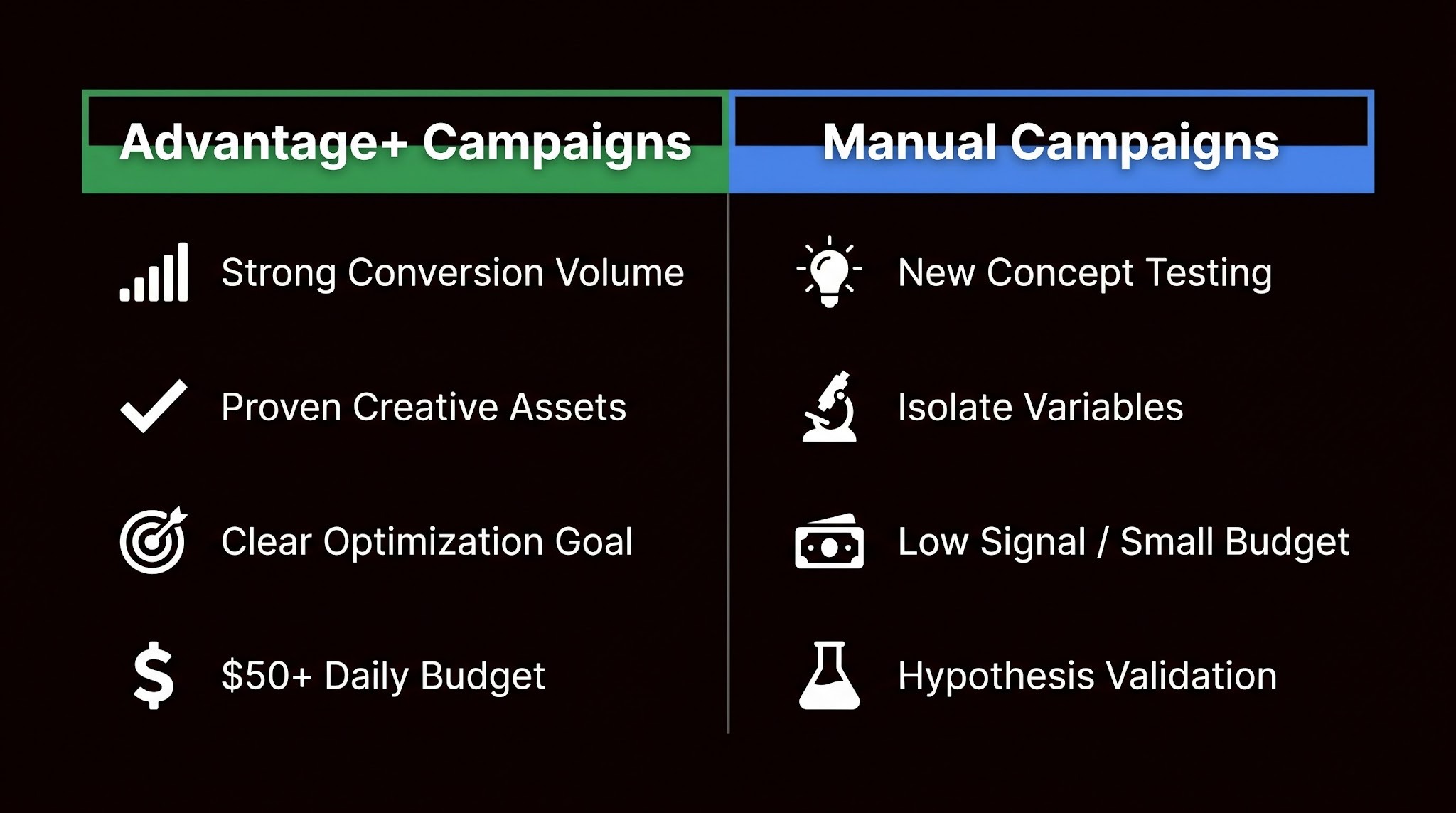
The question isn't whether Advantage+ campaigns or manual campaigns are better in some absolute sense. It's about knowing which context calls for which approach.
Meta Advantage+ performs best when it has sufficient signal to work with: consistent conversion volume, proven creative assets, and a clear optimization goal. Internal benchmarks from Meta show an average of 20% lower cost per result for Advantage+ Sales campaigns versus those without, along with a 9% improvement in cost per conversion on average (Meta for Business). These gains depend on the matching engine having enough data to operate effectively.
Volume Thresholds and Budget Consolidation for Advantage Plus
A practical floor for ASC optimization is a $50 daily budget. Below that threshold, the matching engine lacks sufficient signal density, and manual campaigns with deliberate audience segmentation often outperform ASC because human targeting can be more precise than an algorithm working with sparse data.
Budget consolidation matters too. Spreading budget across too many campaigns or ad sets fragments data and slows learning. Consolidating into fewer, well-structured campaigns lets the algorithm accumulate signal faster, which speeds up optimization and improves spend efficiency. ASC is designed for larger consolidated budgets; fragmenting across multiple small campaigns undermines the matching engine's capacity.
Why Manual Campaigns Still Own Net New Concept Testing
ASC scales what already works. It doesn't discover what might work. When you're testing a genuinely new concept, whether that's a new product angle, a new audience hypothesis, or a new creative format, manual campaigns give you the control to isolate variables properly. Advantage+ will optimize away from things that don't immediately perform, which is exactly what you want when scaling but counterproductive when testing.
A brand testing whether a problem-solution format outperforms a social proof format needs clean data. Manual campaigns allow control over placement, audience, and budget allocation in ways that produce interpretable results. Once a concept is validated, it earns its place inside an Advantage+ structure. The validation has to come first.
Protecting Existing Customers Inside Automated Campaigns
One area where brands consistently lose value inside automated campaigns is customer retention. Advantage+ Shopping Campaigns allocate budget toward whoever is most likely to convert. Returning customers often convert at higher rates than cold audiences, so without intentional exclusions or separate campaign structures, brands end up paying acquisition costs to re-engage people who would have purchased anyway.
The fix is deliberate segmentation. Customer list exclusions keep existing customers out of acquisition-focused campaigns. Separate retention-oriented campaigns with messaging designed for people who already know the brand send cleaner signals to the algorithm and protect margin. Customer lifetime value is a DTC brand's most vital growth metric, and automated campaigns that conflate acquisition and retention quietly erode it.
Creative as an Intent Resolution System: Building a Library of Answers
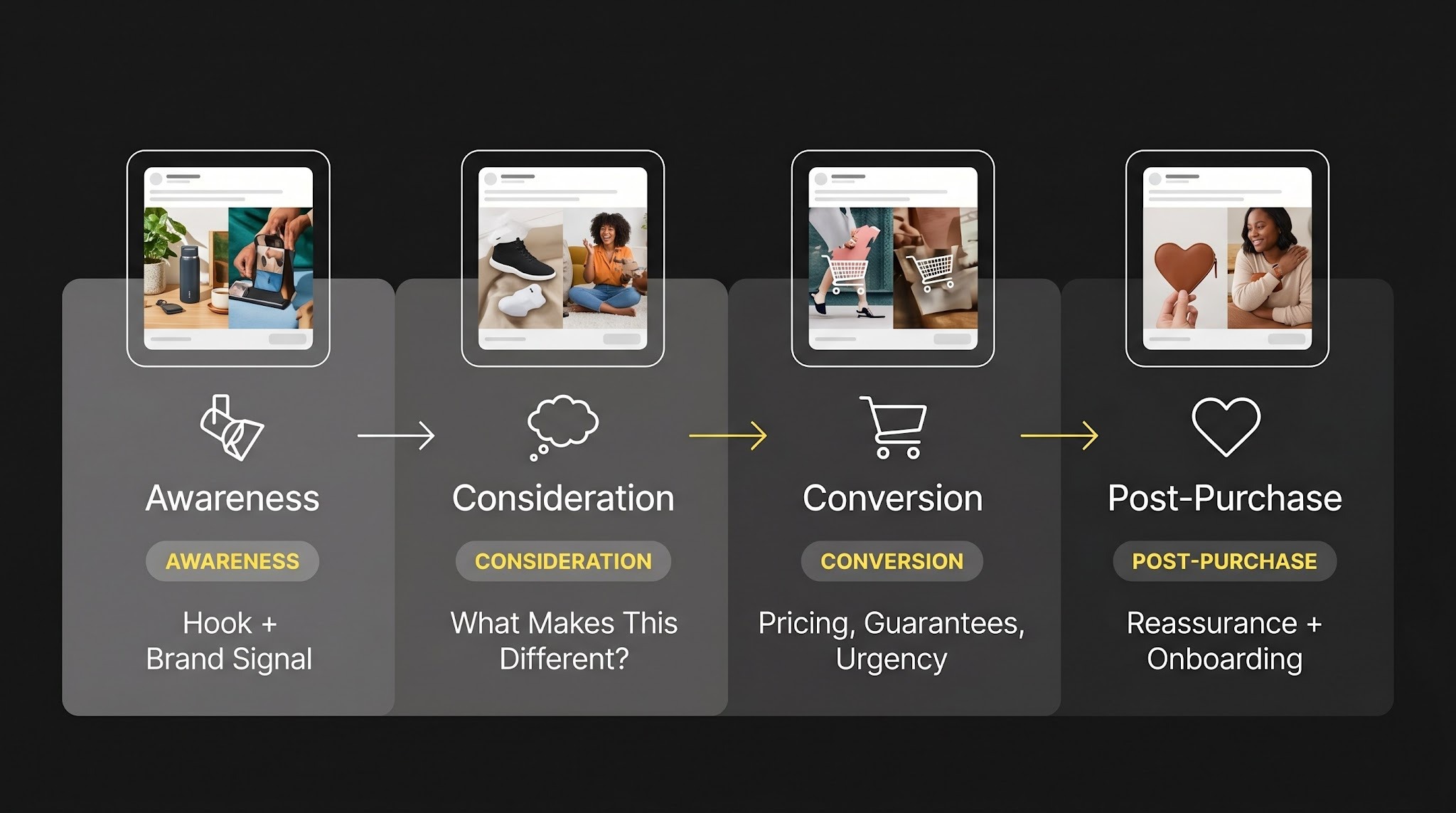
The most useful mental model for creative strategy inside automated campaigns is treating each piece of creative as an answer to a specific customer question. Someone who has never heard of your brand needs different answers than someone who has visited your site three times without buying. A first-time purchaser needs different answers than a long-term subscriber.
Mapping Creative Inputs to Customer Journey Stages
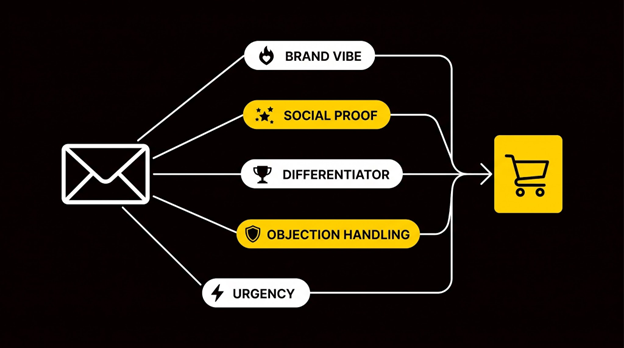
A practical library maps creative to four zones. Awareness creative introduces and creates curiosity, prioritizing hooks and a clear brand signal over product detail. Consideration creative addresses the questions a warm audience carries: what makes this different, is this right for someone like me, what do real customers say. Conversion-stage creative removes the last friction through pricing clarity, guarantees, urgency, and specific social proof. Post-purchase creative provides reassurance and onboarding, reinforcing the customer's decision and reducing churn.
When creative teams brief against these stages rather than a generic campaign brief, the output becomes directly usable by Andromeda as an intent resolution mechanism, matching the right message to the right moment in the customer's consideration.
The Post-Click Readiness Check: Don't Feed Automated Traffic to a Limping Funnel
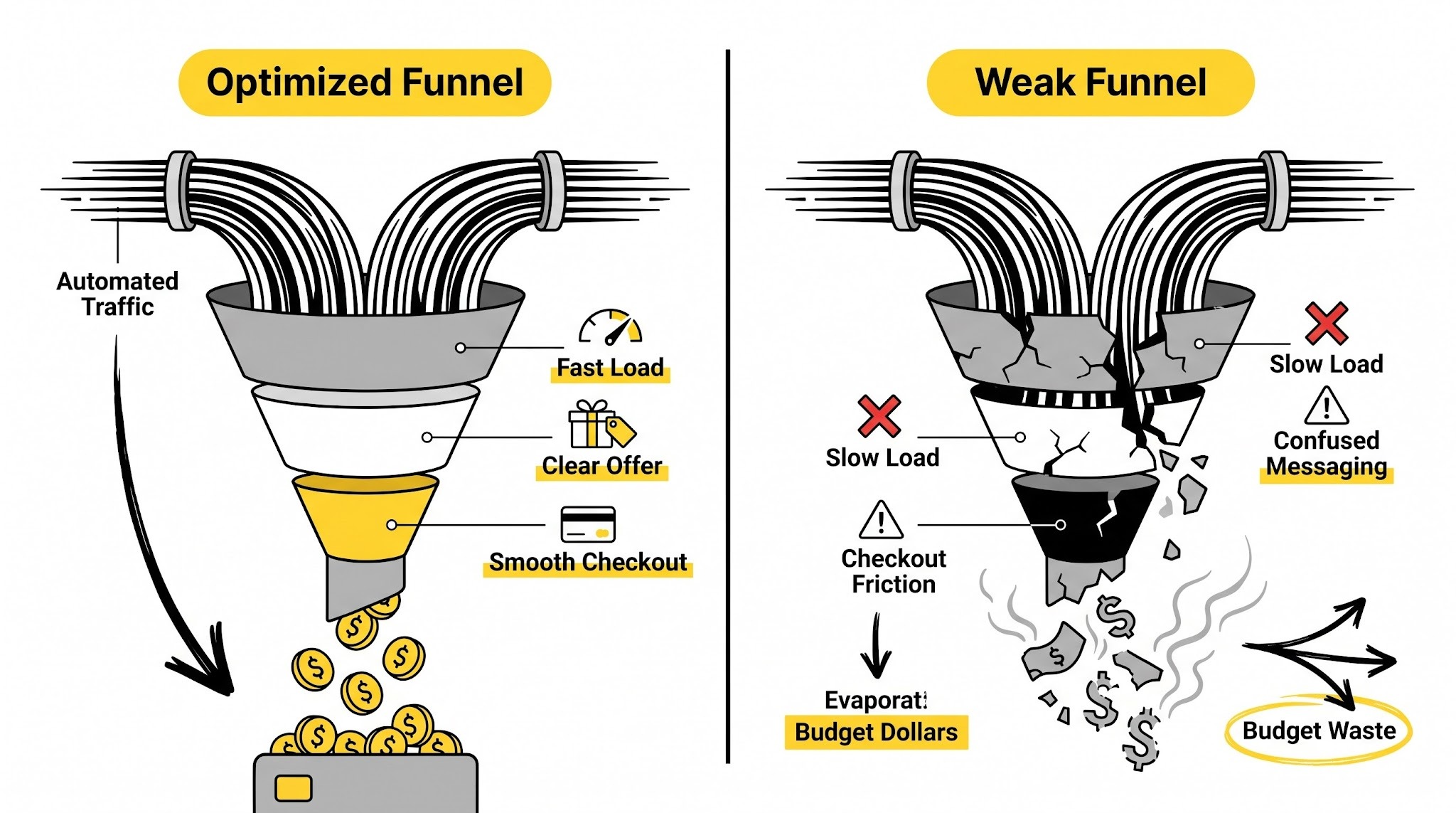
Meta's AI can drive significant traffic volume quickly. That efficiency makes a weak funnel especially dangerous. If a landing page is slow, the offer is unclear, or checkout creates friction, Advantage+ will efficiently deliver that poor experience to thousands of people. The algorithm optimizes for clicks and conversions; it has no mechanism for evaluating whether a landing page deserves the traffic it receives.
Before scaling spend inside any automated campaign structure, audit the basics: message congruency between ad and landing page, mobile load speed, offer clarity above the fold, checkout friction, and trust signals. A well-optimized funnel turns algorithmic efficiency into revenue. An under-optimized one turns it into wasted budget at scale, a risk that compounds fast as spend increases.
The Creative Team as an Insight Engine
Creative teams inside high-performing DTC brands don't just make ads. They generate the data that informs every other part of the growth strategy. When a talking-head testimonial outperforms a polished product video, that's a signal about audience psychology. When a specific hook drives outsized engagement among a particular demographic, that's targeting information, messaging strategy, and product insight all at once.
Brands that get the most from Meta Advantage+ treat their creative team as a feedback loop. Performance data flows back into creative briefing. Creative hypotheses get tested with structure. Winners get codified and scaled. The algorithm handles distribution; the creative team handles meaning. Search intent mapping, customer conversation analysis, competitive creative gap analysis, and conversion data feedback loops all feed into smarter briefs, which cuts down on AI slop and improves the signal quality Andromeda optimizes against.
Pilothouse Digital's client work reflects this integrated approach, where media buying, creative, and strategic analysis operate as a single system rather than separate departments. That structure is what allows brands to move from tactical chaos to scalable, repeatable growth, because insights generated by creative performance inform every layer of paid media strategy, not just the next ad concept.
Meta Advantage+ is a powerful tool when fed well, monitored consistently, and deployed within a strategy that still values human judgment where it matters most. The brands winning with it aren't the ones who handed over control. They're the ones who figured out exactly how much control to keep.












.png)



.webp)


.webp)