


How VSSL Scaled 41% Year-Over-Year Without Adding a Dollar of Spend
Great brand. Strong personas. Real fans. The only thing missing? A strategy that made the channels work together.

Drinkware

The Brand
VSSL makes premium outdoor coffee gear, travel mugs, grinders, and pour-over kits built for people who refuse to compromise on their coffee, even miles from the nearest café. Founded in 2015 and based in Abbotsford, BC, VSSL has built a loyal community around a simple belief: great coffee belongs everywhere adventure takes you.


Overview of Results


The Challenge
Sharp brand identity. Documented customer personas. Products with real, passionate fans. And a brand team that was leaning in hard, launching new products, running Limited Edition initiatives, investing in PR, growing email and SMS through coordinated giveaways, activating at in-person events, building brand collaborations, and bolstering affiliate communications. 2025 was a big testing year for VSSL. They were pulling every lever.
But their digital marketing channels were operating in silos, each with its own fixed budget, its own goal, and limited shared logic connecting them.
Insights from Meta weren't shaping Amazon creative. Email wasn't learning from paid. Media spend wasn't being moved toward what was actually working. And while the team had invested in building out detailed customer personas, that persona knowledge wasn't making its way into the ads themselves.
The result: a brand executing a full-court press across marketing, but with a digital engine that wasn't keeping pace with everything else being built.
They started with Pilothouse on email, then brought on Google and Meta. When they saw how learnings were crossing channels and everything was being managed as one ecosystem, they brought Amazon in as part of that omnichannel approach. Having Pilothouse as an extension of the team freed the internal team to go deeper on brand, product, and offline channels — while the digital side ran as a coordinated, performance-driven system.
The Strategy
Growth Strategy
Pilothouse's role was not to start from scratch. It was to make sure the digital side of the business was reading what was happening across the brand and showing up in a way that amplified it. Every new product launch, every activation, every PR moment needed the paid, email, and Amazon channels to be pulling in the same direction, speaking to the right person with the right message at exactly the right time.
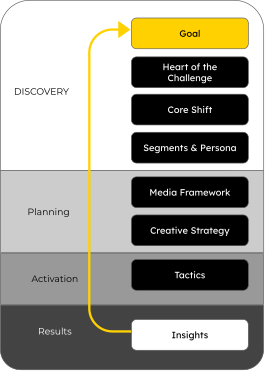
We went deeper on each persona, mapping not just demographics but motivations, values, and the specific moments that drive purchase decisions. One of VSSL's core personas is the Outdoor Adventurer: gear-savvy, sustainability-conscious, quality-obsessed, and always planning the next trip. This is not someone who buys on impulse. They research, compare, and spend consciously on things that enhance their experiences.
With that picture sharpened, we built a creative strategy to match. Ads that tapped into the anticipation of camping season. Creative that positioned VSSL not just as a product, but as part of the adventure itself. The message became less "here's what this product does" and more "this brand gets you." For an audience that values authenticity above almost everything else, that distinction made all the difference.
The Outdoor Adventurer Persona
MINDSET
VALUES

ATTRIBUTES
CORE BENEFITS SOUGHT
PAIN POINTS
Creative Examples - The Outdoor Adventurer Persona


Account Strategy
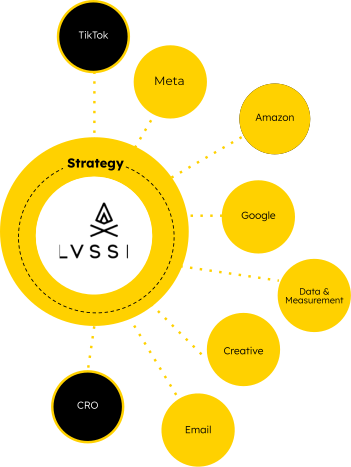
Most brands run their channels this way. Meta has its budget. Amazon has its budget…etc. They are evaluated separately, optimized separately, and rarely compared against each other in real time. The problem: performance does not stay equal across channels, especially during key windows like Q4.
Pilothouse's approach was different. We stepped back and looked at the full ecosystem as a single P&L, reviewing channel performance weekly and asking one question: where is each dollar driving the most incremental, profitable revenue right now?
For example, during Black Friday, the answer was clear. Meta was winning on new customer acquisition at a pace Amazon could not match. So we shifted Amazon budget into Meta and reallocated a portion of Amazon's sales targets to Shopify. Spend did not go up. Efficiency did. That kind of fluid, data-driven reallocation is only possible when you have one team looking at the whole picture.
Channel Strategy
.webp)
The Results
The spend didn't move. The strategy did. That's the difference.
All stats are 2025–2026 YOY


Get a Taste of What Our Creative Team Cooked Up for VSSL

.png)


.gif)
.gif)
.gif)
.gif)
What Made This Work
Personas only create value when they shape execution.
Fixed channel budgets are a ceiling.
Strategy and execution have to run together.
Paid performance doesn't happen in a vacuum.
The Outcome
VSSL came to Pilothouse one channel at a time. What started as an email engagement grew into a full omnichannel partnership, because once the team saw what a connected strategy looked like in practice, the decision to consolidate was easy.
2025 was a big testing year for the brand. While VSSL's internal team pushed into new product lines, activations, brand partnerships, and PR, Pilothouse operated as an embedded extension of the business, running the digital channels as a single, performance-driven system, and freeing the team to go deep on everything else.
In one year, without adding spend, VSSL saw 41% YOY net sales growth, a 92% lift in conversion rate, and Meta results that weren't close to where they started. The channels that had been operating in silos were now feeding each other, and the numbers reflected it. That is what happens when personas shape creative, creative informs media, media planning treats every dollar as fluid, and a brand's full marketing strategy is treated as the brief, not the backdrop. Not three separate workstreams. One ecosystem.

%201.svg)
"Pilothouse blew it out of the water — ROAs we've never seen before, customer engagement we've never seen before. There's no aspect where Pilothouse has fallen short, and it's just brought a lot of peace to our leadership team that were working with the right partners."
