


The Amazon Seller Feedback Crisis: Navigating Star Ratings Without Comments

Seller reputation on Amazon has always been fragile. But a recent shift to the feedback system has made it considerably more so, and most sellers haven't fully processed what that means for their business. On August 4, 2025, Amazon began allowing customers to leave seller feedback stars without any written comments (Amazon Seller Central, 2025). No explanation, no context, no trail to follow. Just a number, and whatever consequences follow.
For anyone managing Amazon seller feedback ratings at scale, this isn't a minor inconvenience. It's a structural problem with real downstream effects on Buy Box eligibility, sales event access, and long-term account health.

Amazon Just Made Seller Feedback Ratings Harder to Fight - Here's What Changed
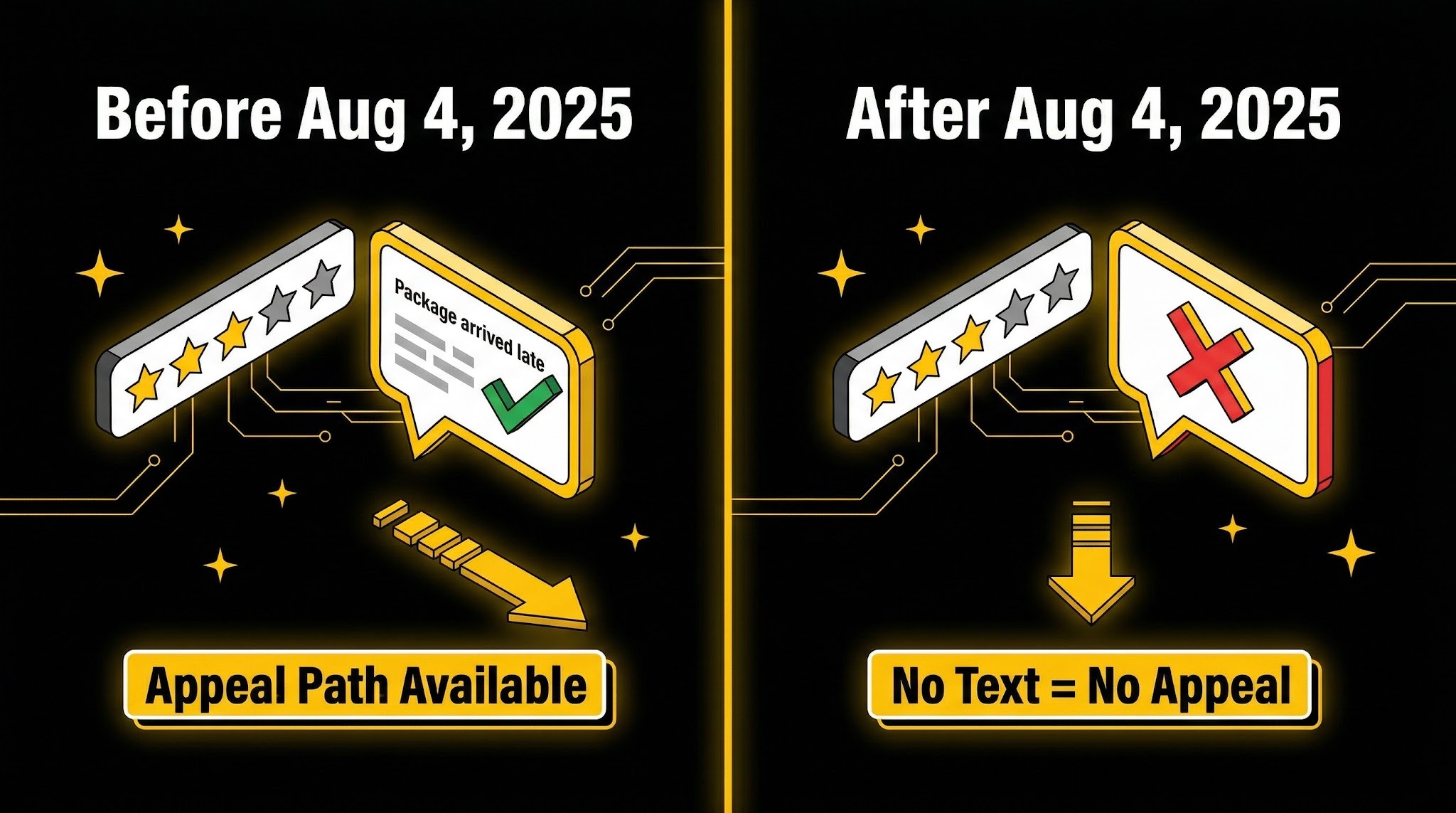
The feedback system update didn't come with a press release. It rolled out quietly, and many sellers only noticed the implications when they saw clean, comment-free star reviews appearing on their accounts with no way to engage with them.
How the Comment-Free Rating Update Works
The option to rate a seller has always existed in Amazon's buyer-facing interface, but completing that action previously required written feedback alongside the rating. Now the process is frictionless. A buyer can assign one through five stars in seconds, though ratings below four stars require selecting a reason from a dropdown menu before submitting.
Amazon's intent appears to be increasing participation rates. In preliminary tests, preliminary tests showed that many star-only ratings came from customers who had positive order experiences but previously did not leave written feedback, which may lead to an increase in average seller ratings. More buyers completing feedback means more data points, which theoretically creates a more accurate picture of seller performance. In practice, it creates a flood of uncontextualized ratings that sellers cannot interpret, respond to, or challenge in any meaningful way.
Why This Quietly Breaks the System for FBA Sellers
FBA sellers operate in a system where Amazon controls fulfillment. Shipping delays, warehouse errors, packaging issues, carrier problems, all of it sits outside the seller's direct control. But Amazon seller feedback ratings don't always reflect that distinction. Customers who receive a late package or a damaged item may assign a low star rating to the seller, even when the fault belongs entirely to Amazon's logistics network.
Before this update, written comments often made it possible to identify exactly that situation. A customer writing "package arrived late and damaged" provided textual evidence that the issue was fulfillment-related. Without that text, FBA sellers are now absorbing ratings they cannot categorize, diagnose, or dispute.
The Strike-Through Button Is Now Effectively Useless
Amazon's dispute mechanism for unfair feedback has always been limited, but it was at least functional for FBA-related complaints. That pathway now leads mostly to a dead end.
How the Strike-Through Process Was Supposed to Work
When a seller submitted a strike-through request, the argument was built around evidence. If a customer left feedback complaining about a delivery issue on an FBA order, that text could be cited as proof that Amazon's fulfillment was the responsible party. Amazon would review the submission and, where applicable, apply a strike-through that visually neutralized the rating, noting that fulfillment was managed by Amazon rather than the seller.
The process depended entirely on having something to point to. A sentence, a phrase, a specific complaint grounded in text.
No Text Means No Appeal Path
Comment-free star reviews remove that foundation entirely. There's no text to cite, no complaint to attribute, and no grounds to argue that the rating reflects a fulfillment failure rather than a seller failure. Star-only ratings cannot be appealed via Amazon's Feedback Manager. Sellers must use the "Report a violation" process instead. That process is designed around written content violations like spam, profanity, and private information. It offers no practical recourse for star-only ratings that contain no text.
This matters more than sellers may initially realize. The strike-through was the primary safety valve in a feedback system that otherwise offered little protection. With it effectively removed from the equation for text-free ratings, the only remaining strategy is prevention, not correction. Seller forum participants have flagged this exact exposure: community concern holds that FBA-fault ratings submitted as star-only reviews cannot be appealed via Feedback Manager, leaving sellers with only the 'Report a violation' process as recourse-a pathway widely regarded as offering little practical protection for context-free ratings.
What's Actually at Stake: Buy Box Ownership and Sales Event Access
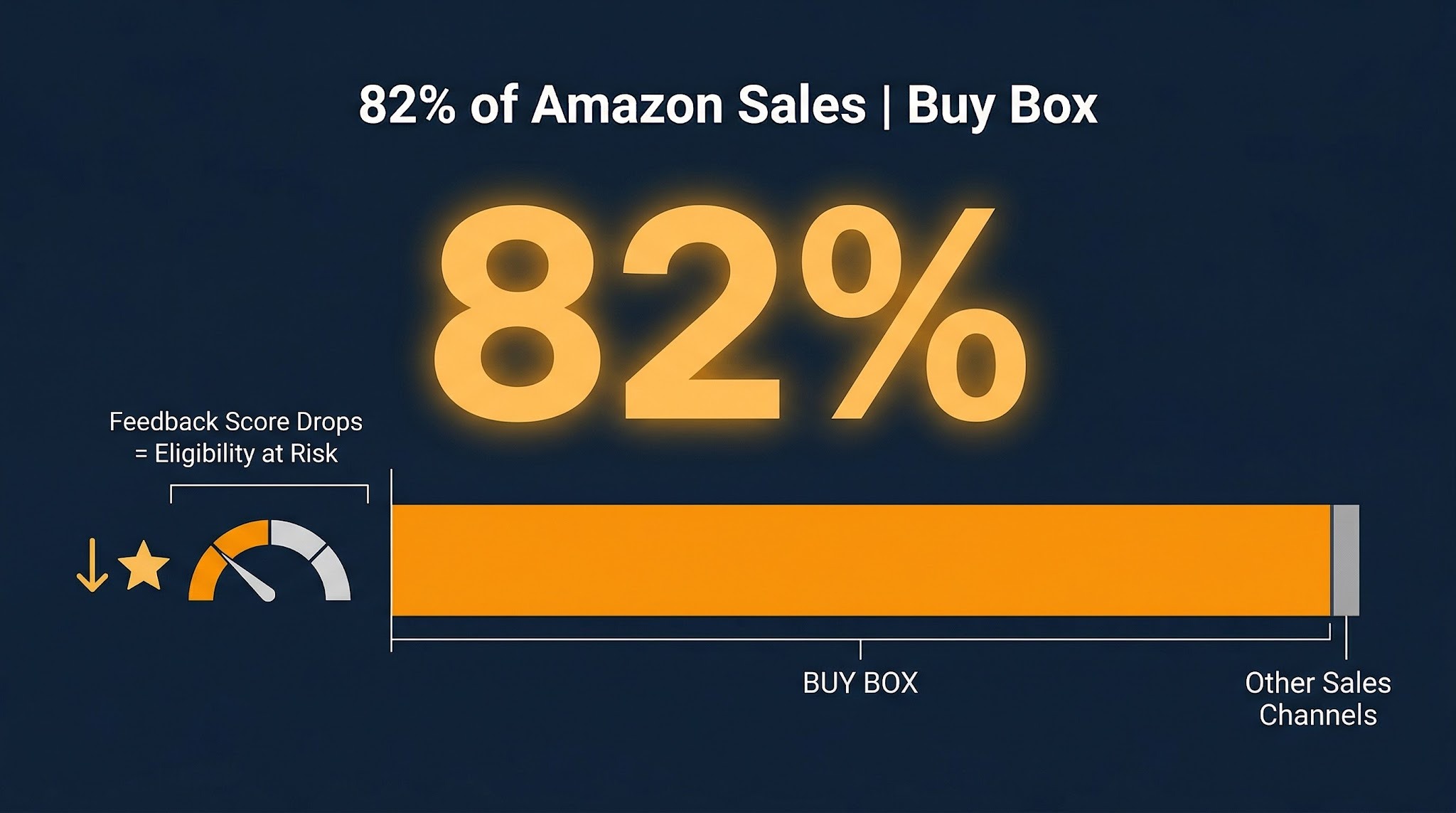
The consequences of a declining feedback score aren't abstract. They show up in revenue reports, campaign performance, and the inability to compete during the windows where competition matters most.
How a Damaged Feedback Score Strips Your Buy Box
The Buy Box algorithm weighs multiple variables, and Amazon seller feedback ratings sit near the top of that list. The Buy Box accounts for over 82% of all Amazon sales, making eligibility non-negotiable for any seller running a serious operation (Repricer). When a seller's feedback score deteriorates, another seller with a marginally higher rating gains the algorithmic edge. Over time, that edge compounds into a structural shift in revenue capture that can take months to reverse.
There's another layer to this too. Sellers must maintain an Order Defect Rate below 1%, which includes negative feedback, A-to-Z Guarantee claims, and credit card chargebacks. Comment-free low ratings feed directly into that threshold with no mechanism to contest them.
The problem compounds when you factor in a longstanding issue the update does nothing to address. As Rob Russell and Clifford Donovan from Pilothouse state: most buyers don't distinguish between seller feedback and product reviews. A customer unhappy with a product's quality, not anything the seller did, can now assign a one-star rating in seconds with no comment to flag the misdirection. Before, a written complaint about screen quality or material durability was at least identifiable as product-related. Without text, that distinction disappears entirely.
Want to learn more? Listen to Ep 532: What Smart Brands Do Differently on Amazon by DTC Podcast.
Why Black Friday and Peak Season Exclusion Is a Real Risk
Amazon uses performance metrics to determine which sellers qualify for high-visibility promotional placements during peak sales events. Black Friday, Cyber Monday, and Prime Day are gated events, and sellers with compromised feedback scores are frequently excluded. A string of comment-free low ratings in October can disqualify a seller from the events that generate their highest revenue concentration of the year. During peak season, the feedback system functions as an access control mechanism, not just a reputation tool.
Why Automating Your Feedback Defense Is a Critical Mistake

The instinct to automate is understandable. Feedback software promises to handle monitoring, dispute submissions, and response management without constant manual intervention. The problem is that the current feedback environment punishes exactly that kind of complacency.
The False Safety of 'Set It and Forget It' Tools
Automated tools are built around rules and patterns. They look for triggers, keywords, and conditions that match pre-set criteria. Comment-free ratings break that logic entirely. There's no keyword to detect, no sentiment to analyze, and no trigger condition to fire. An automated feedback management tool scanning for actionable text in a blank rating will return nothing, and the rating will quietly sit there affecting the account's score.
Beyond the technical limitation, automation creates a false sense of coverage. Sellers who believe their feedback is being managed stop examining individual ratings closely enough to catch patterns, timing anomalies, or spikes that may indicate coordinated negative activity. The set-it-and-forget-it approach turns a manageable risk into an invisible one.
Manual Vigilance During High-Traffic Windows: What It Actually Looks Like
Managing Amazon seller feedback ratings manually during peak periods means building a deliberate rhythm. Checking new feedback daily, not weekly. Logging each comment-free rating by date and order ID to identify whether a particular product, fulfillment center, or shipping carrier is generating disproportionate dissatisfaction. Maintaining a clear internal process for flagging anomalies that look less like genuine customer dissatisfaction and more like coordinated manipulation.
During Black Friday lead-up periods, that rhythm needs to tighten further. Sellers should audit feedback scores at the start and end of each high-traffic day, track Buy Box percentage movement in real time, and maintain direct communication lines with Amazon Seller Support so legitimate disputes can be escalated quickly.
An Antiquated System That May Be Rewarding Bad Actors
The feedback system Amazon built was designed for a simpler marketplace. It assumed buyers would leave honest assessments based on real transactions and that sellers would have access to enough context to respond constructively. Neither assumption holds cleanly today, and the comment-free update has widened an already significant gap.
How the Lack of Accountability Enables Manipulation
Sellers and industry observers have raised concerns that anonymous star-only ratings create conditions susceptible to bot activity, competitor manipulation, and automated abuse. Leaving a one-star rating requires no explanation, no specificity, and no accuracy. A competitor operating unethically can exploit buyer accounts to suppress a rival's score with comment-free feedback that leaves no traceable pattern. The system, as currently structured, cannot distinguish between legitimate dissatisfaction and deliberate manipulation.
Worth noting: a similar star-only initiative was rolled back in 2023 after widespread seller dissatisfaction, including a formal petition campaign from the Amazon Sellers Group (ASGTG) urging Amazon to preserve written feedback requirements. Whether this iteration follows the same trajectory remains to be seen, but the structural concerns that drove that rollback have only intensified with this update.
Building a Manual Defense Strategy for Amazon Seller Feedback Ratings
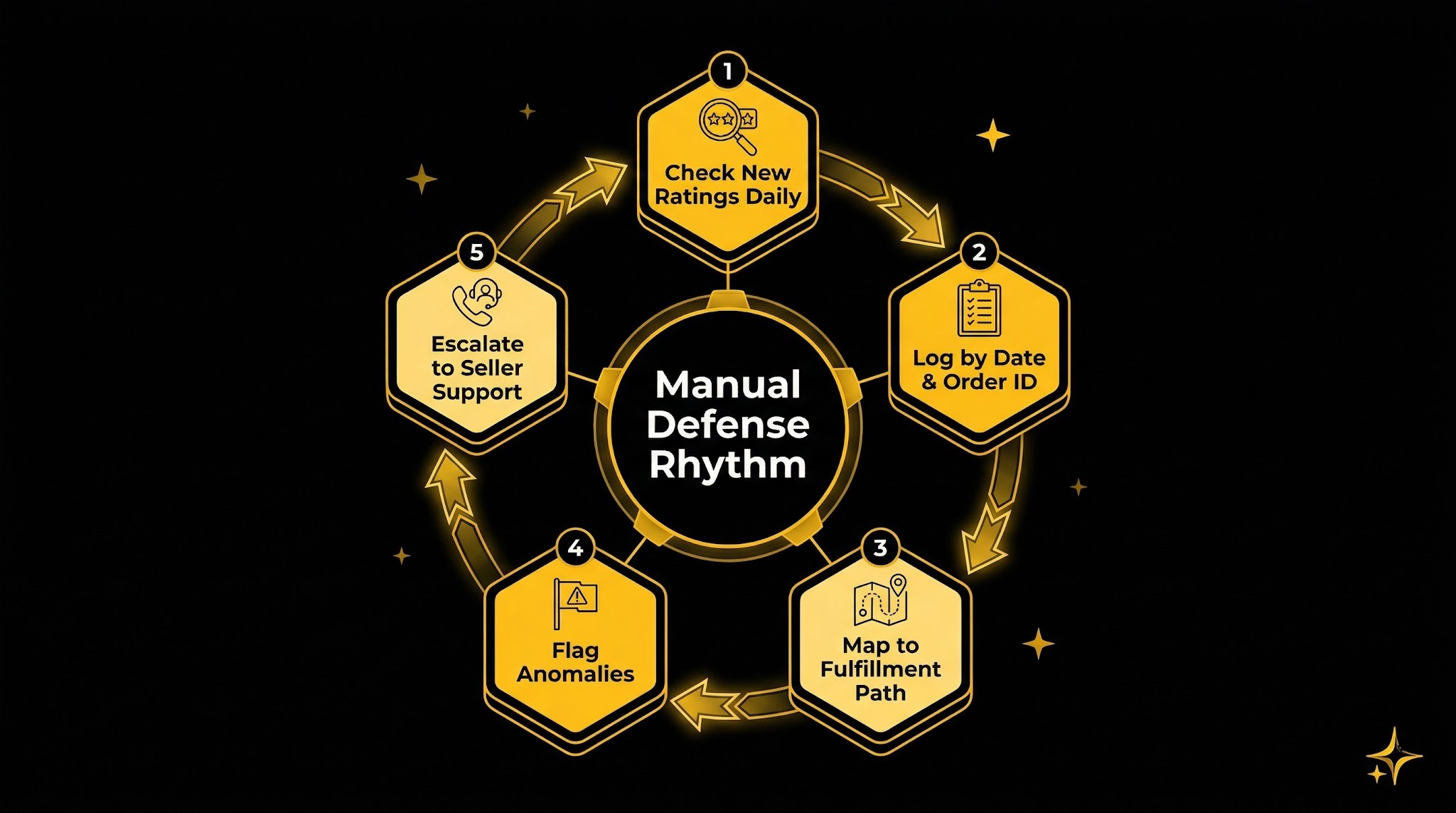
A strong defense starts before a single rating lands. The core of any manual strategy is customer experience execution: fulfillment accuracy, responsive pre-shipment communication, and fast post-purchase resolution. Feedback software can still support anomaly detection and pattern tracking, but it works best as a supplement to human judgment rather than a replacement for it.
Beyond the transaction itself, sellers should build a systematic review of their feedback profile at regular intervals. Cross-reference individual ratings against order data, map low star reviews to specific time windows or fulfillment paths, and establish an internal escalation protocol for unusual feedback patterns. This gives sellers the information they need to act before a score decline reaches a critical threshold.
Equally important is treating feedback score as part of a connected performance system. Tracking ODR, Late Shipment Rate, and Buy Box percentage alongside feedback score creates early warning signals. A decline in one often precedes a decline in others, and catching the leading indicator early creates more time to correct course before peak season eligibility is jeopardized.
The Bottom Line: Pilothouse Digital on Protecting Your Seller Reputation
The Core Argument
The comment-free rating update is a real operational challenge, but it isn't unsolvable. Sellers who treat their feedback score as a passive outcome of customer satisfaction will struggle in the current environment. Sellers who treat it as an active business metric requiring attention, process, and strategy will adapt. The sellers most exposed right now are those relying on tools and workflows built for a system that no longer exists.
Why Operational Strategy Has to Come First
A compromised feedback score doesn't just affect today's sales. It limits access to the promotional infrastructure, Buy Box visibility, and platform trust that compound into long-term growth. Protecting seller reputation isn't a customer service task. It's a growth strategy.
Work With a Partner Who Understands the Full Picture
Pilothouse Digital works with eCommerce brands that compete seriously on Amazon, treating account health and feedback monitoring as core operational disciplines rather than afterthoughts. For brands looking at how that translates in practice, Pilothouse client case studies reflect the operational and strategic depth that serious Amazon growth requires.





.jpg)

.png)










%201.webp)
.webp)