


Amazon Fixed Bidding Strategy: When to Throw Away ACOS Goals
Most Amazon sellers cap their own growth by obsessing over ACOS. They tweak every campaign to hit efficiency targets while organic rankings stagnate. The problem: prioritizing perfect efficiency early kills the momentum needed to dominate search results.
Amazon's fixed bidding strategy gives brands complete control over cost-per-click. They set conservative bids, nail their ACOS targets, and miss what's happening around them. Meanwhile, competitors pump volume into keywords and climb organic ranks, stealing market share that "efficient" sellers can't touch.

Why ACOS Obsession Kills Long-Term Amazon Growth
ACOS (Advertising Cost of Sales) is calculated as ad spend divided by ad revenue. While easy to track, this metric only captures immediate returns, ignoring the compounding effects of visibility, ranking, and organic momentum. Products optimized purely for ACOS stay buried where shoppers never see them, while competitors who invest in visibility eventually own the organic real estate that generates revenue without ad spend.
The Efficiency Trap That Destroys Organic Ranking
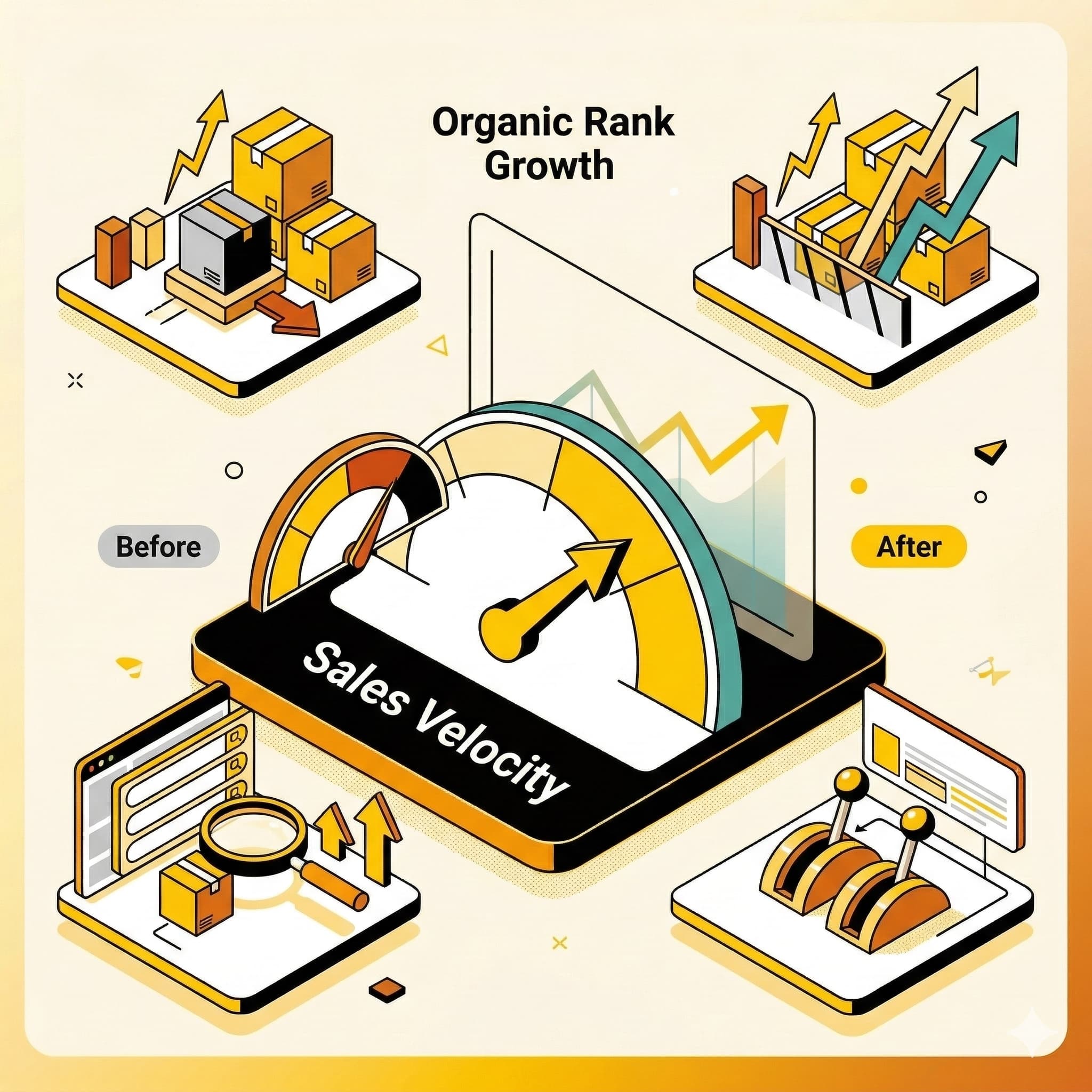
Amazon's A9 algorithm rewards products that convert with velocity. Sales velocity heavily influences organic rankings. Faster, more consistent sales signal relevance to Amazon. When brands bid conservatively to protect low ACOS, they choke off impressions and clicks. Fewer purchases signal to Amazon that the product isn't as relevant as competitors', prompting higher volume. Organic rank stagnates or drops, forcing heavier reliance on paid traffic.
This creates a brutal cycle: lower organic position means heavier ad dependency, creating pressure to maintain tight ACOS. Lower bids to protect ACOS mean fewer impressions and worse organic performance. Brands end up paying for every sale, while competitors who invested early now own organic results.
Shifting to Visibility and Control Over Immediate Returns
Strategic Amazon PPC optimization reframes the core question from "What ACOS can we achieve?" to "What position do we need to own?" Position drives click-through rate, conversion rate, organic ranking, and profitability.
This means recognizing that different campaigns serve different purposes: some target immediate returns, others capture market share, defend brand territory, or launch new products. Fixed bidding serves as the control mechanism that makes this possible, unlike dynamic bidding, which can adjust by up to 100% based on Amazon's predictions. Fixed bids let brands decide exactly where to spend aggressively and where to protect efficiency.
How Fixed Bidding Works as Your Primary Control Lever
Amazon offers three main bidding options: dynamic down only, dynamic up and down, and fixed bids. Dynamic bidding hands over control to an algorithm optimized for Amazon's goals. Fixed bidding returns that control, making it essential for a strategic Amazon PPC campaign strategy.
With fixed bids, the set amount becomes the ceiling per click. Amazon doesn't adjust based on placement or conversion signals. This gives brands a predictable cost structure and surgical control over budget allocation.
A major misconception is using daily budgets to control spend when bids should be the primary lever. If a campaign consistently hits its daily budget cap, it leaves money on the table. Impressions and clicks that could have driven sales go uncaptured. The strategic response isn't blindly raising budgets. It's adjusting bids to control efficiency while letting budgets run longer throughout the day.
Audit Tip (Pilothouse Amazon Team): Bids should move relatively often, at least a few times a week, to remain optimized based on conversion rate shifts. Static bids in dynamic markets lead to either overspending or missed opportunities (EP 532: What Smart Brands Do Differently on Amazon by DTC Podcast).
Ranking Campaigns: When to Intentionally Sacrifice Low ACOS Goals
Ranking campaigns have one job: generating enough purchase velocity on target keywords to trigger organic ranking improvements. These campaigns deliberately sacrifice short-term ACOS to capture positions that deliver long-term profitability. The tactic targets a small subset of high-volume keywords to improve organic ranking and relevance. Brands identify high-value keywords where a better organic rank would generate significant revenue, then bid aggressively enough to drive consistent sales volume regardless of immediate returns.
Ranking campaigns are typically not profitable in the short term. However, as long as you are tracking metrics that show you are gaining a larger share of search, add-to-carts, or purchases, the investment pays off in the long term through increased organic volume.
Fixed Bid Advantage: Fixed bids prevent the algorithm from lowering your bid when it predicts a lower conversion probability, ensuring you stay in the high-visibility "Top of Search" spots necessary to build sales velocity.
The economics change when organic lift is factored in. A 50% ACOS on paid traffic looks terrible until that traffic drives organic ranking improvements that generate profitable sales without ad spend. If aggressive bidding moves a product from position 15 to position 5, and that improvement doubles organic sales at zero ACOS, the combined efficiency tells a completely different story.
Most brands never execute real ranking campaigns because they can't handle the temporary efficiency hit. They launch with aggressive bids, panic when ACOS hits 40%, and pull back before creating meaningful momentum.
Starting Bid Formula: Target ACOS × Product Price × Conversion Rate. Set this high enough to consistently win top positions; the goal is to capture impressions and generate conversion events that signal relevance to Amazon's algorithm.
Niche Down to Scale Up: Strategic Keyword Selection
A critical ranking insight: it is better to be ranked #2 on a 2,000-volume keyword than #30 on a 20,000-volume keyword. Spreading the budget across too many competitive terms dilutes impact. Concentrated spend on winnable keywords builds the sales velocity needed to actually move organic rankings.
Effective ranking campaigns focus on 10-20 keywords with clear commercial intent and substantial, but not overwhelming, search volume. Brands dominate these positions completely before expanding to broader terms.
Velocity Thresholds by Category
The required velocity varies by competition level: competitive niches may need dozens of daily sales to move rankings, while smaller categories might respond to five to ten. The critical factor is consistency; sustained velocity over weeks demonstrates stable relevance to Amazon.
The Low Base + High Multiplier Approach for Placement Control
Most brands either set high base bids that waste money across all placements or low base bids that can't compete anywhere meaningfully. The strategic approach splits control between base bid and placement multipliers. For branded defense or competitor targeting, set relatively low fixed bids while applying a significant product page "placement" percentage modifier (often 300-400%+).
A modest base bid might be too weak for Top of Search, but with a 300% multiplier for that placement, the effective bid becomes competitive where it counts. Meanwhile, bids for Rest of Search or weak-converting placements stay conservative, preventing budget drain on impressions that don't advance core objectives.
Using Modifiers for Top of Search and Product Pages
Top of Search placements capture shoppers with the clearest buying intent. These positions generate the highest click-through rates and typically convert better than other spots. Setting a 200-400% multiplier for Top of Search ensures competitive positioning for these impressions without inflating bids across entire campaigns.
Product Page placements represent another high-value opportunity, especially for complementary or competing products. When products appear on competitor detail pages, they intercept shoppers already in buying mode for the category. A 150-300% multiplier for Product Pages helps win these positions consistently.
Preventing Budget Drain to Low-Value Placements
Without placement multipliers, budget flows wherever Amazon serves ads. The rest of the Search placements often consume significant spend while delivering minimal results. The low base, high multiplier approach creates intentional bid gaps, ensuring competitive positioning for premium real estate while avoiding overpayment for low-value impressions.
Exact Match Focus: Transitioning for Precise Bid Control
Transition successful keywords from Auto campaigns to Exact or Phrase match to gain precise bid control. Auto campaigns serve discovery purposes, identifying which search terms drive conversions. But they offer limited control over individual keyword bids.
Once data reveals winning terms, moving them to Exact match campaigns enables:
- Specific bid levels per keyword based on performance
- Placement modifier strategies tailored to each term
- Clean performance data without keyword overlap
- Intentional ACOS variation based on strategic priority
This migration forms the foundation of a mature Amazon PPC campaign strategy, automated discovery feeding manual precision.
Competitor Conquesting and Branded Defense at Higher ACOS
ACOS goals can be misleading when applied to branded or competitor terms. Both campaign types justify strategic overspending for different reasons: branded defense protects existing territory while competitor conquesting captures shoppers who would otherwise convert elsewhere.
Branded Terms: Necessary "Low-Value" Defense
Branded terms represent "low-value sales" because they capture customers already aware of your brand. These shoppers likely would have purchased anyway. However, you must bid on them aggressively to prevent competitors from stealing your "Amazon's Choice" badge or distracting customers on your own listings.
Branded defense campaigns become critical as brands grow. Once recognition builds, competitors will target those brand terms to steal traffic. Without bidding on their own brand names, brands let competitors control the narrative and potentially capture sales.
Protecting Your Amazon's Choice Badge
Amazon's Choice badges drive significant conversion lift. Running branded campaigns at aggressive bids helps protect the sales velocity needed to maintain badge status even when organic position fluctuates.
For brands that have earned Amazon's Choice badges, the designation becomes an asset worth defending through strategic ad spend. A branded defense campaign running at 25-30% ACOS might appear expensive, but if it preserves Amazon's Choice designation, the indirect value exceeds direct campaign efficiency concerns.
Capturing High Lifetime Value Customers
Converting a customer who is searching for a competitor is worth a temporary loss (a high ACOS), especially for products with a high lifetime value (LTV). Fixed bidding ensures you maintain the "social swarming" effect needed to conquer a competitor's search results, appearing consistently across their product pages, related searches, and comparison results.
Running competitor brand terms makes sense when offering legitimate alternatives to established brands. Customers acquired through conquesting often become more loyal than those acquired through impulse buying. They've compared options and chosen deliberately. These customers return for repeat purchases and leave thoughtful reviews, making 40-50% ACOS acceptable when factoring in lifetime value.
Solving the Cold Start Problem for New Product Launches
New products face a brutal challenge: a lack of sales history means no organic visibility. The cold start problem represents the challenge of getting a product to rank when it has no existing reviews, sales history, or search volume. Amazon's algorithm has no reason to show products organically when established competitors have thousands of conversions validating their relevance.
The Honeymoon Phase: Feed the Algorithm
During the "honeymoon phase" of a new product launch, you must feed the algorithm positive data, impressions, clicks, and conversions, to establish rank (Amazon Honeymoon Phase by DTC). Amazon gives new products a brief window of increased visibility to gather performance signals. Maximizing this window requires aggressive bidding that prioritizes data generation over efficiency.
The only path forward is generating enough initial purchase velocity to trigger algorithmic recognition. PPC launch strategy works because ads quickly generate sales data and clicks that A9 factors into relevance metrics. This often means running at 60-80% ACOS or higher for the first two to four weeks.
The Risk of ACOS Focus During Launch
If you use automated bidding with a strict ACOS target on a new product, the algorithm may lower your bids to zero because it lacks conversion history to justify the spend, effectively "killing" your launch before it gains momentum.
Fixed bidding removes this risk entirely, maintaining consistent visibility regardless of the algorithm's confidence level.
Most failed product launches happen because brands couldn't sustain the initial inefficiency. They launch with reasonable bids, generate a handful of sales over several weeks, fail to build momentum, and eventually abandon the products. The successful approach treats launch as an investment phase completely separate from ongoing operations.
The shift from launch to maturity happens gradually as organic ranking improves. Brands start reducing bids as organic traffic grows, testing how much they can cut paid spend.
Using the Search Query Performance Dashboard for Strategic Decisions
The Search Query Performance Dashboard reveals whether paid placements build organic strength or compete against it.
Identifying Cannibalization in Your Data
Sometimes, high ad spend can actually harm organic rank if it drives traffic to a less-relevant audience, lowering your overall conversion rate.
The Data Point: In certain tests, removing spend on a top-ranked term led to winning the Amazon's Choice badge because the organic conversion rate was higher than the paid conversion rate.
Growth-focused brands use this dashboard to identify where they already own organic market share. If you already own 40% of the purchases for a term organically, you should shift your fixed bidding budget to "competitor conquesting" or "top-of-funnel awareness" rather than cannibalizing your own organic sales.
Use the Search Query Performance Dashboard to see your brand's share of clicks and purchases compared to the rest of the site. This data reveals opportunities for reallocation that pure ACOS analysis misses.
Putting Fixed Bidding Strategy Into Practice
The tactics above only generate results when implemented systematically. Most brands read about ranking campaigns and placement multipliers but never operationalize them. This sequence prioritizes changes by impact and dependency; each step builds on the previous one.
- Audit current campaigns, identify where budget caps limit spend, and where bids control it.
- Migrate proven Auto campaign keywords to Exact match with fixed bids.
- Apply placement multipliers (300-400% Top of Search) to ranking-priority keywords.
- Separate campaign objectives: launch velocity, ranking improvement, branded defense, and efficiency harvesting
- Use the Search Query Performance Dashboard monthly to identify cannibalization and reallocation opportunities.
Fixed bidding transforms Amazon PPC from reactive efficiency management into deliberate market positioning. The brands winning today made these investments early. The question is whether you'll make them now or cede that ground to competitors who will.
Pilothouse manages Amazon advertising for growth-focused brands. We've used fixed bidding strategies to help clients capture organic rankings, defend branded terms, and scale past competitors stuck chasing ACOS targets. Let's talk about your Amazon goals.





.jpg)

.png)









%201.webp)
.webp)