Facebook Ads Split Testing: A Framework That Finds Winners Faster

Facebook Ads Split Testing: A Framework That Finds Winners Faster
Most growth teams running Facebook ads split testing today are still using a playbook built for a platform that no longer exists. They swap a headline, change a button color, call it a test, and wonder why CPAs keep climbing anyway. Effort isn't the issue here. Meta's delivery system now actively punishes the exact methodology most brands were trained to trust. A real facebook ads split testing framework in 2026 has to start from a different premise: creative diversity earns efficient delivery, and micro-iteration kills it.
Why Andromeda Broke Traditional Facebook Ads Split Testing
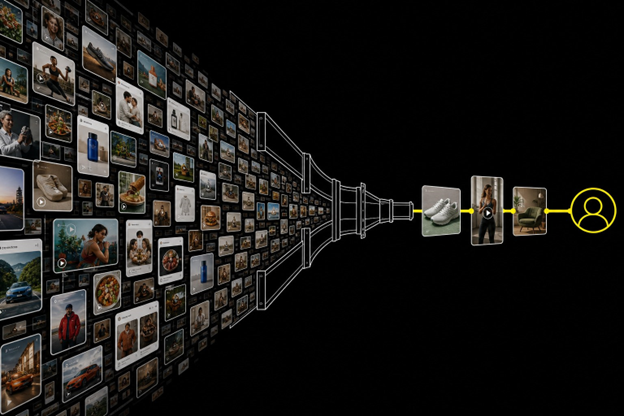
Andromeda, Meta's AI delivery and retrieval engine, reads the actual content of an ad, its visuals, audio, and copy, to match it to a user's intent state. This replaced the old audience-first targeting model, and it completed its global rollout by October 2025. That single shift is why so much legacy split testing produces noisy, unreliable results now.
Isolated Variables Don't Survive Creative Fatigue Anymore
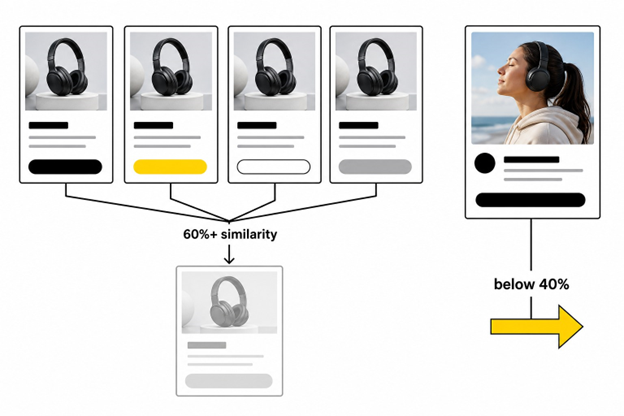
The classic "Pilot Test," isolating one variable at a time, is dead. Andromeda identifies small tweaks like a font size change, a button color swap, or a single headline edit as redundant content, folding near-duplicate ads into the same Entity ID. Creative Similarity Scores above 60% trigger retrieval suppression, so the system starts treating multiple ads as one entity and starving them of delivery. The safe zone sits below 40%. Meanwhile, fatigue windows have compressed from 6+ weeks down to 2-3 weeks, based on a study spanning 3,014 advertisers across 73 countries and 115.7 billion impressions (ChatterBuzz Media). Tweaking a winning ad slightly and hoping it holds is arguably the worst creative strategy available today, because it never answers why the original worked in the first place. Andromeda was built specifically to shut down the flood of "AI slop," the millions of barely-different variations that clogged Meta's infrastructure, forcing advertisers to submit one strong, distinct concept instead of a hundred cosmetic clones.
Creative Is the New Targeting Lever
With detailed targeting exclusions removed from ad sets in March 2025 and from boosted posts in June 2025, Meta's own testing showed a 22.6% lower median cost per conversion once exclusions were dropped (Wicked Reports). Manual audience stacking has lost its pull. Creative content is now the primary signal the algorithm uses to decide which user state an ad belongs to, a point Pilothouse strategist Abby Kohler, Strategist at Pilothouse, raised on the podcast episode 587: Meta Andromeda Strategy: 5 Creative Testing Shifts for $5M+ DTC Brands. Meta ad testing has effectively become audience testing in disguise.
Idea Variety vs. Design Variety: Rethinking What You Test
Most brands still running a facebook ads test are optimizing the wrong axis. Swapping a background color or trying a new colorway is design variety, and it produces creative that Andromeda reads as duplicates. Idea variety means testing distinct answers to distinct questions a customer is silently asking. A test built on genuine idea variety generates a learning that holds up in front of leadership. A test built on design variety just burns budget confirming what the algorithm already flagged as redundant.
Testing Answers to Psychological Friction, Not Colorways
Every underperforming ad set usually traces back to unresolved friction, not weak design. A customer unsure about durability needs a different message than one unsure about price. This is where Pilothouse's proprietary P.D.A. framework becomes the organizing logic for a testing plan. Persona, Diversity, Angle: define the persona, build genuine creative diversity around it, and vary the angle to hit different psychological objections rather than different filters.
Building Intent Buckets Around Customer Anxieties
Before any meta ads test goes live, the objections need to be mapped. An intent bucket is a specific worry or hesitation, something like "this product looks too complicated to use," pulled directly from customer language, reviews, or support tickets. Each bucket becomes a target for a creative answer grounded in an actual objection, rather than a shot in the dark.
Turning Objections Into a Library of Creative Answers
Once objections are cataloged, each one gets matched to a creative concept built to resolve it directly. Over time this becomes a reusable library. A complexity objection gets a demo-style answer. A price objection gets a value-comparison answer. A trust objection gets a UGC testimonial answer. This is the same logic Pilothouse applied in its work with VSSL, where creative built around specific customer hesitations replaced generic product messaging, and with The Rag Company, where addressing category-specific skepticism shaped the testing roadmap. The intent bucket library feeds the next stage, since every winning batch should trace back to a specific anxiety it was built to answer.
The Winning Batch Strategy: One Concept, Five Distinct Formats
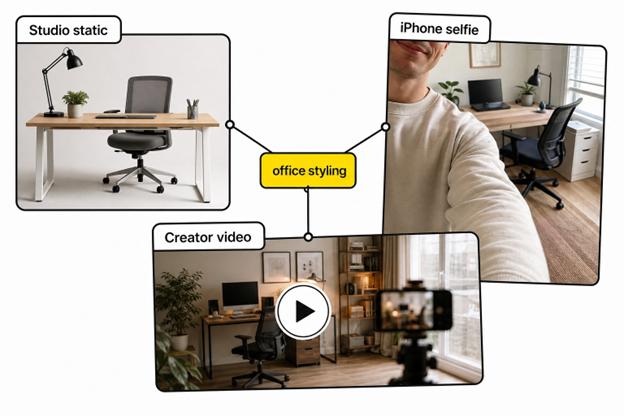
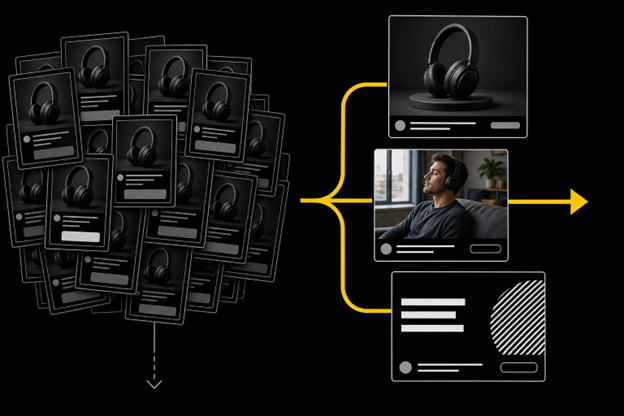
Once an intent bucket has a concept assigned to it, that concept needs to be expressed across genuinely different executions rather than resized versions of the same asset. The winning batch strategy calls for one core concept, "office styling," for example, built out across five formats that look nothing alike to a casual scroll.
Studio Static, iPhone Selfie, and Creator Video Examples
A single concept might show up as a polished studio static shot, a casual iPhone selfie-style photo, or a creator video shot in a completely different setting. Each format hits a different scroll pattern and a different trust signal, while still answering the same underlying objection. Idea variety and format variety work together here instead of substituting for each other.
The Squint Test for Visual Distinction
Before launching a batch, it's worth pulling up the ad library and squinting at the set. If two ads blur together into the same shape, color palette, or composition, Andromeda likely reads them the same way too. Every ad in a batch should be visually distinct enough to survive that squint test, since that's a rough proxy for the Creative Similarity Score sitting below the 40% threshold. The practical build target: 8-12 conceptually distinct concepts per campaign, with 2-3 variations each, keeps the account comfortably under that ceiling (ChatterBuzz Media).
The Testing Sandbox Campaign Structure
Structure determines whether Andromeda has enough signal to actually learn from a test. Meta's system needs volume, and consolidation is what supplies it, not fragmentation.
Scaling Campaign vs. Consolidated Testing Campaign
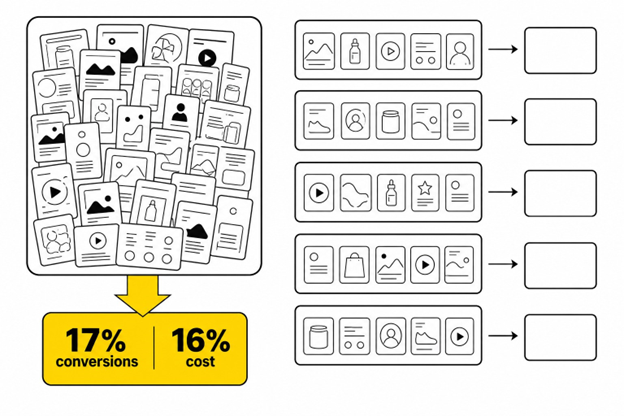
A lean structure typically runs one Scaling campaign under CBO and one Testing campaign, rather than dozens of narrow ad sets, an approach Pilothouse's Jacob Geary, Head of Socials, discussed on Ep 591: Meta Andromeda Updates: CASC + AI Assistant + Creative Testing. The data backs this up: consolidating into a small number of broad ad sets, each holding a large pool of diverse creatives, gives Andromeda enough volume to identify winners reliably. One documented comparison found a single ad set with 25 diverse creatives outperformed five separate ad sets of five creatives each by 17% on conversions and 16% on cost, per Logical Position's 2026 paid social playbook. The sandbox itself typically gets a modest share of total budget, enough to generate signal without starving the scaling side.
Using Meta's Ad-Level Creative Testing Feature
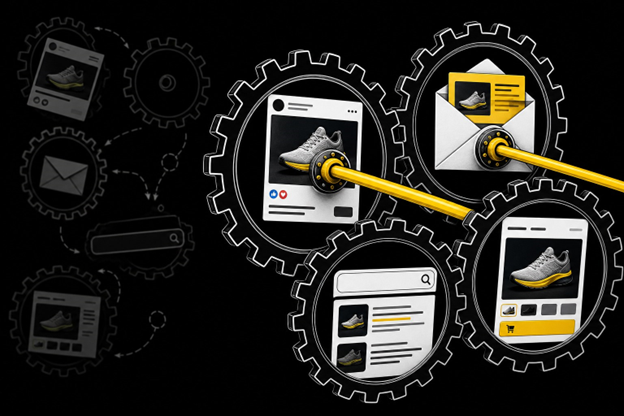
Meta's native Creative Testing tool tests up to seven versions of an ad, whether that's different hooks, headlines, or copy, within a single ad unit, splitting the audience across variants so each user only sees one version (Meta Business Help Center). Losing versions can be paused without resetting the social proof, likes and comments, on the winning Post ID, which stays intact for scaling. One important caveat: existing live ads can't be tested directly, they need to be duplicated first. The sandbox structure also supports full-funnel testing by holding creative identical across five ads while only swapping the destination URL: homepage, product page, or collection page. That way funnel performance gets isolated from creative performance, and each variable gets judged on its own.
Measuring Winners Beyond ROAS
A test can be statistically valid and still be operationally worthless once margin gets factored in. That gap gets lost when ROAS is the only scoreboard anyone checks.
Why ROAS Is a Lagging Indicator
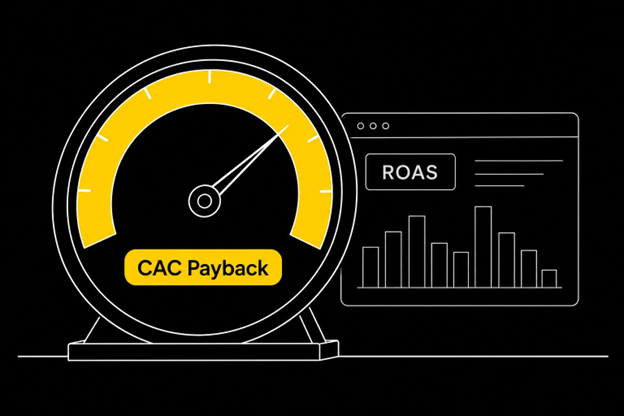
Platform-reported ROAS regularly runs 20-40% higher than reality, with mobile-heavy businesses seeing attribution loss in the 20-30% range (Traffiy). An analysis of 792 marketing mix models found true incremental ROAS lands around 1.90x for prospecting and 3.64x for retargeting, against Meta-reported figures near 8x (Measured). Reporting a "winner" to leadership based on platform ROAS alone means reporting a number that falls apart the moment finance asks a follow-up question.
Using Multi-Touch Attribution to Validate Awareness Ads
Multi-touch attribution and incrementality testing answer the question leadership actually cares about: how much revenue would actually disappear if Facebook ads were turned off entirely. That question matters most for awareness-stage creative, which platform ROAS almost always undervalues. A test winner should run long enough to reach a stable read before it goes into a leadership deck, generally through at least one full fatigue cycle under the new 2-3 week window, and it should be validated against contribution margin rather than spend efficiency alone before scaling budget behind it.
Velocity Isn't Strategy: Quality Over AI Slop
Publishing volume for its own sake is a margin problem disguised as a testing strategy. Pumping out dozens of low-effort variations without a messaging hierarchy doesn't just waste production hours, it triggers the fatigue and suppression mechanics Andromeda was built to enforce, a point Pilothouse's Abby and Taylor made on Ep 611: Velocity Isn't Strategy – Pilothouse on the Andromeda Creative Trap. Consumers notice too: the most common behavior consumers want brands to stop doing is posting AI-generated content without clearly labeling it, per a Sprout Social survey. Quality concepts built around real intent buckets will consistently outperform quantity built around none.
Partner With Pilothouse Digital to Build a Winning Testing Framework
Facebook ads split testing that actually holds up under Andromeda needs to run as a system every time, not something people remember to do occasionally. Pilothouse Digital built its testing approach around how Meta's AI actually reads and rewards creative today, not how it worked two years ago: the P.D.A. framework, the five-format winning batch, the sandbox structure. With more than 160 specialists producing over 5,000 creative assets monthly and $1B+ in attributable client revenue, Pilothouse ties every test back to contribution margin and P&L impact rather than platform-reported ROAS alone, so results hold up in front of leadership.
Get Started
Brands at the $10M+ inflection point looking to replace ad-hoc facebook ads split testing with a defensible, repeatable system can connect with Pilothouse Digital to build one.