


Ecommerce Marketing Strategy: Building a Full-Funnel System That Compounds

Most $10M-$50M DTC brands don't have a demand problem. They have a systems problem. They're running dozens of smart tactics that never talk to each other, and the growth curve flattens even as the team works harder. A real ecommerce marketing strategy treats channels as one connected engine instead of a pile of isolated levers.

Escaping the Tactical Spin Cycle in Ecommerce Marketing
Growth stalls when tactics never get built into a system in the first place. Industry data shows most DTC brands hit the wall somewhere between $5M and $15M in revenue (GTM 8020). That's the point where activity-driven growth stops working and structural decisions start to matter more than daily optimizations.
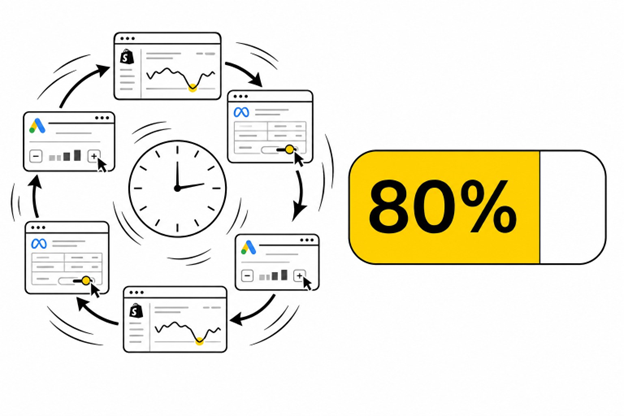
What the Tactical Spin Cycle Looks Like
Dave Steele, CEO and co-founder of Pilothouse, and Duncan Ferguson, Senior Strategist, describe the tactical spin cycle as a positive feedback loop built around short-term outcomes. Every reactive tweak "squeezes the rag" a little harder, degrading efficiency and eating into the time needed for real strategic work (Ep 561). Marketers stuck in this loop can spend 14 to 16 hours a day chasing minor Shopify, Meta, or Google adjustments in response to a revenue dip, never addressing the upstream cause. Here's a quick gut check: if more than 80% of a marketing team's time goes toward optimization rather than strategy, that team is trapped in tactical execution instead of running a real ecommerce marketing strategy.
Why Easy Mode Ended: From 2020 Tactics to Today's Hard Mode
Strategist Ben Thompson has described this shift as the move from "easy mode" to "hard mode" (Stratechery). During the 2020 ecommerce boom, brands with an unremarkable product and a Shopify store could still win, because demand outpaced supply. Steele and Ferguson point out that warehouse-photo ads and sticky-note creative performed fine because the market was forgiving (Ep 561: Unwinding the Tactical Spin Cycle: How Pilothouse Builds Strategy That Scales by DTC Podcast). That forgiveness is gone. US D2C ecommerce reached roughly $240B in 2025 but has stalled at about 19% of total US ecommerce, a share EMARKETER expects to stay flat through 2028 (EMARKETER). Inside that plateau, the mix keeps shifting toward incumbents: digitally native brands now account for less than 20% of D2C sales, with established brands taking the rest (EMARKETER). The pie has stopped growing while the biggest players keep eating more of it. Under hard mode, optimization alone can't fix a mediocre product or a weak structural position; brands need a defensible competitive advantage built into the system itself.
Building a Real Ecommerce Marketing Strategy Using the Strategy Kernel
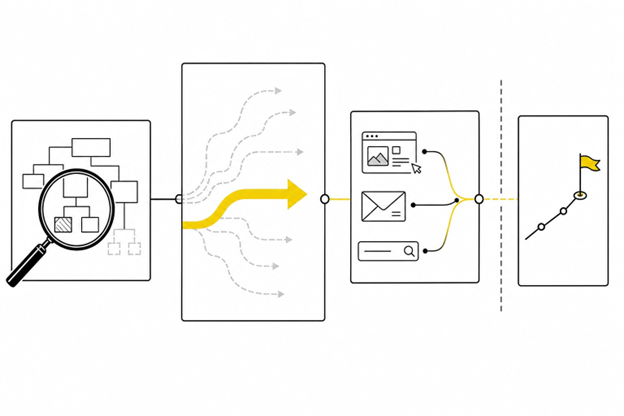
An ecommerce marketing strategy that actually holds up under pressure needs a backbone. Richard Rumelt's strategy kernel, from Good Strategy Bad Strategy, gives brands that backbone: a diagnosis, a guiding policy, and coherent action (Alex Murrell). In plain terms: name the real problem, decide how you'll win despite it, then align every channel investment behind that decision.
Diagnosis: Identifying Your True Structural Challenge
Diagnosis is about naming the single core challenge blocking growth rather than the symptom sitting on top of it. Rumelt's research finds the most common cause of bad strategy is a weak diagnosis, with confusing goals for strategy a close second (Lenny's Newsletter). Nvidia's 1995 diagnosis was blunt: the company was losing the performance race. In ecommerce, Abby and Henry, Pilothouse Account Strategists, see the same failure to diagnose play out differently: leaning on historical ad account data during a decline often produces obsession over minor details, like an ad's color, rather than asking how the product is actually being introduced to the market (Ep 546: How Pilothouse’s Strategy Team Transformed Ad Accounts & Grew Audiences). A channel-agnostic diagnosis, grounded in unit economics before any tactic gets touched, is what separates a real ecommerce marketing strategy from a list of channel fixes.
Guiding Policies: Your Structural Competitive Advantage
The guiding policy is the "how we win" statement, the structural advantage a brand commits to building rather than borrowing. From that diagnosis, Nvidia's guiding policy followed directly: release a chip three times faster than the industry norm, and everything downstream followed from that single commitment (Perdoo).
Coherent Actions: Aligning Every Channel Investment
Coherent actions are the specific moves that bring the guiding policy to life, and every channel investment should trace back to it. Nvidia backed its guiding policy with three overlapping development teams, heavy investment in simulation and emulation, and reclaiming driver development in-house. In an ecommerce marketing strategy, this looks like aligning Meta, Google, Amazon, email, and creative production around one shared objective instead of letting each channel optimize for its own local metric. That absence of direction is one of the four hallmarks of bad strategy Rumelt identifies, along with fluff and mistaking goals for strategy.
Why a Strategy Is Not a Goal
Rumelt's kernel has three parts. Pilothouse works with four: the same diagnosis, guiding policy, and coherent action, plus the goal itself, because the "how" changes dramatically depending on whether a brand is targeting 20% growth or 100% growth. Steele and Ferguson are direct on this point: retention increases, LTV growth, a 20% CPA cut, or hitting $50M ARR are all outcomes, and none of them is a strategy (Ep 561). Without a clear diagnosis behind them, goals become, in Rumelt's words, all results and no action.
Thinking in Systems: Evaluating Channels as an Interconnected Whole
Marketing complexity can't be managed by optimizing parts in isolation; it requires looking at the relationships between channels as a whole. Steele has been blunt about this: true efficiency comes from how well the entire system moves someone from a stranger who's never heard of the brand to a loyal repeat buyer, and cheap acquisition on one channel doesn't tell you much on its own (Ep 502: DTC Survival Guide: Marketing Efficiency). That system-level lens is what separates a strong ecommerce digital strategy from a scattered set of channel wins that don't add up.
Why Meta ROAS Can Look Low in a Compounding System
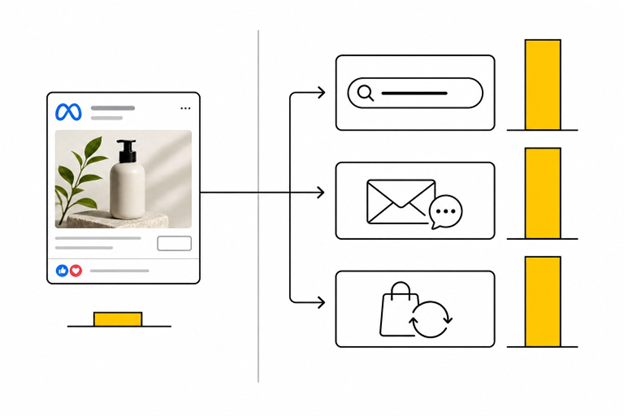
Meta ROAS on its own can overstate or understate reality depending on how it's read. Meta overstates ROAS by roughly 28% on average, and blended platform inflation across channels can run 30% to 40% higher than actual incremental impact (Mako Metrics). In a properly built system, on-platform ROAS may look intentionally lower, because paid media isn't there to close every sale directly. Its job is to build attention and hand prospects off to owned channels for nurture and eventual conversion. Abby and Henry warn against the classic silo mistake: cutting Meta spend because Google Search shows a higher immediate ROAS, without recognizing Meta is what drove the branded search and email revenue in the first place (Ep 546). A healthier reference point is marketing efficiency ratio, total revenue divided by total spend, which typically sits between 3.0 and 5.0 depending on category margin (Eightx).
How Owned Channels Capture Value Paid Media Creates
Paid media builds a persistent, resilient baseline of repeat customers who don't require continuous ad spend to keep buying. Pilothouse's VSSL case study shows this compounding effect directly: revenue kept scaling without a matching jump in spend, because owned channels captured more of the value paid media had already created. The size of that opportunity is measurable. A healthy Shopify store with the four core Klaviyo flows and a weekly campaign cadence generates 25 to 35% of total revenue from email, while stores running only a welcome and cart abandonment flow typically sit at 12 to 18%. Adding browse abandonment and a post-purchase sequence lifts that share to around 25% within 60 days without touching the campaign calendar (CorePPC). That gap shows how much value gets stranded when owned channels are underbuilt.
Creative as the Targeting Mechanism Under Open Algorithms
As platforms move toward open, AI-driven targeting, creative has become the primary lever for reaching the right audience. Ad settings barely move the needle by comparison.
Speaking to the Psychographic 'Why' Behind Purchases
Meta's Andromeda update replaced interest-based segments with broad targeting, so creative is now the filter that tells the algorithm who to show an ad to. Sequence-learning models like GEM shift targeting from static demographics toward the psychographic "why" behind a purchase. Abby and Henry note that under open targeting, creative has to clearly communicate a persona's values, language, and emotional drivers, or it risks confusing the algorithm entirely (Ep 546). AI tools can now generate large volumes of generic ads in minutes, so genuine customer understanding, not volume, separates winning creative from noise.
Stocking the Pond With a Diverse Creative Range

Because creative fatigue hits faster under open algorithms, brands need a living pool of assets ready before demand peaks. Scrambling to produce new creative after a performance dip is already too late. That means a real mix, UGC, founder-led video, branded content, scrappy statics, tested continuously rather than refreshed on a fixed calendar. Disciplined creative testing shows what a well-built system can do: brands that adapt to Meta's Advantage+ creative approach have reported meaningful ROAS gains, and structured testing consistently improves click-through rates over time. Both came from building creative as a system, not producing one-off assets and hoping something sticks.
Post-Click Experience: Mapping Ad Angles to Landing Pages
Strong top-of-funnel creative gets undone fast if the landing page breaks the story it just told. The click and the conversion need to read as one continuous thought.
Matching Message Congruence From Click to Conversion
A useful diagnostic checks three variables, the angle, the avatar, and the awareness level, and looks at whether all three stay consistent from ad to landing page. If a brand shifts its target audience, say from an older retiree segment toward working mothers in their late thirties and early forties, the landing page has to shift with it, or the message breaks the moment someone clicks. Sub-two-second load times and a closed feedback loop between media and landing-page teams keep that congruence intact as campaigns scale.
Capturing Demand Beyond the In-Market Buyer
Demand capture can't stop at the shopper who's ready to buy today. The brands that compound are building relationships with people who are still months away from purchase.
The Role of Email and SMS in the Two-Year Value Stack
Repeat customers make up roughly 21% of a typical customer base but drive up to 44% of revenue (Gorgias), which is why lifecycle marketing matters as much as acquisition. Segmenting flows around engagement windows (30, 60, 90 days) rather than a fixed calendar lets email and SMS respond to actual behavior. Retention also feeds marketing efficiency ratio without adding spend, since it lets a brand pay more to acquire a customer it knows it can keep for years, not months.
Bridging Paid Search and Social With Mid-Funnel Education
Acquisition costs have climbed roughly 60% over five years (Invesp), and the entire content ecosystem keeps getting pricier to compete in, so leaning on demand capture alone gets harder every year. Separating branded from non-branded search reveals the true cost of acquisition, while mid-funnel education, content built around ingredients or problems rather than products, feeds future search demand and protects organic brand traffic. YouTube and other top-of-funnel exposure improve search efficiency downstream by moving prospects through awareness and consideration before they ever type a branded query.
Building Your Compounding Marketing System With Pilothouse
None of this works as a checklist. Diagnosis, guiding policy, creative, media, and lifecycle only compound when they're built as one system with a shared P&L objective, evaluated together rather than measured channel by channel against vanity metrics like raw ROAS or engagement.
How Pilothouse Connects the Channels
Pilothouse's account strategists exist specifically to bridge media planning and creative strategy, so an insight from Meta audience data gets applied to YouTube, Google, and email without delay (Ep 546). The Rag Company's work with Pilothouse shows this in practice, unifying acquisition and conversion rate optimization so paid traffic and post-click experience move together instead of competing for credit. Four Sigmatic's Amazon growth followed the same logic, using top-of-funnel discovery to feed bottom-of-funnel conversion on the same platform, folding Amazon into the same connected system instead of running it as a standalone marketplace channel.
See the Results
Brands that want to see this kind of integrated results can review Pilothouse's full case studies. Pilothouse's broader model, more than 160 specialists producing over 5,000 creative assets a month and more than $1B in attributable client revenue over seven years, is built to run exactly this kind of compounding ecommerce growth marketing system, backed by a full team working every channel in concert.
Frequently Asked Questions
What Is the Tactical Spin Cycle in Ecommerce Marketing?
It's the repetitive loop of chasing short-term tactical fixes, ad tweaks, minor budget shifts, one-off promotions, without a cohesive ecommerce marketing strategy behind them. For brands past the $10M mark, this cycle usually shows up as declining margin even as the team works harder, because no one has diagnosed the actual structural problem.
How Do You Know If Your Strategy Is Actually a Goal?
A goal is a measurable outcome, like a lower CPA or a higher LTV. A strategy is the specific "how" that gets a brand there, grounded in a real diagnosis and a guiding policy. If a strategy document reads like a list of targets with no explanation of how they'll be reached, it's a goal wearing a strategy's name.
Why Does Meta ROAS Look Different in a Full-Funnel System?
In a system built for compounding growth, Meta is often used to build awareness and feed owned channels rather than close every sale on-platform. That can make its standalone ROAS look lower even as it drives branded search, email revenue, and repeat purchases elsewhere, which is why scaling brands need to evaluate marketing efficiency across the whole system, not one channel's dashboard.

