


Campaign Budget Optimization on Meta: How to Structure Budgets That Scale
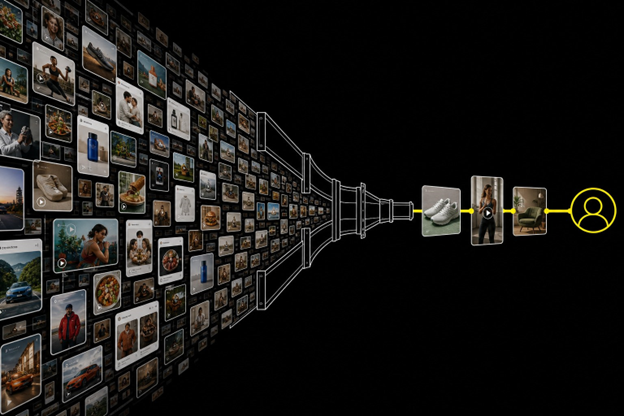
Brands scaling past six figures in monthly Meta spend often watch their carefully built account structures collapse into one or two ad sets within weeks. That's campaign budget optimization doing exactly what Andromeda and GEM were built to do: concentrate spend wherever the system finds the strongest signal, fast. Most media buyers still treat CBO like a "set it and forget it" budget tool. It's actually a matching engine that needs structure and oversight to work in a brand's favor.

Why Campaign Budget Optimization Is Meta's Matching Engine, Not Just a Budget Tool
Campaign Budget Optimization (CBO), now rebranded as Advantage+ Campaign Budget, is the same underlying mechanism under a new name. Advertisers set one budget at the campaign level, and Meta's algorithm distributes it across ad sets based on predicted results. That part hasn't changed, but the sophistication of distributing has gotten a lot smarter.
Andromeda-Powered Distribution Replaced a Simple Budget Feature
Andromeda, Meta's next-generation ads retrieval engine, runs on the NVIDIA Grace Hopper Superchip and Meta's own MTIA hardware, delivering roughly a 10,000x increase in model complexity at the retrieval stage, narrowing tens of millions of active ads down to a few thousand candidates for any given person (Meta Engineering). That's the infrastructure sitting behind every CBO campaign now, whether a brand knows it or not.
How GEM and Andromeda Read Creative to Find the Right Cohorts
Meta's Generative Ads Recommendation Model, GEM, is trained on ad content combined with ad and organic engagement data, weighing both a user's activity history and attributes like age, location, and creative format. It runs roughly four times more efficiently than the prior generation of models (Meta Engineering). Andromeda and GEM catalog every element of an ad, down to the copy and visual, and connect it to the person most likely to respond. That's why campaign-level consolidation now works better than the fragmented, audience-layered structures media buyers relied on for years.
The Consolidation Principle: Fewer Campaigns, Higher Budgets
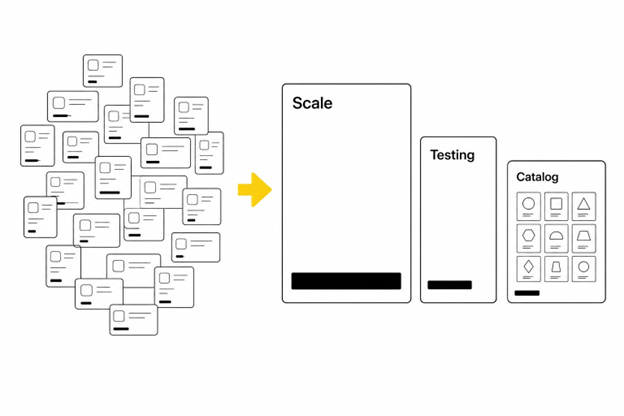
Fewer campaigns with higher budgets feed Andromeda more usable data per decision, which is the whole point behind consolidation. Jacob, Head of Meta at Pilothouse, has been direct about this: consolidating budgets into fewer campaigns lets Combined Awareness & Sales Campaigns, or CASC, optimize without the budget getting split across too many narrow segments (Ep 591: Meta Andromeda Updates: CASC + AI Assistant + Creative Testing). Splitting budget thin across a dozen testing campaigns doesn't give the algorithm enough volume in any single pocket to learn quickly, and it shows up as inconsistent CPAs that are hard to explain to finance.
Structuring Scale, Testing, and Catalog Campaigns
Taylor Cain, Technical Media Planner and Senior Strategist at Pilothouse frames the modern account-structure best practice around three buckets. There's a scale campaign carrying the bulk of proven budget, a dedicated testing campaign for new concepts, and a tactical catalog campaign for retargeting and dynamic product ads (Ep 611: Velocity Isn’t Strategy - Pilothouse on the Andromeda Creative Trap). Each campaign has a clear job, so the algorithm isn't asked to optimize toward conflicting goals inside the same budget pool.
Combining Awareness and Sales Campaigns for Algorithmic Wins
CASC lets awareness and conversion objectives sit inside a single optimized budget rather than fighting each other across separate campaigns. In practice, this means the algorithm can build recognition and drive purchases simultaneously, using the same consolidated signal instead of splintering it.
Protecting High-Value Audiences Inside Broad CBO Structures
Broad CBO structures are efficient, but efficiency without guardrails can quietly starve the audiences that matter most to the P&L.
Using Value Rules to Bid Up on Priority Personas
For larger brands, custom campaign structures using Value Rules let advertisers bid up on specific high-value personas, preventing the algorithm's default allocation from starving smaller but highly profitable segments, according to Jacob's insights from the Pilothouse Meta Brain Trust (Ep 611). Think of this as a contribution-margin decision rather than a ROAS vanity metric. A segment converting at a lower volume but a materially higher AOV or margin deserves protected bid priority, even if its raw click-through numbers look unremarkable next to broader cohorts.
Isolating Past Purchasers and Mid-Funnel Ad Sets
Abby Kohler, a Pilothouse Strategist, notes that properly segmenting and isolating past purchasers and mid-funnel ad sets matters a lot, because broad CBO-style campaigns will otherwise over-hammer already-engaged audiences instead of driving true prospecting (Ep 587: Meta Andromeda Strategy: 5 Creative Testing Shifts for $5M+ DTC Brands). Left unchecked, budget quietly drifts toward the cheapest, warmest conversions instead of new customer acquisition, which inflates blended CAC even as top-line ROAS looks healthy.
The 3x3 Framework: Mapping Angles Across the Funnel
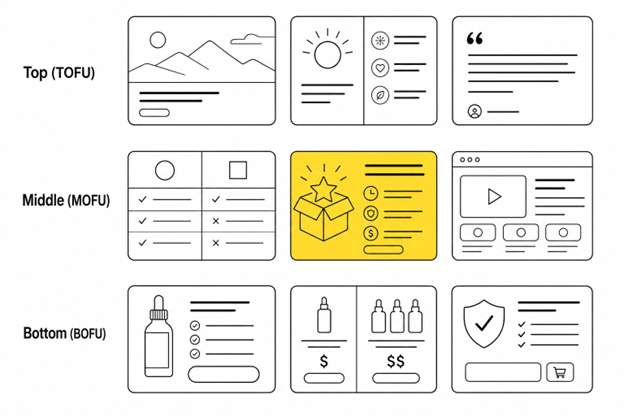
The 3x3 framework, one of Pilothouse's original structural models, exists specifically to stop CBO from starving key audiences or creative concepts. Jacob and Taylor describe it as mapping three distinct angle concepts across three funnel stages, with each stage getting three contrasting executions (Ep 554: Q4 Meta Strategy in the Andromeda Era).
Three Distinct Concepts Across Top, Middle, and Bottom Funnel
Funnel Stage
Concept Goal
Example Angle Type
Top (TOFU)
Broad problem awareness
Category education, brand story
Middle (MOFU)
Product differentiation
Comparison, social proof
Bottom (BOFU)
Purchase urgency
Offer, testimonial, objection handling
Genuinely distinct concepts at each level, rather than nine variations of one idea, give Andromeda enough contrast to route each concept to the cohort it's actually built for. Targeting different user states with entirely distinct concepts prevents the AI from bucketing similar creatives together, which otherwise triggers fatigue and drives up CPAs, as Abby points out (Ep 587).
Creative as the Targeting Layer
Under Andromeda, creative doesn't just accompany targeting anymore. It is the targeting layer, and that shift changes how media buyers need to think about their whole approach.
Why Idea Variety Beats Minor Design Iterations
Andromeda buckets similar creatives together, so minor variations like font swaps or border colors are largely redundant to the algorithm. Jacob and Taylor recommend feeding accounts 5 to 8 contrasting, net-new creative ideas to keep budgets spending healthily and prevent over-concentration on a single asset (Ep 554). This mechanic pays off directly: Meta's updated retrieval systems have driven up to a 30% year-over-year improvement in outbound CTR by matching diverse creative to the right user profiles, according to Pilothouse's own performance data, helping offset rising CPMs (Ep 567: Ecom CMOs: How Pilothouse Used Meta’s Update to Drive 30% Higher CTR with Fewer Campaign). Casting a wide net with open targeting is now the correct move, since the creative itself is doing the routing that manual audience parameters used to handle (Ep 587).
The First 3 Seconds: Winning the Visual Hook
Meta's own research with Nielsen found that up to 47% of a video campaign's value is delivered in the first three seconds, and up to 74% in the first ten (Meta for Business), underscoring how much weight the opening seconds carry in a video ad's performance. Testing genuinely different visual hooks and intros, rather than swapping color grading on the same hook, is the most effective way to prevent creative fatigue under CBO.
ABO Testing Graduates Into CBO Scaling
ABO and CBO serve different jobs. ABO is necessary for pointed creative tests requiring equal spend for an apples-to-apples read, while CBO/Advantage+ is better suited for finding a single winner as fast as possible. Launching multiple untested ads straight into CBO risks starving new concepts, sometimes down to a couple cents of daily spend, because the algorithm shifts budget quickly toward whatever shows the highest predicted action rate.
Sandbox Testing with Average Order Value as Your Budget Floor
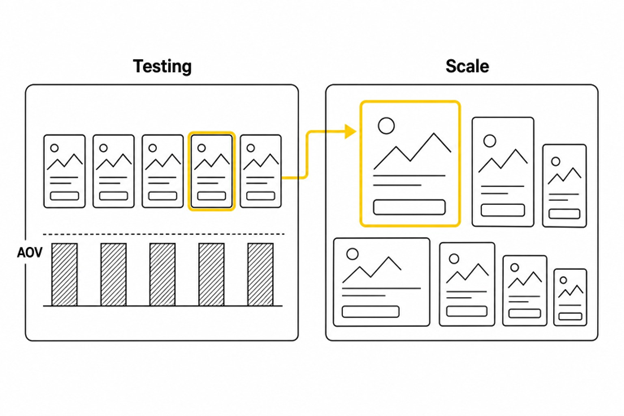
To prevent that starvation, Pilothouse's graduation system allocates a testing budget of at least the product's AOV to every single creative in ABO, giving each concept a fair shot before judgment. New concepts live in a focused, manual testing campaign representing only 5% to 10% of total budget; proven winners then graduate into the Advantage+/CBO scale campaign (Ep 520: How Pilothouse Tests 30+ Creatives Weekly on Meta: A Practical Guide). It's the same consolidation logic applied earlier at the account level, now applied at the creative level.
Avoiding the Warm Zone Trap with Buyer Exclusions
Over-relying on automated CBO delivery without manual guardrails risks trapping budget in a "warm zone" of retargeting. Top-of-funnel campaigns need strict exclusions of past purchasers to guarantee spend is actually driving net-new acquisition instead of recycling existing customers at a flattering CPA (Ep 567). Pilothouse's work with brands like VSSL reflects this same gradual, consolidation-first approach to scaling Meta budgets responsibly, as detailed in the VSSL case study, and similar structuring principles show up in The Rag Company case study.
Building a Living Creative Library That Answers Consumer Friction
Consolidated structures, the 3x3 framework, and disciplined ABO-to-CBO graduation all feed the same end goal: a living creative library that answers real consumer friction points as they surface, funnel stage by funnel stage. Consolidated campaign structures under Andromeda are more flexible than prior algorithm generations, letting secondary ads gain delivery and rise or fall in spend as new creative gets dynamically filtered in, according to Taylor Kain, Pilothouse's Ecom Strategist and Senior Media Buyer (Ep 567).
Dynamic Partnership Ads as an Extension of the Answer Engine
Partnership Ads have become highly dynamic in this environment. A single Dynamic Creator Partnership Ad can display one profile, both profiles, or let Meta optimize the display order based on user behavior with a given influencer, driving stronger down-funnel conversion, as Taylor Kain noted (Ep 567) That flexibility extends the same matching logic that governs CBO itself, letting the format adapt to whichever consumer question it happens to be answering in the moment.
Key Takeaways for Scaling Meta Budgets With Pilothouse Digital
What Changes When CBO Becomes a Matching Engine
CBO strategy in the Andromeda era rewards consolidation and creative volume over manual audience tinkering. Fewer, higher-budget campaigns feed Andromeda cleaner signal. Value Rules and audience isolation protect the high-margin personas broad automation tends to overlook. The 3x3 framework keeps creative concepts distinct enough to avoid algorithmic bucketing. A structured ABO-to-CBO graduation system, anchored to AOV as a testing floor, keeps new ideas from being starved before they get a fair read.
Why Structure Alone Isn't the Finish Line
None of these levers work in isolation. Budget structure only becomes defensible growth when it operates in sync with creative strategy and a clear view of the customer journey. That's precisely the system Pilothouse Digital builds for DTC brands scaling past the $10M inflection point.

