


Zero-Party Data: Collecting Customer Intent Brands Can Actually Use

Every DTC brand hits a wall around $3-5 million in revenue where the tactics that got them there stop delivering the same returns. Creative that once felt fresh starts blending into the feed, ad spend climbs while conversion rates flatten, and brands often respond by testing more colors, more hooks, more "vibes." Vibes are a guess, and guesses don't scale. A real zero-party data strategy replaces subjective creative decisions with defensible ones, built on structured, validated customer intent.

Zero-Party Data: Collecting Customer Intent Brands Can Actually Use
Every DTC brand hits a wall around $3-5 million in revenue where the tactics that got them there stop delivering the same returns. Creative that once felt fresh starts blending into the feed, ad spend climbs while conversion rates flatten, and brands often respond by testing more colors, more hooks, more "vibes." Vibes are a guess, and guesses don't scale. A real zero-party data strategy replaces subjective creative decisions with defensible ones, built on structured, validated customer intent.
Zero-party data is information a customer intentionally and proactively shares: preferences, purchase intentions, communication choices. Forrester Research coined the term to distinguish this volunteered data from the first-party data collection that happens passively through site behavior and purchase history. The distinction matters because zero-party data reflects explicit intent, not inferred behavior. For brands past the $10M mark, that explicit signal separates a creative strategy built on evidence from one built on internal opinion.
Why Aesthetic 'Vibes' Stop Working Past the $3-5M Plateau
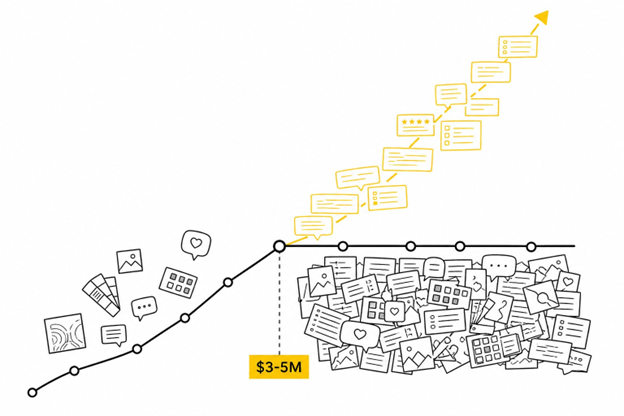
At lower revenue, a brand can often win on visual polish and a distinct point of view. That stops being enough once the audience matures and diversifies. Customers arriving at $10M+ scale bring a wider range of motivations, objections, and prior experiences with the category, and a single aesthetic can't speak to all of them. The brands that break through this plateau replace assumption-driven creative with a validated understanding of who's actually buying and why, then build systems around that understanding instead of refreshing the same visual language indefinitely.
Step One: Audit Your Assumptions With Post-Purchase Surveys and Reviews
Before any creative or media strategy can be rebuilt, a brand needs to know whether its internal picture of the customer matches reality. Post-purchase surveys triggered at checkout, using tools like Fairing, Typeform, or Fillout, are the fastest way to gut-check that picture. The highest-value questions are simple: what almost stopped someone from buying, how they'd describe the product to a friend, what problem they were actually trying to solve. Answers to those questions routinely surface gaps between internal assumptions and lived customer reality.
Avery Valerio, Creative Strategist at Pilothouse Digital, notes that combing through market research, post-purchase surveys, and customer reviews is the necessary first step to gut-check target personas and determine whether a brand's understanding of its audience is accurate or "delusional" (Ep 575: The Angle Audit: How to Break Out of the $5M "Vibes Plateau"). Skip that foundational work, and the odds of scaling past a vibes-based plateau drop fast.
Mining Reddit and Forums for Unfiltered Customer Language
Surveys capture intentional feedback, but Amazon reviews, Trustpilot, and Reddit capture something surveys often miss: transformation language, objection language, unscripted moments of surprise, written in the customer's own informal phrasing. A brand doesn't need customers to sound polished; it needs their exact words. One clear example of this gap comes from Figgy, where survey data revealed customers referred to a core offering as "Expansion Packs," not the brand's internal label of "Add-Ons." That single mismatch in language had direct implications for every piece of copy built on the internal term.
Spotting Delusional Assumptions Before They Cost You Ad Spend
Assumption-based personas that never get revisited quietly drain budget at this stage. A brand might believe its buyer is motivated by convenience when review data shows the real driver is fear of making the wrong purchase. Every dollar spent on creative built around the wrong motivation reinforces a message nobody asked for. Validating personas against actual customer language determines whether ad spend compounds or leaks.
Private Search Queries: A Purer Proxy for Zero-Party Intent
Once assumptions are checked against surveys and reviews, the next layer of intent data comes from an unexpected place: private search history. Daniel Sendecki, VP of Brand and Performance at Pilothouse, describes Google search history as the world's largest and most honest consumer dataset, because it's explicit, private, and carries zero social pressure or posturing (Ep 581: Meta Ads Aren't About Targeting Anymore: How $5-50M Brands Win with Intent-Based Creative). Customers type what they actually want to know, not what they want others to think of them, which is exactly why this data works so well for creative strategy.
Why Search Behavior Beats Social Data for Honesty
Social platforms reward curated behavior. What someone likes or comments on is shaped by audience and image. Search queries carry no such performance layer; they're typed in private, for the searcher alone. That gap shows the raw question a prospect is actually trying to answer before they ever see an ad.
Using AI and LLMs to Cluster Queries by Psychological Intent
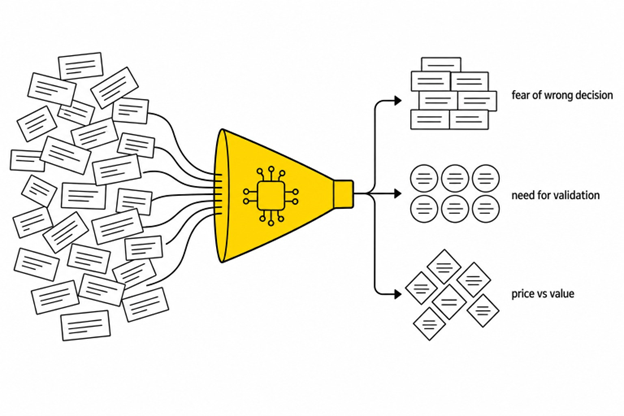
Raw search queries are messy and inconsistent in wording, which is where LLMs earn their place in the process. Using models like GPT-4o, a brand can prompt the system to identify the intent type behind a query, justify that classification, and generate an explicit intent statement, then cluster thousands of variously worded queries into semantically coherent groups. This moves analysis beyond keyword syntax and into the actual goal behind a search. Done well, it's a governed, repeatable lifecycle, not a one-off research exercise.
From Keyword Syntax to Underlying Fears and Value Justifications
The output of that clustering isn't a list of popular terms; it's a map of psychological drivers, things like fear of making the wrong decision, need for third-party validation, or justifying price against value. Sendecki frames this shift as moving creative strategy closer to resolution: instead of trying to convince someone of something, the brand simply answers the specific question that's already sitting in their head.
Building Persona-and-Angle Matrices From Clustered Intent
With psychological intent clusters mapped, brands can build what Valerio calls a persona-and-angle matrix: a structured pairing of product USPs against persona-specific "why buys," tested systematically instead of guessed at. This matrix becomes the backbone of a zero-party data strategy, since every creative angle traces back to a validated cluster of real customer language. Valerio also notes that the most narrowly targeted, specific audience connections, sitting at the bottom of the "upside-down triangle" framework, are better suited for owned channels like email retention or organic community-building than for top-of-funnel paid media, where broader angles perform better.
Turning Intent Clusters Into Creative Briefs and Recognition Hooks
Once intent clusters exist, they need to become briefs a creative team can actually execute against. Rather than a generic instruction to "highlight quality," a brief built from clustered intent might specify the exact objection a segment holds and the exact language they use to express it. Creative teams end up writing toward a resolution instead of selling a vague value proposition.
Feeding Meta's Andromeda Algorithm the Right Answer for Each User State
This matters more now because of how ad delivery itself has changed. Meta's Andromeda system, an AI retrieval engine introduced in December 2024 and powered by the NVIDIA GH200 Grace Hopper Superchip, narrows millions of candidate ads down to a few thousand using creative, behavioral, and contextual signals. It then aligns an ad's visual Entity ID to a user's psychological state. Sendecki compares the algorithm to a matchmaker: when a brand builds a library of creative answers to real consumer questions, Andromeda drops the right answer into a user's feed at the exact moment they're holding that specific concern. Targeting works through context now, not command, and creative diversity across distinct Entity IDs matters more than raw ad volume. Ten genuinely distinct concepts outperform fifty variations of one.
Recognition Hooks vs. Interruptive Hooks
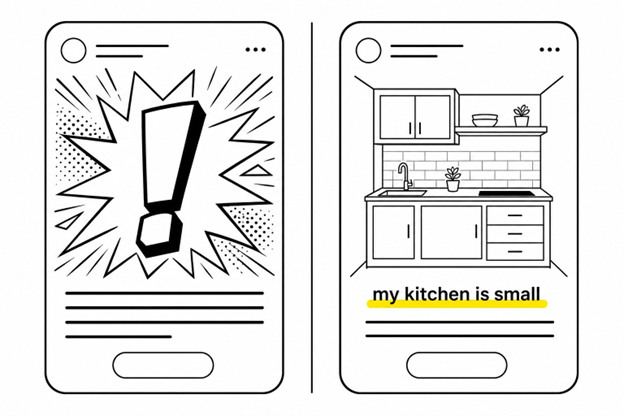
An interruptive hook tries to grab attention with something loud or unexpected, regardless of what the viewer is thinking about. A recognition hook does the opposite: it mirrors language pulled directly from survey, review, or search data, so the viewer feels like the ad read their mind. A common example is an objection tied to physical space, a shopper hesitating over a product because their kitchen is small, say. When creative addresses that exact concern in the customer's own words, it reads as recognition rather than interruption. It was built from what real customers already said, not from what the brand assumed they'd think.
The Retention Trap: Black-Box AI Segmentation and Shrinking Lists
The same AI that strengthens acquisition creative can quietly undermine retention if applied without scrutiny. Jordan Gordon, Head of Email & Customer Retention at Pilothouse, points out that email success depends on the intersection of inbox placement and message quality, but inbox placement ranks higher, since a message that never reaches the inbox can't generate any reaction at all (Ep 601: 25% of Your List Drives 75% of Revenue. The Dangers of AI Email Segmentation). Handing list segmentation over to black-box AI tools tends to shrink the list being messaged, because the AI over-optimizes toward only the most active addresses.
How Over-Targeting the Top 25% Chokes Inbox Placement
Gordon's data shows a core 25% of an on-site segment can drive 75% of revenue and half of all clicks, but abandoning the remaining 75% is a costly mistake. That broader group still shops across multi-touch journeys and responds to intent triggers like browse-abandonment flows. Some AI segmentation tools go further, unsuppressing previously suppressed addresses in search of "high potential" contacts. That practice feeds dead or spam-trap addresses back into active sends, which drags down deliverability across the entire program.
A Better Retention Model: One Clean Funnel at a Safe Send Size
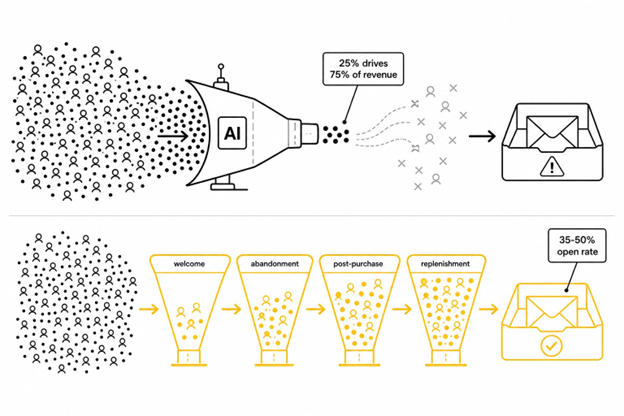
Gordon's recommended fix is a "safe send size." Start by rewarming with a very small, highly engaged segment (30-day clickers, or something like a 5,000-contact subset of a 150,000-person list), then expand gradually over the 30 to 60 days it typically takes to restore an account, holding campaign open rates at 35% as the absolute floor and aiming for 50% or higher as the operating range. One clean funnel supported by core automations, covering welcome, checkout abandonment, and post-purchase, consistently outperforms micro-segmented campaigns split by basic attributes like gender, which mostly create extra operational work without adding real value. Advanced scoring like Klaviyo's RFM model still has a place feeding specific flows and complex rules, but it runs alongside blanket campaigns, not instead of them: you still need blanket sends to maintain overall inbox placement, opens, and traffic.
Capturing Behavioral Signals With Non-AI Tools Like Sonar and Black Crow
Expanding the list without compromising deliverability requires better signal capture, not more segmentation. Sonar, from Triple Whale, enriches identity data through Triple ID resolution across devices and feeds that data into both Meta and Klaviyo, with Sonar Optimize supporting ads and Sonar Send powering abandonment flows across cart, browse, and checkout. Black Crow AI takes a similar approach on the identity side, using first-party data to recognize returning visitors and trigger abandonment flows, with its Smart ID setting privacy-safe, server-side identifiers that get around Safari's ITP restrictions and the standard seven-day cookie limit. These tools extend the reach of behavioral zero-party data collection without the black-box unpredictability that damages retention programs.
Building Your Zero-Party Data Strategy With Pilothouse Digital
Learning how to collect zero-party data is only half the equation. Using it to run acquisition and retention as one connected system is what actually moves contribution margin and LTV.
One Feedback Loop Across Strategy, Creative, and CRO
Pilothouse Digital handles strategy, acquisition, retention, creative, and CRO under one roof specifically to keep that feedback loop intact, so a psychological intent cluster discovered in search data can inform both a Meta creative brief and a Klaviyo flow without getting lost between teams.
Compounding Retention Programs Built on Deliverability
On the retention side, Pilothouse builds compounding email and SMS programs designed around healthy deliverability rather than aggressive micro-segmentation, treating welcome, abandonment, post-purchase, and replenishment flows as shoppable landing pages in their own right. That approach has supported growth for brands including Four Sigmatic, VSSL, and The Rag Company.
The Path Forward
Third-party data keeps getting less reliable, and stakeholders keep asking harder questions about marketing ROI. A validated zero-party data strategy explains why growth is actually working, not just optional infrastructure sitting on top of a media plan. Brands at the $10M inflection point need a system that turns real customer intent into decisions they can defend.

