How to Lower Customer Acquisition Cost Without Cutting Growth
Most conversations about how to lower customeracquisition cost start with the budget line, and that's the wrong place tobegin. Brands at the

50M stagerarely have a spending problem; the trouble sits in the system around thespend. Creative fails to answer buyer questions, pages lose paid traffic, andoffers lean on price. Measurement, meanwhile, can't survive a board meeting.
Pilothouse Digital is an integrated growthagency helping DTC eCommerce brands at the $10M+ inflection point scale withdefensible growth. This guide covers how to reduce customer acquisition cost byfixing that system.
Why Lowering Customer Acquisition Cost Should Not MeanCutting Growth
The healthiest way to lower customer acquisitioncosts is to convert more qualified prospects from the same investment. Trimmingspend or shrinking reach can make CAC look better while new-customer volume,and eventually revenue, quietly erodes.
A cheaper customer isn't automatically a moreprofitable one. Read efficiency alongside customer quality, LTV, andcontribution margin. Raising lifetime value through retention or higher revenueper customer also makes acquisition more sustainable, since the same CAC buysmore return.
For founders and marketing teams, the usefulquestion is how to acquire customers more efficiently and defend thatefficiency to a board. That means reaching the right people and improving theirpath to purchase, and it also means keeping enough investment in market tobring in new customers.
How to Measure CAC and Spot Where Spend Is Leaking
Reducing CAC starts with an honest number. Manybrands optimize against a figure that flatters them, then discover the gap inthe P&L. Every later fix depends on measurement.
CAC Formula, Blended vs. Paid CAC, and Channel-Level Tracking
The formula is total sales and marketing spenddivided by new customers acquired, with both aligned to the same period.Example, not data: $60,000 in spend over a month and 1,200 new customers givesa $50 CAC.
Include paid advertising, creative and contentproduction, agency and contractor fees, influencer and creator fees,acquisition software, and the proportional salary of dedicated acquisitionstaff. Exclude retention spending, fulfillment, and customer service. Scopematters: a $50 CAC on ad spend alone can become $90 once the broader costpicture is counted.
Three terms deserve clear separation. BlendedCAC divides all acquisition cost by all new customers across channels. Paid CACdivides paid media cost by the customers attributed to paid. New-customer CAClimits either measure to first-time buyers, so repeat purchasers don't dilutethe figure.
Blended numbers hide channel performance. In anexample, $30 CAC from organic search and $140 from paid social produce an $85blended average, which describes neither channel. Read blended andchannel-level views together.
Platform-reported CAC also diverges from P&Lreality as attribution degrades. Incrementality testing plus MER andcontribution-margin views give a figure a board can trust. Monitor CAC bycohort and campaign, and watch for cost shifts at scale and channel saturation.An attractive average can conceal expensive traffic or lower-value customers.
A compact diagnostic helps locate leaks:
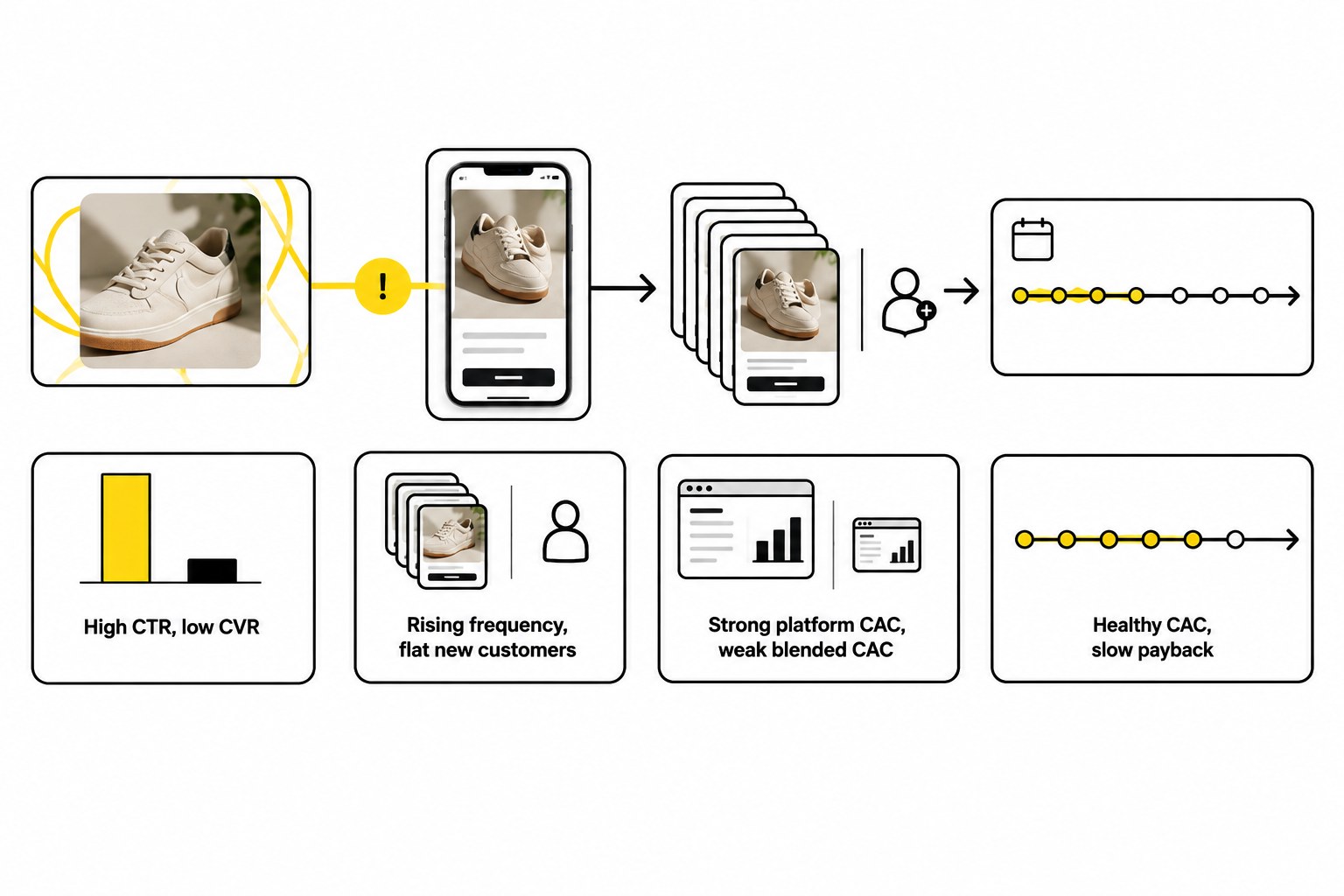
● High CTR with low CVR: landingpage or message mismatch.
● Rising frequency with flat newcustomers: creative fatigue or saturation.
● Strong platform CAC with weakblended CAC: attribution overlap or low incrementality.
● Healthy CAC with slow payback: lowAOV, thin margin, or weak second-purchase behavior.
What Is a Good CAC? LTV:CAC Ratio and Payback Benchmarks
There's no universal answer to what is a goodCAC. The cross-median CAC is $50.42 as of October 2026 (Polar Analytics), but treat that as contextrather than a goal. Benchmarks shift across CPG, beauty, apparel, home, andhealth & wellness, so a good CAC is one that LTV, margin, and payback cansupport.
Benchmark
Typical guidance
Caveat
LTV:CAC of 3:1
SaaS-derived
Not ecommerce-wide; varies by model
Payback under 12 months
SaaS-derived
Subscription brands may tolerate longer; one-time, low-AOV brands often need faster
Ecommerce average CAC of $41.83
April 2026 average
Context, not a goal
Subscription and repeat-heavy models can justifyhigher CAC. Brands selling one-time, low-AOV products face tighter paybackwindows. Companion metrics matter here: conversion rate, AOV, repeat purchaserate, new-customer share, and contribution margin (revenue less COGS, shipping,payment processing, and returns).
How to Lower Customer Acquisition Cost With Intent-BasedCreative
Creative is now one of the biggest levers forlowering customer acquisition cost. Relevance improves engagement andconversion without adding spend. Messages built around what prospects aretrying to accomplish reach more qualified people per dollar.
The action is to turn search queries, on-sitebehavior, and funnel patterns into distinct creative angles. Then judge thoseangles by qualified customer acquisition and downstream value, not clicksalone. Behavioral signals can inform both who sees a message and which messageserves them.
Why Creative Now Replaces Interest Targeting
On Ep 581: Meta Ads Aren't About Targeting Anymore,Pilothouse VP of Brand and Performance Daniel Sendecki explains that Meta'sAI-driven direction makes creative specificity matter more than interest-basedaudience selection. Advertisers provide signals, and the platform findsrelevant people.
That shifts creative from generic persuasion tointent resolution. Strong ads answer real questions: will this work, is it worththe price, will it solve the problem, is it right for this customer? Thosequestions cluster into themes such as value justification, fear of making thewrong choice, brand comparisons, lifestyle aspiration, identity, and emotionalfriction. Each cluster can shape a creative brief and map to a stage of thecustomer journey.
Sendecki also frames Meta as increasingly amatching engine that rewards specificity and intent alignment. That changesfunnel congruency: the post-click experience should continue the conversationthe ad started.
Mine Search Queries and Run Angle Audits to Break the $5MPlateau
Search queries are a direct record of howcustomers describe problems. Mining them, along with on-site search and supportquestions, surfaces recurring needs and objections that aesthetics alone neveraddress.
Ep 575, The Angle Audit: How to Break Out of the $5M"Vibes Plateau", is a useful prompt here. An Angle Auditinventories the distinct problem-solving angles a brand is running and findsthe gaps. Brands stuck on the plateau tend to rotate visual styles while sayingthe same thing. The fix is auditing which customer problems the current libraryactually answers.
Test Real Idea Variation and Recycle Winning Angles AcrossFormats
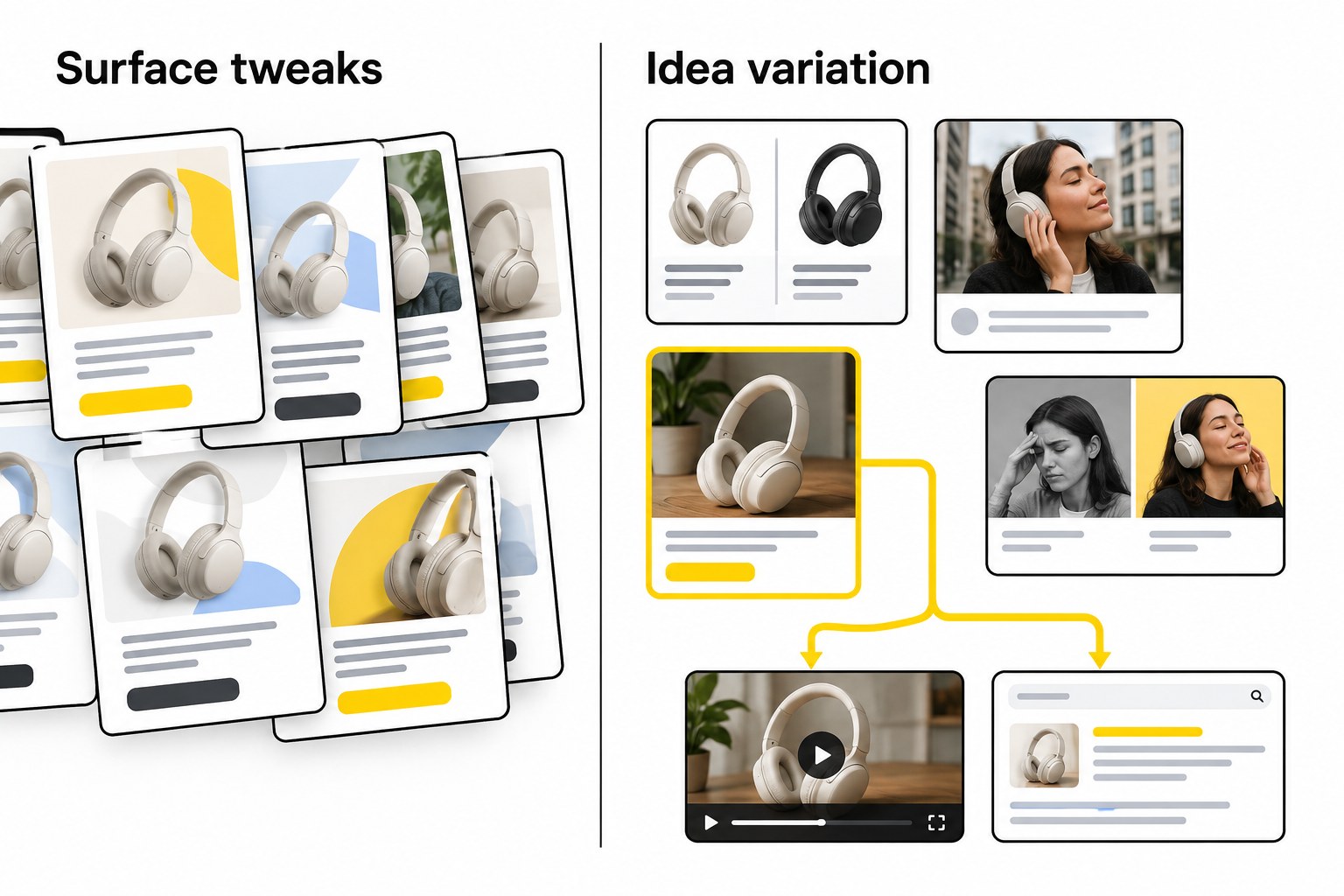
Idea Variation means testing different answersto different customer pain points. Only real differences in the idea count, andswapping buttons, colors, or hero images falls short. Sendecki describesbuilding a creative library of those answers. Surface tweaks produce noise,while distinct ideas give teams something to learn from.
Winning angles should then travel. Adapt themacross static, video, UGC, and search copy, keeping the core message intact andtailoring execution to each placement. Sendecki's stated bigger bet is thatpaid social and paid search converge around intent, and that creative librarieswill feed both.
Automation belongs here in concrete form:creative production systems that turn one proven angle into many formatsquickly, so testing volume can rise without the mess.
Fix Landing Pages and Post-Click Friction to Convert theTraffic You Pay For
Every visitor who leaves after a paid clickraises effective CAC. Improving a high-friction step produces more customersfrom existing traffic, which is the cleanest way to lower CAC without touchingreach.
Start by matching page messaging to the ad'spromise and intent, so visitors confirm within seconds that they landed in theright place. This is the congruency shift from Ep 581: the ad now does more ofthe targeting, so the page must carry that specificity forward.
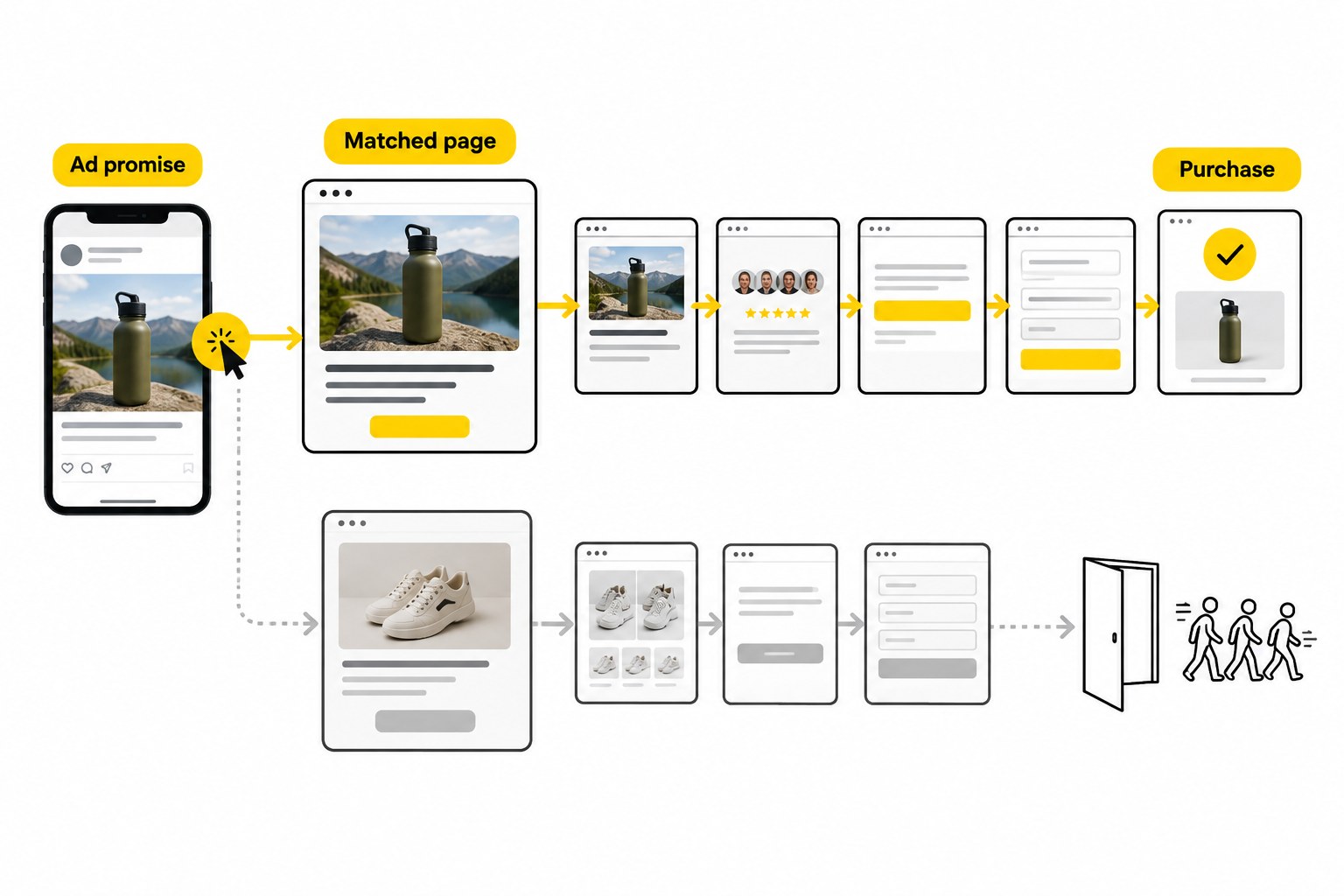
Then map the steps between arrival and purchaseand find where visitors leave. Mobile deserves particular attention, sincelimited space makes confusing layouts costlier. Speed up sign-up and checkout,and sharpen the value proposition. Testable variables include headlines, heroimages, social-proof placement, CTA copy, mobile checkout form fields, andpayment options. Measure against completed purchases, not clicks.
Landing pages should also earn their place. On Ep39: Bundles Aren't Discounts. They're Strategy., Pilothouse CreativeStrategist Aves Valerio points out that landing pages can unlock exclusivebundle offers, so they don't hurt conversion rates. Exclusivity beats redundantcontent.
Pilothouse has paired acquisition work with CROfor clients such as The Rag Company, and it has driven efficiencywithout added spend for VSSL. More examples are on the casestudies page.
Structure Offers and Bundles to Lower CAC WithoutMargin-Eroding Discounts
Offer design changes CAC because perceived valuedrives conversion. Improve the fit and value of an offer before relying on aprice cut. Relevant product combinations help prospects find an option thatmeets their need, without training the customer base to wait for discounts.
In Ep 39, Valerio treats bundles as a strategy,and discounting is only a side note. Top-of-funnel bundles often fail forfirst-time buyers, yet some cold traffic can respond to them, and customerbehavior can inform lifecycle bundles.
Test structures instead of defaulting to blanketdiscounting: free shipping, percentage-off, dollar-off thresholds, andbuy-now-pay-later. Evaluate each against conversion rate, AOV, and margin,because a higher conversion rate doesn't automatically mean more profitableacquisition. Count incentive costs in CAC and payback, and consider how thefirst offer shapes later purchases.
Retention closes the loop. About 27% ofcustomers return after a first purchase, and the likelihood of a third purchaserises to more than 54% after a second (MobiLoud). Lifecycle flows that lift repeatrate raise LTV and make every acquisition dollar work harder.
Balance the Channel Mix and Watch Frequency Benchmarks
Costs are rising. Median paid-ad CPA across53,000+ ecommerce brands climbed 5.1% to $23.20 between August 2025 and July2026 (Triple Whale), so channel efficiency matterseven more. Compare channels by new customers and customer quality alongsideacquisition cost, since traffic volume alone reveals little.
Pair demand creation with intent capture. Paidsocial is an interruption channel, where relevance comes from the message. Paidsearch reaches shoppers who have already expressed product intent. Togetherthey cover the journey, and Google's March 2025 analysis shows eight in 10online purchase journeys involve multiple touchpoints (Google). Reallocating budget on last-click resultsalone risks cutting the channels that create demand.
Monitor repeated exposure and conversionresponse by audience. When extra impressions stop producing proportionateresults, revisit the message, audience, or spend level. Diversify withlonger-term sources such as useful content, partnerships, and referrals, andinclude their real costs in comparisons. Shift investment toward strongeropportunities without removing the reach that sustains new-customer growth.
Lower CAC Without Slowing Growth
Pilothouse Digital helps DTC brands at the $10M+stage find where acquisition spend leaks across creative, landing pages,offers, and channel mix, then fix it without cutting reach. Start a diagnostic conversation.