Post-Purchase Upsells: Adding Revenue Without Adding CAC

Why a Post-Purchase Upsell Adds Revenue Without Adding CAC
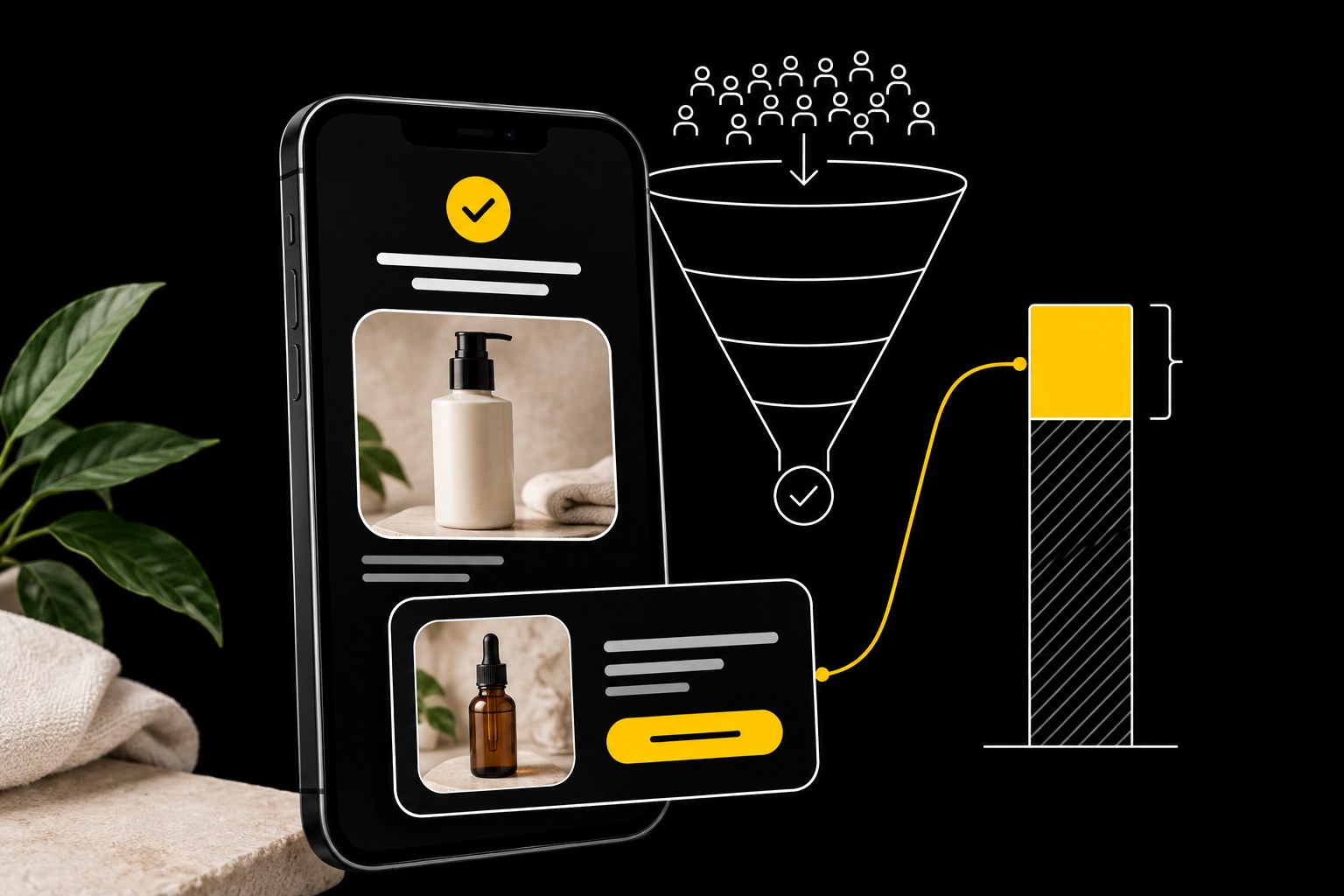
The original sale has already covered the cost of acquiring that customer. An accepted offer raises revenue per acquired customer without another campaign. Jordan Gordon, Head of Email, Retention, and CRO at Pilothouse, makes this case in Ep 583: Counter Intuitive Ways to Maximize Net Present Value from Your Email List. CAC-free post-purchase and retention revenue improves MER, which unlocks margin that teams can reinvest in top-of-funnel acquisition. Optimizing upsells alongside site conversion builds a repeatable engine that supports long-term NPV.
Joselyn Hyslip, Ecommerce Strategist at Pilothouse, calls automated upsell tools "free money" in Ep 563: 3 Moves to Win Black Friday While It's Happening (Pilothouse Playbook). Pilothouse Digital's framing is more careful. There's no acquisition cost, but product margin, incentives, fulfillment and returns still decide the outcome.
How a Post-Purchase Upsell Works After Checkout
Post-purchase begins once payment succeeds. In a typical post-purchase flow, the customer can add the offer to the confirmed order without starting a new checkout, though the buyer may be charged the price difference. Aves (Avery Valerio, Creative Strategist at Pilothouse) argues in Ep 39: Bundles Aren't Discounts. They're Strategy. that the first conversion should stay friction-free, with upsells and secondary offers placed in post-click and post-purchase stages.
Timing matters too. In Ep 43: Sell Like It's 1999: Infomercial Tactics That Still Work, Aves describes the "And wait, there's more" tactic as belonging at or right after the point of purchase. Unexpected value moments, such as post-purchase add-ons, can surprise customers and lift AOV.
Post-Purchase Upsell vs. Checkout Upsell vs. Cross-Sell
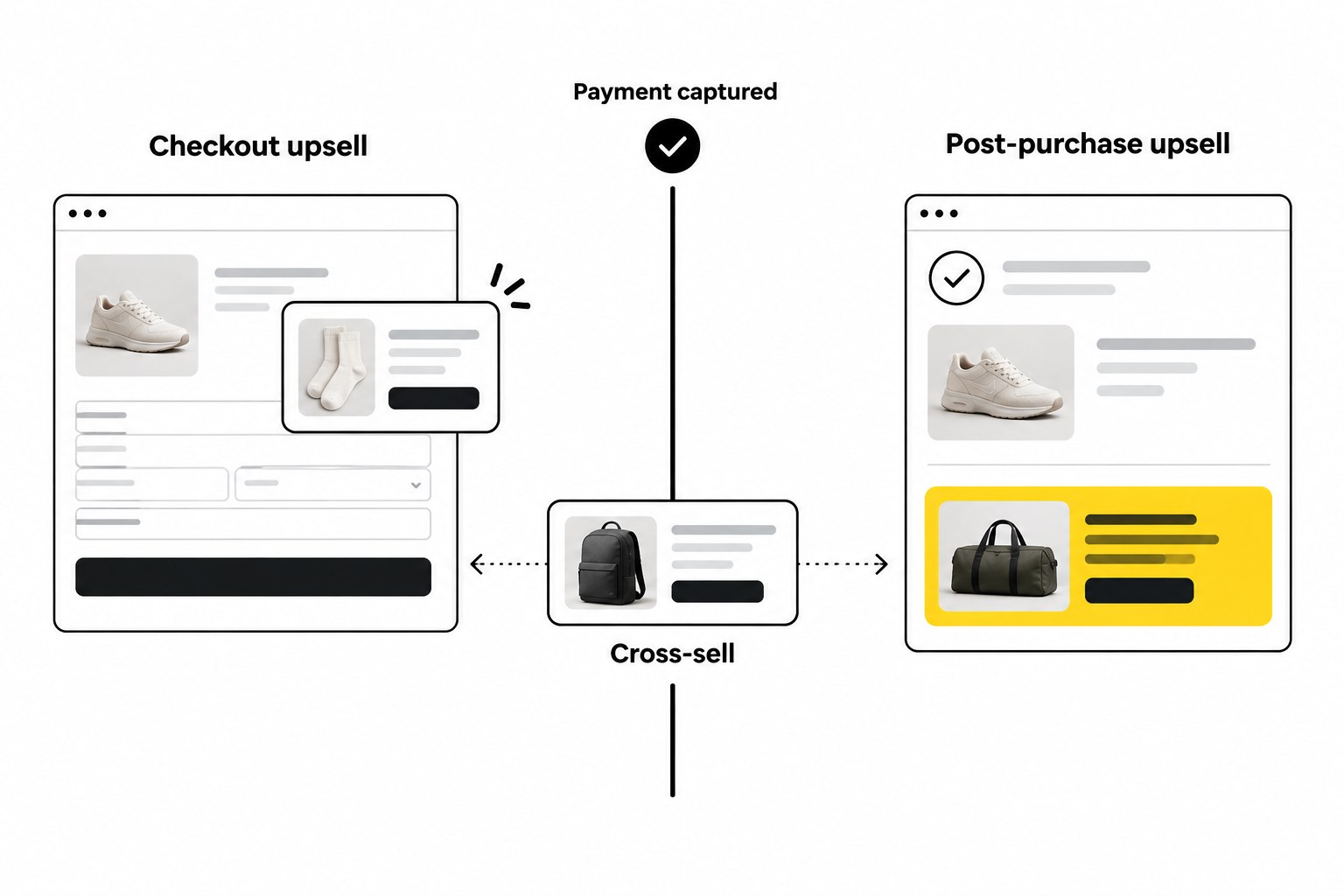
These three are distinguished here by placement only:
TimingRisk to conversion rateBest use casePost-purchase upsellAfter payment is capturedLow; the order is already confirmedAdd-ons and bundles tied to the first purchaseCheckout upsellBefore the purchase is completeHigher; adds a decision to checkoutSmall, obvious additions that suit the orderCross-sellPlacement variesDepends on placementComplementary items on the product page, cart or after payment
Timing and offer type are separate choices. Checkout upsells appear before the purchase completes, and post-purchase offers follow it. A cross-sell can land in either spot. Teams searching for a checkout upsell Shopify setup should test it against the post-purchase option, since the answer differs by brand.
Post-Purchase Upsell Offers That Convert
The strongest upsell offers connect directly to the first purchase. They help the customer use it or care for it. Convenience and relevance can persuade without a discount. When an incentive is needed, the offer must stay profitable, and repeated promotions shouldn't weaken perceived regular pricing. The offer should feel intentional, never like a way to move unrelated inventory.
Add-On and Complementary Product Offers
Modestly priced extras are easy to judge quickly. A beauty brand might offer a matching serum after a cleanser order, or a CPG brand a refill pack. The margin check is whether the add-on carries healthy product margin, since a small item can lose its contribution once shipping and fees are counted.
Exclusive Bundles, Upgrades, and Volume Offers
Aves notes in Ep 39 that post-purchase offers gain pull through exclusivity: add-ons, deeper discounts or bundles intentionally unavailable on public product pages. An apparel brand could offer an exclusive two-piece set, and a home brand a multi-unit pack. Discount depth is the margin risk. Volume and bundle pricing should still clear the contribution threshold, and any urgency claim must be genuine.
Purchase-Security Offers for Utility Products
This is Pilothouse's view. For functional, utility-driven categories, Aves suggests in Ep 39 that post-purchase add-ons should add purchase security rather than low-utility items. Extended warranties and essential spare parts are examples, and shipping protection fits too. They work best where the product is expected to perform over time or where loss and damage worry buyers.
The offer should state exactly what is covered, what it costs and any limitations. Language around warranties and protection plans should go through legal and consumer-terms review before launch; this is not legal advice. Margin depends on the plan's cost to administer and fulfill.
How to Choose Profitable Upsell Offers by Persona and First Purchase

Start with the item purchased, then use order data and commonly co-purchased products to find the likely next need. Aves stresses that offers should match the first-purchase category and persona: gifting buyers get personalization or gift-wrapping, while utility buyers get complementary parts, accessories or size variations.
First purchaseLikely needOffer typeMargin checkGift itemPersonal touchPersonalization or gift-wrappingAdded labor and materials costUtility productParts, accessories, sizingComplementary parts or size variationsFulfillment and return rateUtility product with durability concernsPurchase securityProtection or support planPlan cost and legal reviewRepeat-use consumableBetter value per unitVolume or bundle offerDiscount depth vs. contribution
Screen each candidate for clear usefulness, availability and brand fit, and check that it's simple to run operationally. Start with a limited number of purchase-to-offer paths so results trace to specific choices.
Consider an illustrative margin check with the assumptions stated. A brand shows a $25 offer to every eligible order and 10% accept. Revenue per order rises by $2.50. If product, shipping, fulfillment and fees consume $17 of each $25 sale, contribution rises by $0.80 per order. A 10% take rate looks healthy, yet the margin is thin. A good take rate can still hide an unprofitable offer.
Timing, Flow, and Design Tips for Higher Take Rates
Good design lowers doubt and keeps pressure off the buyer. These recommendations rest on reasoning, and no universal benchmark backs them.
Where the Offer Appears and How Many to Show
Show the offer promptly after successful payment, while the purchase is fresh, and make clear the original order is confirmed. Start with one highly relevant offer; a crowded selection is harder to assess and muddies attribution. Once that baseline is clear, test a second. Joselyn recommends in Ep 563 that teams A/B test post-checkout and checkout upsell placements, because the answer differs by brand.
Acceptance, Copy, and Mobile Experience
In a typical post-purchase flow, the customer can add the offer to the confirmed order without starting a new checkout. Make accepting and declining equally understandable: state the product, total added price, key terms and what happens to the order. Lead with the benefit of adding it to this purchase, using concise copy and clear imagery, with one obvious button. Design for mobile first. Text should be readable, controls sized for thumbs, and essential information visible without much scrolling.
How to Set Up a Post-Purchase Upsell on Shopify
Strategy comes first and the tool second. Merchants searching for post purchase upsell Shopify guidance, or an aftersell Shopify app, should settle offer logic before comparing software.
Choosing a Tool Like Rebuy and Defining Triggers
Choose a compatible tool. Check its post-purchase capabilities, trigger rules, integrations and reporting, and how well it fits the checkout configuration. Rebuy is one option; its post-checkout and in-cart widgets use AI to analyze behavior and intent segments and pair complementary SKUs, so recommendations aren't static.
Define a narrow first flow. Specify the qualifying purchase, the offer, eligibility and exclusions, pricing and inventory behavior, and what the customer sees after accepting or declining.
Align with thresholds. Joselyn advises that upsells align with free-shipping tiers or spend-and-save milestones, so accepting pushes the shopper over the threshold.
Testing the Flow and Knowing Technical Limits
Confirm order handling. Check how accepted items affect payment, taxes, shipping, confirmation messages and fulfillment.
Test the full experience. Run desktop and mobile with representative orders, including discounts, shipping methods and international purchases.
Verify limits in documentation. Confirm payment gateway and checkout constraints in current Shopify and Rebuy documentation, along with how subscriptions, discounts and order editing are handled. Eligibility can vary by order conditions, so no order should be assumed eligible.
A pre-launch QA checklist: mobile layout, discount stacking, shipping-cost handling, tracking and analytics, and whether support and fulfillment can recognize accepted offers without ambiguity.
How to Measure and Optimize Post-Purchase Upsell Performance
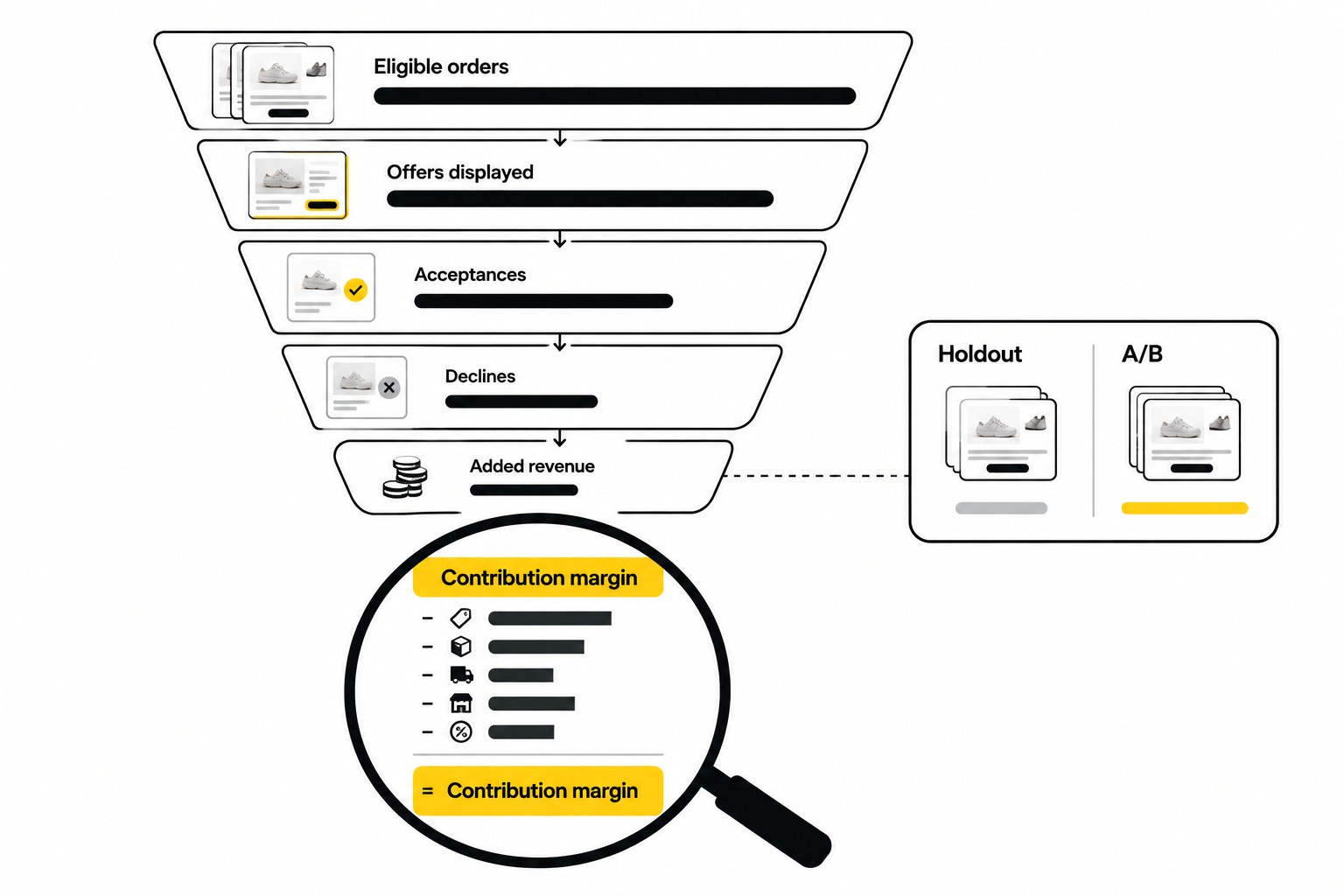
Track the full funnel: eligible orders, offers displayed, acceptances, declines and added revenue. Calculate take rate with displayed offers as the denominator, then look past it. Take rate misleads because a heavily discounted offer can convert well and still lose contribution margin.
Measure incremental AOV, revenue per visitor or order, refund and cancellation rate, and contribution margin per offer, after incentives, product cost, shipping, fulfillment, fees and support. Track repeat purchase and LTV impact too, so an offer doesn't create confusion or regret. Compare by first purchase, segment, device and offer type.
To prove incrementality, use a holdout group or A/B testing, changing one variable at a time. Test in this order: offer type, price point, discount depth, then placement. Joselyn shared a Pilothouse client anecdote in Ep 563: for a brand with a large catalog, integrating Rebuy widgets across PDPs, cart and post-checkout coincided with a 20% top-line lift within a week. That's a podcast anecdote and isn't audited data.
Next Steps: Launch Your First Post-Purchase Upsell with Pilothouse Digital
Pilothouse Digital is an integrated growth agency with 160+ specialists and $3B+ in attributable revenue, working with DTC brands at the $10M+ inflection point. Its approach is diagnostic-first, connecting creative, CRO and lifecycle around the customer journey so the program supports profitable growth beyond AOV.
Your Next Step
Brands ready to start can pick one consistently purchased product, set a contribution-margin threshold and launch a simple, tested flow. For a diagnostic conversation about AOV, contribution margin and customer-journey opportunities, connect with Pilothouse Digital.