


How to Scale Facebook Ads Without Tanking Efficiency
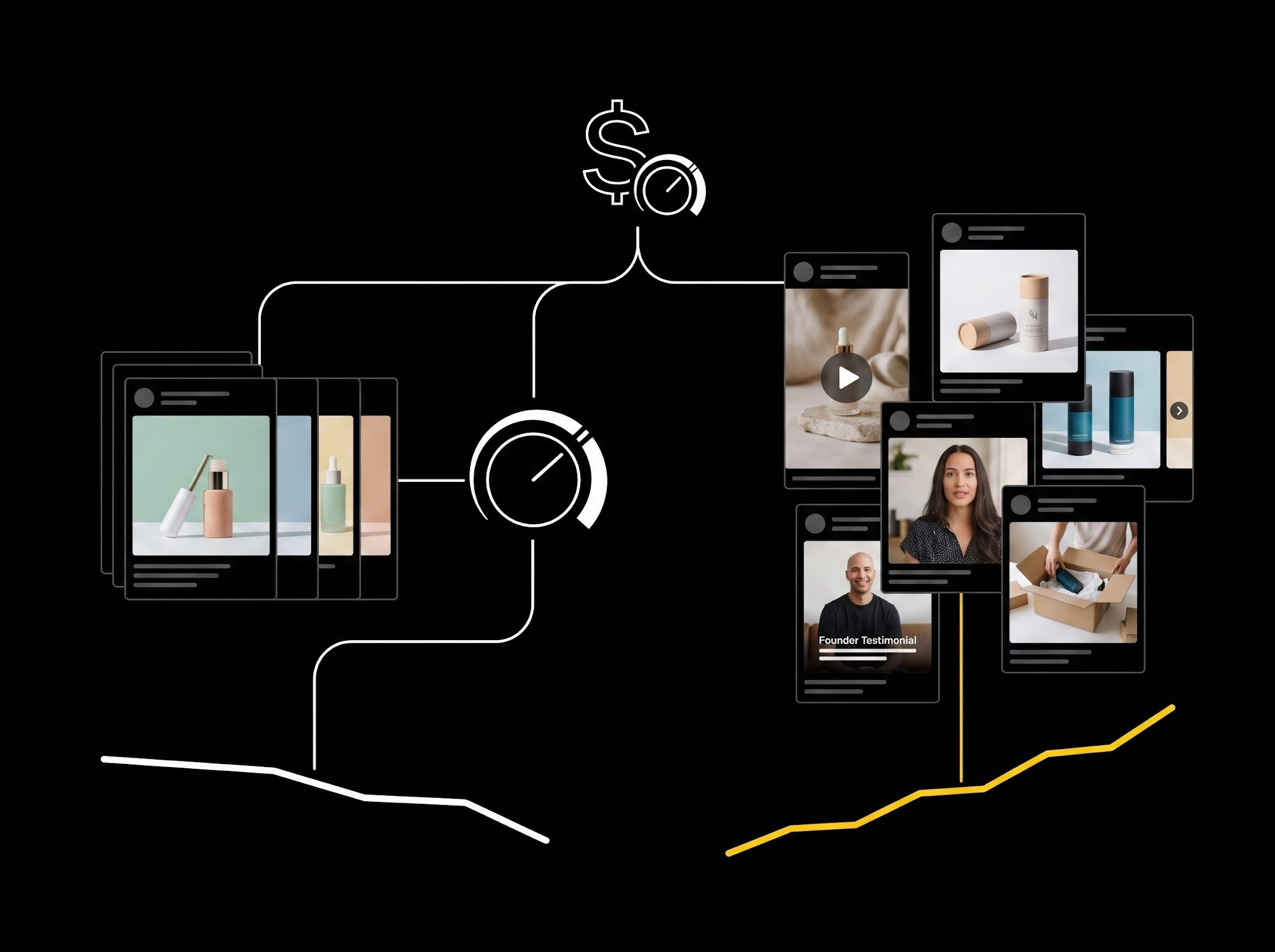
Every DTC brand hits a wall where spending more on Facebook ads stops producing more revenue. The instinct is to push budget harder, but that usually just accelerates fatigue. Learning how to scale Facebook ads today means understanding that Meta's algorithm has fundamentally changed how it rewards advertisers. Creative is now the lever that matters most, not budget.

Why Facebook Ads Scaling Fails in the Andromeda Era
Meta's Andromeda system runs on the NVIDIA Grace Hopper Superchip and enables a 10,000x increase in retrieval model capacity, with over 100x improvement in feature extraction latency and throughput compared to the CPU-based components it replaced (Meta Engineering). It works alongside GEM, Meta's generative foundation model. That shift changes what "scaling" actually requires.
Creative Is Now the Primary Targeting Lever
Manual audience targeting used to carry the weight of scaling an account. Andromeda changed that. As Daniel Sendecki, VP of Brand and Performance at Pilothouse, put it on Ep 581: Meta Ads Aren't About Targeting Anymore, winning brands "aren't out-designing or out-targeting anyone; they're out-resolving." Andromeda now reads creative signals to determine placement and audience fit, so the ad itself has become the targeting mechanism. Facebook ads strategies that ignore this shift keep optimizing the wrong variable.
The $3-5M Vibes Plateau: When Aesthetics Stop Converting
Pilothouse has watched a pattern repeat itself among brands crossing the $3 to $5 million mark: CAC climbs, attribution gets murky, and the creative looks polished but stops moving the needle. Avery Valerio (Aves), Creative Strategist at Pilothouse, calls this the "vibes plateau" on Ep 575: The Angle Audit: How to Break Out of the $5M "Vibes Plateau", where brands coast on aesthetic B-roll and brand-focused content without doing the strategic work to connect product to a real human need. Coordination between creative, media, and measurement tends to break down further as brands scale past $5 million and push toward $30 million and beyond, which is exactly where Facebook ads scaling efforts stall out.
The Real Bottleneck: Creative Diversity, Not Budget
Raising daily spend on a single ad set rarely fixes a plateau. What actually limits growth is how many genuinely different ideas a brand feeds the algorithm, no matter how much budget sits behind them.
Why the Algorithm Buckets Similar Ads Together
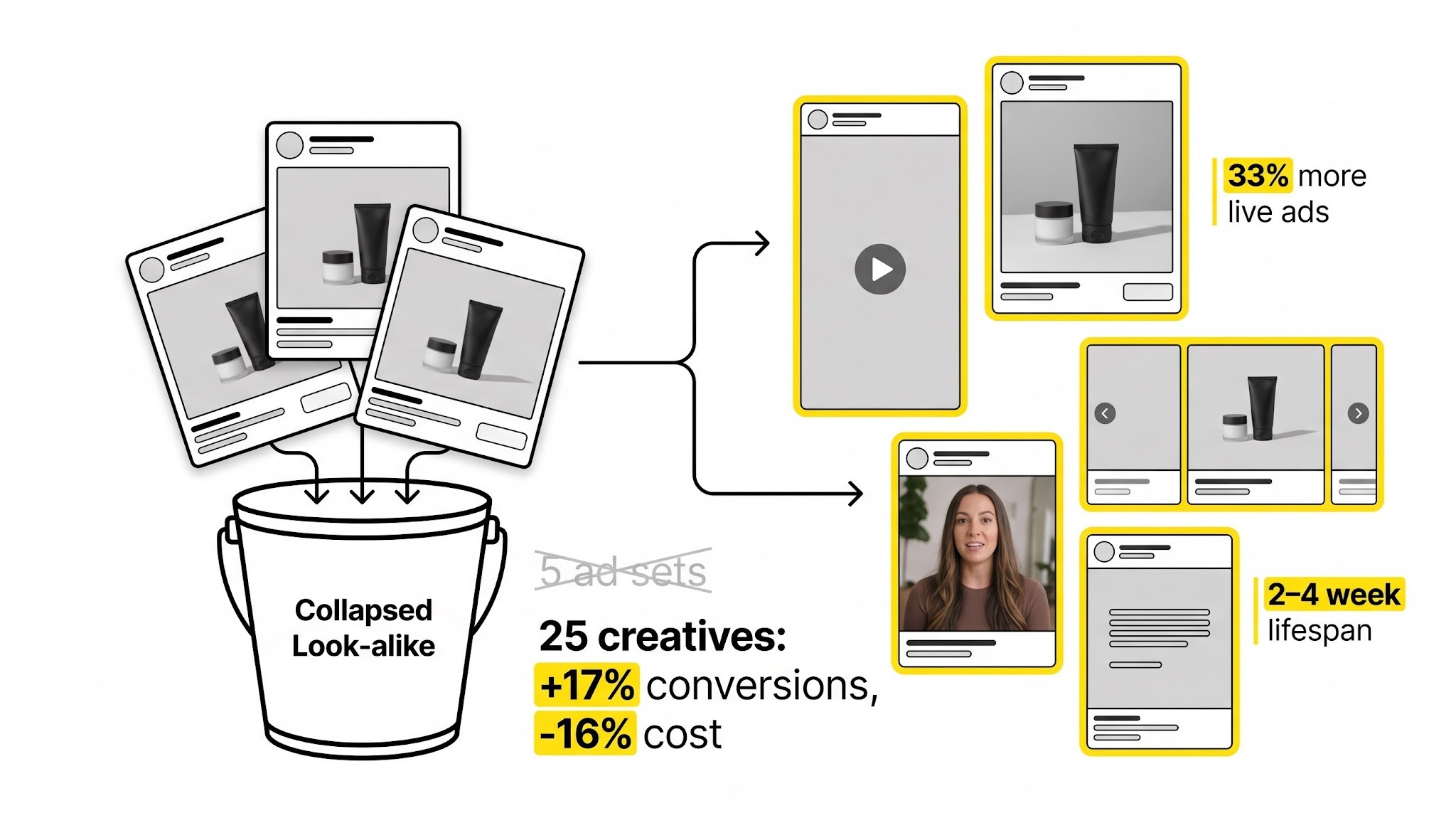
Andromeda groups creative that looks or performs similarly, and Brayden Germaine, Senior Content Manager at Pilothouse, uses a working rule on Ep 589: 9 Static Ads in 2.5 Hours: if two ads aren't at least 70% different from each other, assume the system is treating them as the same concept. Swapping a button color or headline doesn't clear that bar. Germaine notes that the real scaling bottleneck is idea variation, not design variety, because look-alike iterations get bucketed together and burn through their relevance fast. That bucketing shows up operationally too. Top-performing advertisers under Andromeda run roughly 33% more live ads than bottom performers, and effective ad lifespan has compressed from 6 to 8 weeks pre-Andromeda down to 2 to 4 weeks (ScaledOn). In a controlled test, a single ad set running 25 diverse creatives produced 17% more conversions at 16% lower cost than a traditional five-ad-set structure (ScaledOn). The system rewards consolidated volume over fragmented budget.
Core Ideas vs. Minor Design Iterations
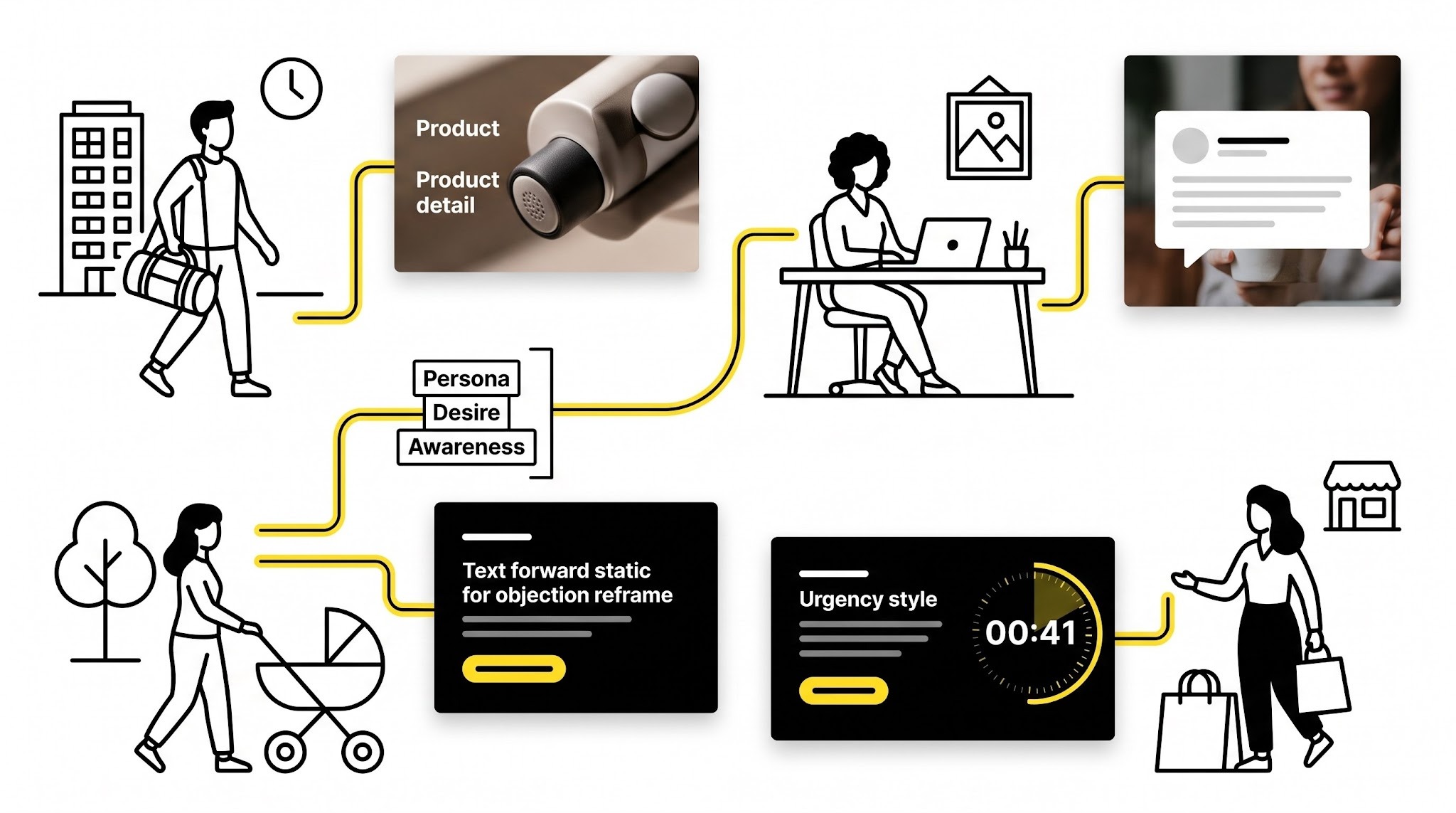
Twenty headline-only variations on the same concept create what's sometimes called "fake variance": the ads look numerous but carry no real signal difference for Andromeda to learn from. Real variance means distinct visual hooks, formats, and angles, not palette swaps. This is where Pilothouse's Five-Message Framework becomes useful, structuring creative around the core product benefit, the emotional driver, a social proof angle, an objection reframe, and an urgency or scarcity signal, so each new ad actually represents a different idea rather than a cosmetic tweak.
Niche Down to Scale Up: The Persona-Led Approach
Broad targeting used to work because Meta's algorithm could filter audiences on its own. That filtering power has shifted toward creative, so brands now have to do more of the segmentation work themselves, upfront, in the message.
Bespoke Messaging for Distinct Customer Segments
Valerio's guidance on Ep 56: Avery's Four Rules for Founders Who Actually Want to Scale is direct: brands must define specific target personas and build bespoke messaging for each one instead of relying on generic ads and hoping the algorithm sorts out who should see what. Pilothouse's PDA (Persona, Desire, Awareness) framework typically produces 8 to 12 distinct concepts per brand in practice, mapping each persona's desire and awareness level before a single ad gets written. A common failure point Valerio has flagged: brands sink money into creator-generated content before mapping persona segmentation or figuring out which specific product benefit actually drives the "why buy." Skipping that step means paying for volume without paying for relevance.
Resolution Over Persuasion: Ads as an Answer Engine
Treating ads as resolution rather than persuasion marks a real mental shift for most teams. Sendecki frames this idea on Ep 581 as central to scaling Facebook ads in the Andromeda era: instead of interrupting someone with a pitch, the ad answers a specific anxiety or question the moment it appears. Pilothouse's Intent Resolution lens applies this directly, treating each ad as a targeted answer rather than a broadcast message. This also changes how performance should be judged. Abby Kohler, Strategist, and Taylor Cain, Senior Ecommerce Strategist at Pilothouse, warn on Ep 611: Velocity Isn't Strategy against pulling underperforming-looking ads based on ROAS alone, since diverse creative also creates brand "moments" in a customer's day that build recall and feed the algorithm better audience signals over time.
A Decision Tree for Horizontal Creative Scaling
Once a winning ad emerges, the temptation is to just pour more budget into it. A better path is horizontal: iterating on the winner itself before scaling it vertically.
Testing Speed, Panels, and Voiceover Swaps on Winning Content
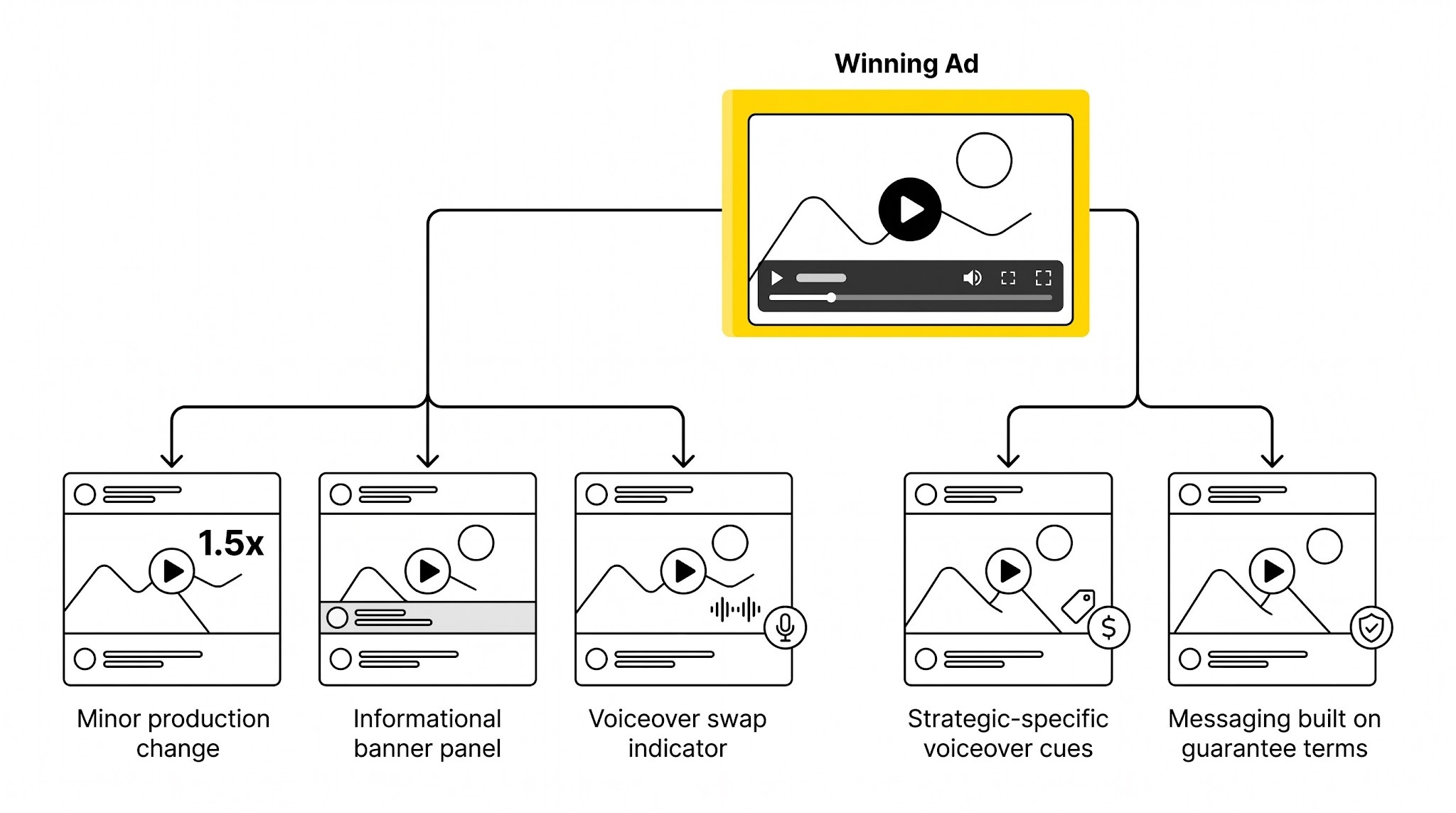
Valerio's approach to horizontal expansion, outlined on Ep 52: When You Find a Winner: Four Ways to Iterate on Creator Content, is systematic. Rather than raising budget on a single winner, test the same creator content at a different speed, such as 1.5x, add an informational panel, or swap in a new voiceover to address a different stage of the funnel. On the vertical side, once a creator winner is confirmed, you can rehash the successful visuals with new, more aggressive voiceovers that tackle specific conversion frictions like price sensitivity or guarantee terms. Format mix matters here too. Working baseline for a healthy ad set is 10 to 20 ads, weighted toward short video with meaningful static and carousel coverage, and 3 to 5 hooks tested per video angle. Horizontal iteration multiplies real creative signal without diluting the account with copies of the same idea.
Avoiding the Tactical Spin Cycle
A lot of accounts stay busy without getting anywhere. Constant small adjustments feel like progress but often just churn the account in place.
Knob-Fiddling vs. a Repeatable Growth Engine
Duncan Ferguson, Strategy Lead at Pilothouse, on Episode 595: 5 Messages That Scale DTC Growth describes this pattern bluntly: efficiency gets tanked when teams spend resources on minor "knob-fiddling" and attribution fixes instead of building a scalable engine rooted in a clear ideal customer definition. His advice: "stop doing light work on 300 ads and start doing real work on 5 to 10." That's the gap between a tactical spin cycle and a repeatable system. Pilothouse's "inspiration not iteration" principle reinforces this, pushing teams toward 10 high-quality concepts that address the key beliefs a customer needs before purchasing, rather than hundreds of small tweaks.
Incremental Attribution: Scaling on Causation, Not Correlation
Jacob Geary, Head of Meta at Pilothouse, points to Meta's incremental attribution settings as a better north star than last-click data, since they isolate conversions that wouldn't have happened without the ad running (Episode 609: The New Rules for Meta Attribution). Chasing whatever metric moved last week is exactly how the spin cycle starts. Tying scale decisions to a defined ad graduation rule instead, such as 10 or more conversions at target CPA before an ad moves into scale, keeps growth attributable rather than accidental. This is also where signal density matters. Ad sets generally need a meaningful volume of weekly events to learn effectively, and underspending against that threshold produces false negatives that look like creative failure when it's actually a data problem.
Getting Your Story Straight for an Infinite Content Pipeline
None of these frameworks hold up without a consistent brand narrative underneath them. Valerio's guidance for founders on Ep 56: Avery's Four Rules for Founders Who Actually Want to Scale is to find a repeatable, emotional kernel of truth in the brand story, one that can be told from a dozen different angles without losing its core. That kernel becomes the source material for an infinite content pipeline, feeding new personas and new hooks and formats that all still trace back to the same truth. Valerio draws a distinction on Ep 60: Air Game vs. Ground Game: A Better Way to Build Brands between "air game" and "ground game," where air game is the macro brand message and ground game is the bespoke digital content tailored to a specific persona's feed. Brands that blur the two end up with ads that feel generic on one end or disconnected from brand identity on the other. There's a cultural dimension too: cooperating with culture by translating brand truths into a persona's native visual language works, while co-opting a trend that doesn't fit the brand produces the kind of content audiences scroll past without registering.
Structuring Your Account for Andromeda: Scale, Test, and Catalog Campaigns
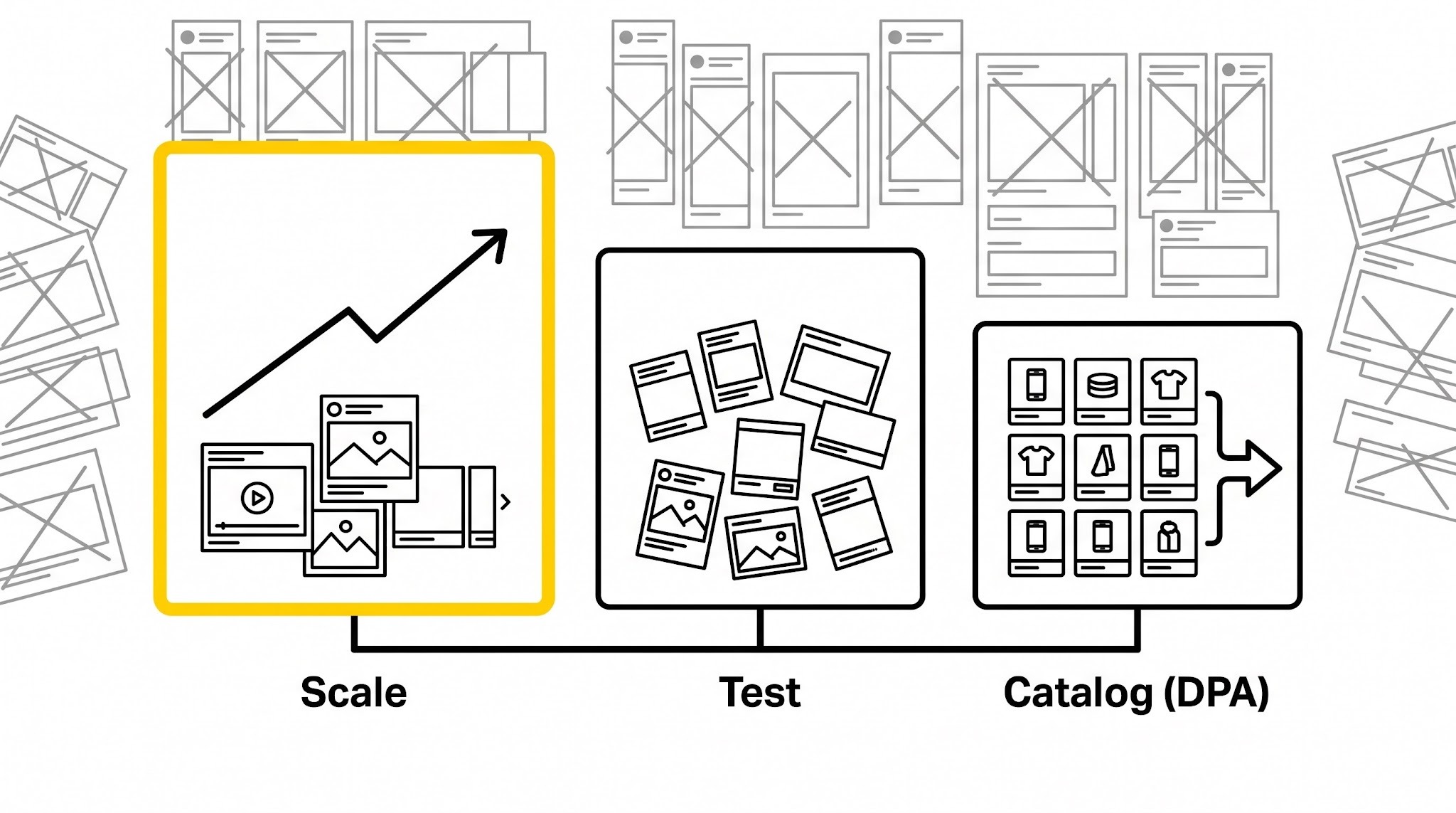
Strategy only translates into results if the account structure lets Andromeda act on it. Pilothouse strategists Taylor and Abby recommend a three-tier structure: a scale campaign for proven winners, one central testing campaign for new concepts, and a dedicated catalog (DPA) campaign for product-level retargeting. Consolidating spend this way, rather than fragmenting it across dozens of narrow ad sets, gives Andromeda enough signal density per ad set to optimize toward genuine message-user fit. Pilothouse has seen this structure meaningfully improve outbound CTR for consolidated, creative-first accounts. Facebook ads scale most efficiently when the account itself is built for the algorithm's current logic, not the one that existed three years ago.
Partner With Pilothouse Digital to Scale Efficiently
Proven Results at Scale
Pilothouse Digital has generated over $1 billion in attributable revenue for clients, backed by more than 160 specialists producing over 5,000 creative assets a month across 125-plus active brands. For CorneaCare, that system drove gross Meta revenue up 3,595% while lifting ROAS by 97%. VSSL's 41% YoY scaling and The Rag Company's unified acquisition and CRO results tell a similar story, with creative, media, and funnel moving together instead of in isolation.
Start Building a Defensible System
Brands at the $10M+ inflection point don't need more activity. They need a system built for how Andromeda actually works: creative as the targeting layer, personas driving messaging, structure carrying signal. That's how brands build scale instead of chasing it. Explore Pilothouse's client results or reach out to talk through what a defensible scaling system could look like for their brand.

