


Reels Ads: Creative Specs and Performance Playbook
.png)
Instagram Reels Ads: Creative Specs and Performance Playbook

Instagram Reels ads reward creative that looks native, resolves quiet viewer hesitation, and rotates fast enough to dodge fatigue penalties. Winning on this format now requires two parallel investments: a technically precise creative foundation, and a strategic shift away from persuasion and toward resolution. This playbook covers the specs, safe zones, and performance tactics marketers need to run Instagram Reels ads that actually hold up under Meta's algorithm.
Instagram Reels Ads: Why Resolution Beats Persuasion in 2026
The rules for Instagram Reels ads have shifted. Brands that once dominated through persuasion, hammering hooks and stacking CTAs, are losing ground to brands that look native and answer a need the viewer already has. Modern creative strategy on platforms like Meta has moved from "persuasion" (interrupting the user) toward "resolution" (answering the quiet anxieties or questions already in the user's head), according to Daniel Sendecki, VP of Brand and Performance at Pilothouse, on the DTC Podcast (Ep 581: Meta Ads Aren't About Targeting Anymore).
Sharper screens and more refined visual taste mean blurry, poorly framed, or clearly repurposed creative signals a brand that doesn't understand the platform. That silent judgment leads to a scroll, and once viewers scroll past an ad, the algorithm notices.
Getting the Technical Foundation Right: Specs and Safe Zones
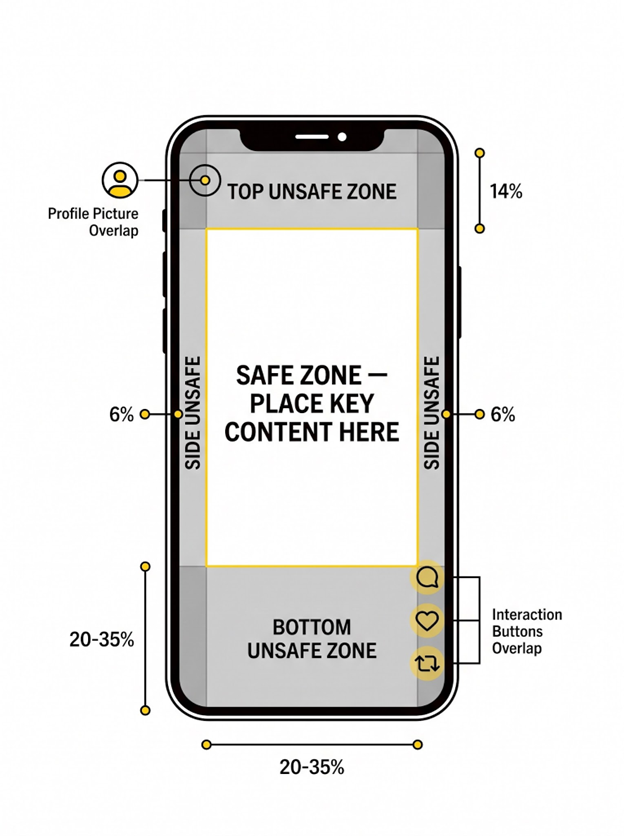
Reels is an unforgiving format. A single spec error can undercut a creative's visual integrity before the message even lands.
9:16 Vertical Dimensions and Safe Zone Placement
The standard for Instagram Reels ads is a 9:16 vertical aspect ratio, with a recommended resolution of 1080 × 1920 px. Creative should be shot and designed for full-screen mobile viewing from the start, not adapted afterward.
Safe zones matter on Reels because they keep important information, text and product shots especially, from getting buried under UX elements like the profile picture, comment icon, or repost icon, as Aves (Avery Valerio, Creative Strategist) explains in Ep 45: Platform-by-Platform Guide to Paid Social Ads. Under the unified Stories/Reels safe zone standard, critical content, text, logos, CTAs, should stay outside the top ~14% (≈270px), the bottom ~20-35% (≈380-670px depending on placement), and the sides ~6% (≈65px) (Meta Business Help Center). Instead of trying to calculate an exact center region, just design key elements around the central portion of the frame, where UI overlays rarely intrude.
Element
Spec
Aspect ratio
9:16 vertical
Recommended resolution
1080 × 1920 px
Top safe zone
~14% (≈270px)
Bottom safe zone
~20-35% (≈380-670px)
Side safe zone
~6% (≈65px)
Avoiding the 'Janky' Look: Proper Padding and Resizing
Brands should avoid slamming vertical content into standard feed campaigns without proper resizing. 9:16 assets need to be properly formatted or padded to prevent a "janky" appearance that turns off scrollers. Letterboxed horizontal video, awkward cropping, and generic black padding bars signal low production investment, even to viewers who can't articulate why.
A reusable two-format asset library solves much of this: 1:1 (1080×1080) for Feed, and 9:16 (1080×1920) for Stories and Reels. Building both formats at production time, rather than resizing after the fact, keeps creative native to each placement.
The Shift from Persuasion to Resolution-Based Creative
For years, the dominant paid social framework leaned on persuasion. Interrupt the scroll. State the problem. Present the product. Deliver the CTA. In Reels, that approach increasingly feels like someone talking over a conversation. Resolution-based creative instead answers something the viewer was already quietly wondering, meeting them in an existing state of mind instead of trying to create one from scratch.
Answering the Viewer's Quiet Anxiety Before They Scroll
The most effective Reels hooks are built on recognition rather than interruption. They make the viewer feel "that's exactly what I was wondering," which mirrors the psychological intent behind search queries, per Daniel Sendecki (Ep 581: Meta Ads Aren't About Targeting Anymore). Resolution-based creative shows the resolved state as the default: the product used naturally, delivering an outcome the viewer already wants, instead of amplifying the pain point first. When a viewer feels recognized rather than sold to, engagement follows.
Why Native, CTA-Free Creative Earns More Distribution
Socially native creative, ads that remove obvious CTA buttons and look like authentic social posts, improves the viewing experience and gets rewarded by Meta's ranking systems with higher distribution, notes Braden Germain (Senior Content Manager) in Ep 621: Anything is possible now – The AI Creative Stack. Ads with natural framing, casual speech, and storytelling over selling earn longer watch time, more shares, and more comments. Those engagement signals lead to wider distribution and lower CPMs.
Proven Creative Styles That Perform on Reels
Not every format translates equally. Matching creative style to product category is one of the higher-leverage decisions in a Reels campaign.
The Unboxing Video: A Long-Term Performance Workhorse
A strong unboxing video is a foundational style that can carry an ad account for years. It naturally addresses middle and bottom-funnel friction points like shipping speed and product quality, while staying visually entertaining, according to Aves (Ep 48: Unboxings, B-roll, and 3 More Video Styles That Scale). The format works especially well for subscription boxes, skincare kits, apparel, and any product with a meaningful packaging experience.
For gifting content specifically, showing the giftee receiving and reacting to a product is often more profitable than showing the purchase itself. It has longer shelf life and reaches a broader audience, per Aves.
Product-Focused B-Roll: iPhone-Style 10-15 Second Clips
Short-form video is one of the most important content types to get right, since it's the common denominator for creative success across platforms. Product-focused B-roll, 10-15 second, well-lit iPhone shots, works well because it mimics organic content and viewers don't immediately clock it as an ad. Reels creative should also prioritize ASMR-driven lifestyle footage that captures the specific ritual of a product's use, rather than listing technical specs.
Cooperating with Culture Instead of Co-Opting It
Winning on Reels means working with culture, finding what's actually relevant to the brand instead of forcing a trend onto it, since the latter risks looking cringe and damaging long-term brand reputation, according to Aves (Ep 593: 3 Rules for Culturally Relevant DTC Ads That Still Convert on Meta). Reels ads should also be funny, short-form, and sharable, delivering entertainment quickly to match the TikTok-style experience users expect on the platform, Aves notes (Ep 44: Stop Running the Same Ad on Every Platform). Genuine cultural alignment earns shares and saves, among the strongest signals Meta uses to evaluate distribution reach. Tone-deaf trend-chasing does lasting damage to brand perception instead.
Beating Meta's Andromeda Algorithm with Creative Variety
Meta's Andromeda algorithm rewards creative diversity in ways earlier systems didn't. Running the same concept repeatedly, even with minor tweaks, accelerates fatigue and drives CPMs upward.
Why Idea Variety Matters for Rising Costs
Under Andromeda, creative assets that aren't meaningfully different from one another risk being "bucketed" as redundant. The focus needs to be on idea variety, not small design tweaks, to maintain delivery, per Braden Germain (Ep 589: 9 Static Ads in 2.5 Hours). A common industry rule of thumb is targeting roughly 70% new idea variety across an active creative mix, though this figure is a directional benchmark rather than a documented Meta spec. Running a wider set of distinct creatives per ad set, varying angles, formats, and emotional tone, gives the algorithm fresh signals and surfaces audience pockets a narrower approach would miss. This matters most for DTC brands scaling into higher spend tiers, where cost efficiency matters just as much as revenue growth.
Building a Reels Ad Testing and Production Workflow
A strong testing workflow starts with a clear hypothesis per creative: what insight it's based on, what audience it targets, what outcome is expected. Production needs to move ahead of media spend instead of scrambling to catch up. In practice, that means a repeatable system with consistent shot lists, briefing templates, and editing standards, not one-off projects.
Before publishing, creative should be validated with the Ads Manager Safe Zone Guardrail and previewed individually across Stories, Reels, and Feed placements to confirm nothing critical falls into an overlay zone. Iteration speed matters too. The window between deploying a creative and getting actionable signal is short in Reels, and brands that review performance weekly and feed learnings into the next cycle consistently outperform brands that batch creative quarterly.
Partner with Pilothouse Digital to Scale Reels Performance
Where DIY Testing Runs Out of Road
Executing resolution-based creative, safe-zone discipline, and Andromeda-aware variety at scale takes more than a checklist. It takes a team running creative, media, and analytics as one integrated system rather than separate functions. That's usually where brands that have outgrown ad-hoc Reels testing hit a ceiling.
What Pilothouse Digital Brings
Pilothouse works with ecommerce brands built around three core disciplines: resolution-based creative strategy that answers viewer intent rather than interrupting it, strict safe-zone and format discipline across every placement, and a creative-variety approach built for how Meta's ranking systems actually distribute ads. That combination turns Instagram Reels ads into a repeatable performance engine rather than a one-off testing exercise.
Brands whose Reels ads are burning budget without building signal, or whose creative pipeline can't keep pace with media spend, usually have a systems problem rather than a product problem. That's the specific gap Pilothouse is built to close.

