Why Your TikTok Paid Advertising Fails on Meta (And Your Meta Ads Fail on TikTok): The Platform Intent Problem

Same creative. Both platforms. Same hook, same offer, same visual. One campaign limps along with weak engagement while the other burns through budget without a meaningful conversion to show for it. When this happens, most brands assume the ad itself is broken, so they tweak copy, swap the thumbnail, and try again. But creative quality isn't the problem. The brand is speaking fluent TikTok to a Meta audience, or the reverse, and neither group is listening.
Platform intent is the most underestimated variable in paid social today. Getting it right is what separates campaigns that scale from campaigns that simply spend.

The Platform Intent Problem: Why Your Ads Fail Before Anyone Sees Them
Running TikTok paid advertising or Meta ads without accounting for platform intent is like walking into two completely different conversations and delivering the same speech. The words might be technically correct, but the context makes them land wrong every time.
When an ad fails, most advertisers go straight to execution: the hook was weak, the thumbnail was boring, the CTA wasn't clear. These things matter, but they're downstream problems. The real issue sits further up the chain, in the alignment between an ad's emotional register and the mental state users are already in when they encounter it. If that alignment is off, no amount of optimization will save it.
Platform intent describes the psychological posture users carry when they open an app. It's shaped by why they opened it, what they expect to feel, and what kind of content they're already primed for. Ads built for the wrong mindset don't just underperform. They erode algorithmic trust as platform systems register poor engagement signals and start throttling distribution.
Scrolling to Wait vs. Intense Intent to Be Entertained: Two Completely Different Minds
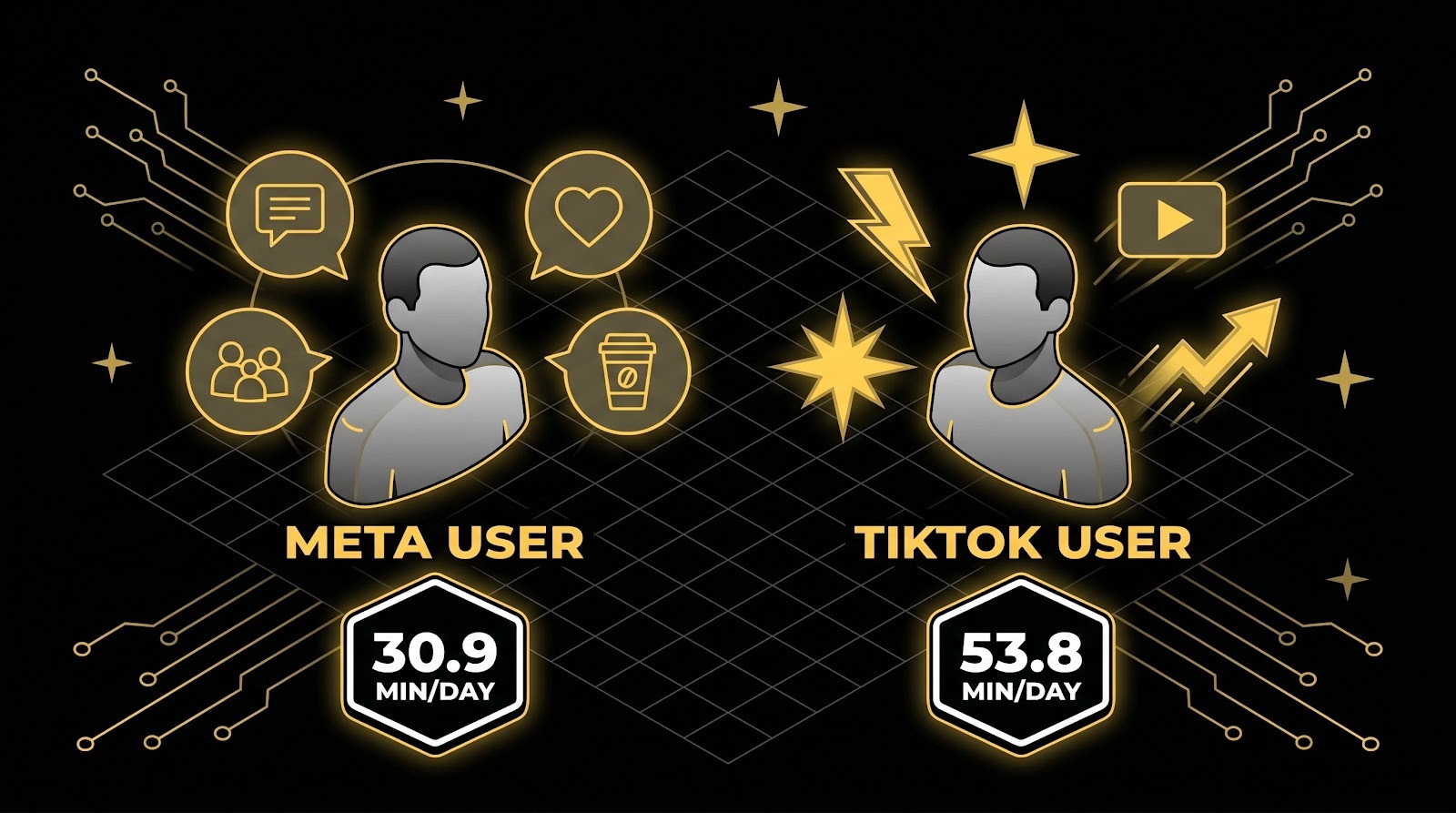
Both Meta and TikTok are scroll-based platforms serving video to billions of users. Treating them as interchangeable, though, is one of the most expensive assumptions in performance marketing. The person scrolling Facebook while waiting for coffee and the person deep in a TikTok session are not the same person, even if they share a demographic profile. They're operating from completely different psychological states.
Meta's Passive, Connection-Seeking Mental State
According to GWI research, 69% of Facebook users visit to message friends and family (their top reason), while 62% of TikTok users visit to find funny and entertaining content (their top reason) (GWI via bloggingwizard.com). That single distinction shapes everything about how ads land on each platform.
Meta users open the app to check in - catching up on what friends posted, browsing family updates, dipping into a group they follow. Their intent is relational and passive. Ads that interrupt this connection experience too aggressively create friction. Content that performs well here feels organic to the feed, grounded in community, relatability, or personal relevance. The winning Meta hook makes a viewer think "that's exactly what I was wondering" rather than hitting them like a pitch.
TikTok's Discovery-Hungry, Entertainment-First Mode
TikTok runs on a completely different psychological contract. Users open the app hungry for novelty. The For You page trains people to expect something they've never seen before, and it delivers relentlessly. Boredom is punished instantly with a swipe. This behavioral intensity shows up in the numbers: TikTok users average 53.8 minutes per day on the platform, compared to roughly 30.9 minutes for Facebook users, reflecting deeper, more immersive sessions driven by content consumption rather than social check-ins (Statista).
This is why TikTok paid ads demand entertainment as the entry point. Open with a product shot or a brand logo and you're already losing. The standard for effective TikTok creative is the "stumble-upon" effect: the ad should feel discovered, not placed. When it works, viewers genuinely can't tell if it's sponsored. When it doesn't, the forced quality registers immediately and the swipe comes fast. Purchase intent on TikTok is very real: 55% of TikTok users report making impulse purchases on social media, compared to 46% on Instagram and 45% on Facebook [Statista, 2022], which reflects how a discovery-first format primes action (Statista).
One thing worth noting for brands still treating TikTok as a youth channel: the 25-to-34 age group is now the platform's largest demographic at 35.3% of users, and the over-30 category keeps growing (DataReportal). Underinvesting because of audience age assumptions means leaving a significant, increasingly purchase-ready segment on the table.
Meta's Algorithm Shift Changed the Rules
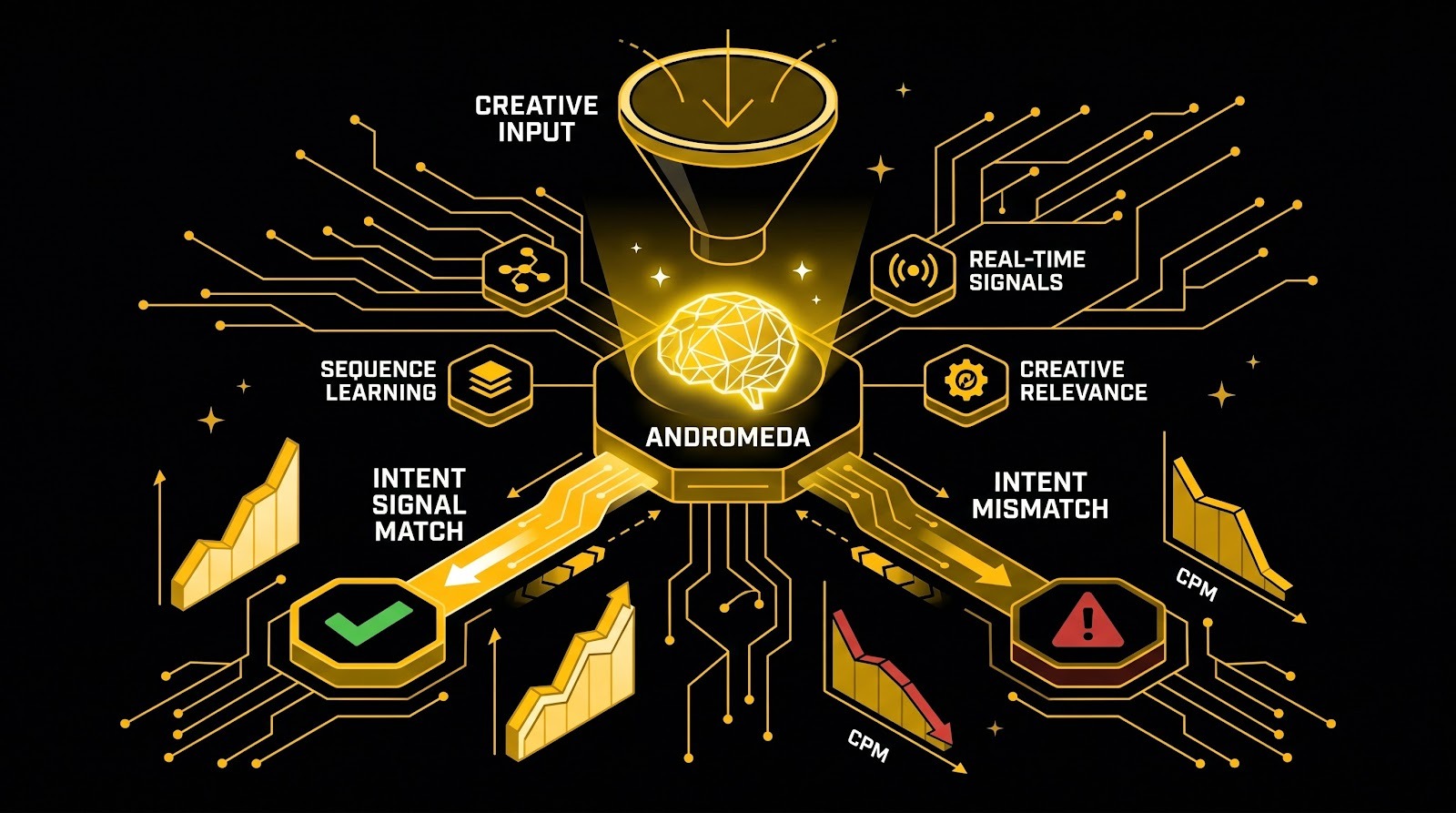
Meta's ad distribution has undergone a significant structural change. The Andromeda update is an AI retrieval engine that shifted Meta's ad matching away from demographic targeting toward creative relevance signals. It incorporates sequence learning to track where users are in the purchase journey. Combined with ongoing Advantage+ Sales Campaigns enhancements, Meta's system now dynamically adapts delivery based on real-time signals rather than preset audience parameters.
The practical implication for DTC advertisers: creative-first optimization is no longer optional. Under Andromeda, creative diversity is the primary performance lever. Meta no longer asks primarily who should see this ad; it asks how your creative performs against user intent signals. Winning Meta creative functions as a resolution engine, surfacing when users are already wrestling with a specific question or anxiety and delivering an answer that meets them exactly there. That's precisely why TikTok-style cold-discovery creative consistently underperforms in this environment. It's built to introduce a need, not resolve one.
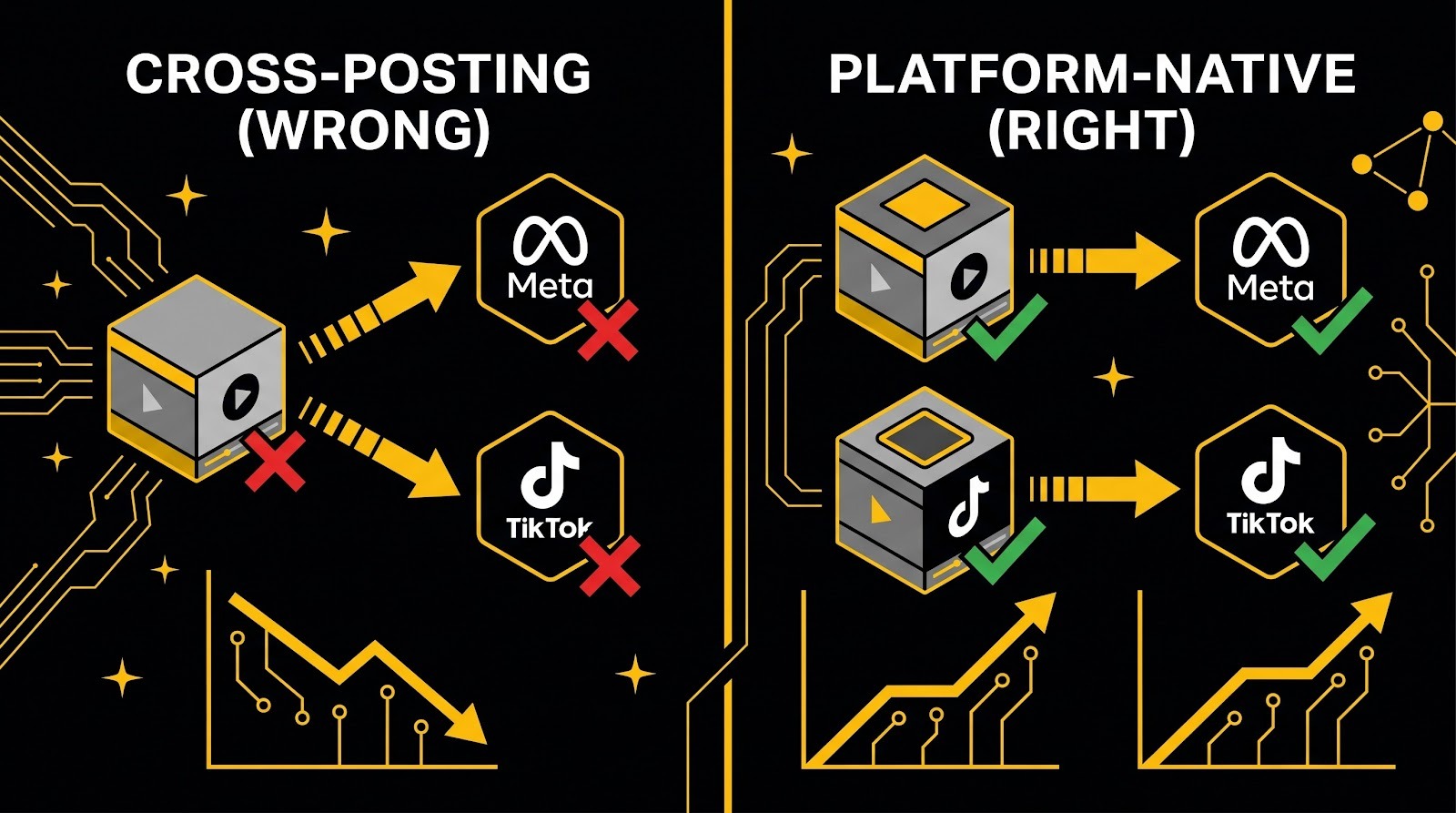
Brands seeing declining reach or rising CPMs without an obvious explanation are likely misaligned with this shift. Centering Meta creative around problem-resolution framing, where the ad communicates what it solves and does so immediately, is now a baseline requirement. This also reinforces why cross-posting fails mechanically: the messaging architecture for each platform must be purpose-built. The offer can be identical. The structure and emotional journey must be different.
The Execution Errors That Quietly Kill Cross-Platform Performance
Strategic misalignment is the root cause of cross-platform failure, but execution errors are where that misalignment becomes most visible. These mistakes feel minor in isolation and compound quickly at scale.
Ignoring Platform-Specific Safe Zones and Visual Real Estate
Every platform has a visual layout that determines how users actually experience content. On TikTok, the bottom third of the screen is frequently obscured by the caption, profile handle, and engagement icons. On Meta's mobile feed, text overlays near the top compete with the post header. On Instagram Stories, the top and bottom fifths are essentially UI territory. It's also worth separating Instagram Reels and TikTok despite their shared vertical format: Reels exists within a social-connection-oriented environment, while TikTok is a dedicated entertainment feed. Format similarity does not make them equivalent placements.
When creative teams export the same video across every placement without adjusting for safe zones, key messaging disappears behind interface elements. A product close-up gets hidden. A text hook lands behind a username. Checking platform-specific safe zone templates before launch is one of the simplest and most consistently overlooked steps in cross-platform execution.
Audio Dependency on a Silent Feed
Meta's feed is predominantly silent. Most users scroll without sound unless something compels them to tap. A TikTok ad built around an audio-driven hook, repurposed for Meta without captions, is a guaranteed engagement failure. The punchline never lands. The story never resolves.
TikTok users, by contrast, often have sound on by default. Trending audio is a discoverability mechanism there, not a nice-to-have. Ignoring it on TikTok means missing one of the platform's most powerful native tools. Building for one audio environment and deploying it in another creates a mismatch that no targeting precision can fix. Meta creative must communicate the full message visually, with audio as an enhancement. TikTok creative should treat audio as a core hook from the start.
Why Speaking the Wrong Platform's Language Isolates Your Best Buyers
Every platform develops its own cultural grammar over time. TikTok has trending sounds, lo-fi aesthetics, self-aware humor, rapid cuts, and a continuously evolving library of references that signal belonging. When a brand speaks this language authentically, users feel like the ad belongs in their feed. When it's visibly forced or lifted from last month's trend cycle, inauthenticity registers fast and the scroll reflex takes over.
The same dynamic plays out on Meta, where content culture skews toward editorial headlines, social proof framing, and community-adjacent storytelling. A TikTok ad dropped into a Facebook feed often reads as jarring simply because the visual grammar doesn't match what users expect from that environment.
Mapping Creative to Psychological Intent Clusters
The most effective approach to building platform-native creative isn't to produce dozens of minor variations (swapping headlines, changing colors, tweaking CTAs) and call it testing. That burns budget on directionless iteration without solving the underlying intent mismatch. Real creative leverage means identifying the three to five core messages a customer needs to hear to move from awareness to conversion, then building distinct, platform-native executions around each.
This starts with mapping psychological intent clusters: thematic buckets of emotional or rational concerns that represent distinct mental states among potential buyers. Search data through tools like Google Search Console, Reddit threads, and Amazon review mining can surface the anxieties, questions, and decision triggers that drive purchase behavior, since users rarely articulate intent directly on social platforms. A skeptic needs proof. An aspirational buyer needs vision. An analytical buyer needs comparison. Each cluster becomes its own creative brief rather than a surface-level reskin of the same asset.
For brands without a celebrity face or major cultural presence, problem agitation is especially critical on Meta, where users won't engage with vibe-based creative unless there's a pre-existing emotional hook. Surfacing a specific anxiety and resolving it earns attention that brand personality alone can't. Pilothouse's case studies reflect how this intent-cluster approach drives genuine creative variety and measurable lift, as opposed to the incremental gains typical of iteration-based testing.
Stop Cross-Posting. Start Platform-Native TikTok Paid Advertising With Pilothouse
The Real Cost of Platform-Intent Mismatch
Cross-posting is the shortcut that costs more than it saves. It feels efficient: one asset, two placements, half the production effort. But when that asset underperforms on both platforms because it was designed for neither, the cost goes well beyond wasted creative. It's missed revenue, burned budget, algorithmic penalties as platform systems learn the content isn't driving intended outcomes, and creative fatigue that has nothing to do with creative quality.
Building Platform-Native Strategy
Pilothouse Digital builds platform-native creative strategies for DTC brands serious about scaling. That means separate creative briefs for Meta and TikTok, built from the ground up around each platform's user psychology, visual real estate, audio environment, and cultural language. For TikTok, that includes promoting high-performing organic content as paid, which removes production guesswork and delivers the stumble-upon authenticity the algorithm rewards. For Meta, it means leading with resolution-first messaging calibrated to where buyers are in their decision journey.
Pilothouse integrates media buying, creative production, and strategic execution across Meta, TikTok, Google, Amazon, and YouTube into a single growth engine. The difference between cross-posting and building platform-native creative isn't a nice-to-have. It's the difference between a campaign that scales and one that stalls.
If TikTok creative keeps underperforming when it moves to Meta, or Meta ads fall flat on TikTok, the platform intent problem is likely at the root. The fix isn't a new hook. It's a new strategy.