TikTok Shop for DTC Brands: An Honest Assessment of What It Drives (And What It Doesn't)

Most brands approach TikTok Shop the same way they approached Instagram Shopping five years ago: bolt it onto existing creative, throw a few creators at it, and wait for orders. That approach didn't work then and it won't work now. TikTok Shop isn't a new distribution tab you activate. It runs on fundamentally different principles, and brands that treat it otherwise are leaving real growth on the table while burning budget in the process. What separates brands that scale from those stuck in plateau mode is rarely budget. It's usually mindset, creative strategy, and a clear-eyed view of what the channel is actually built to do.

Why TikTok Shop Demands a Different Mindset Than Every Other Sales Channel
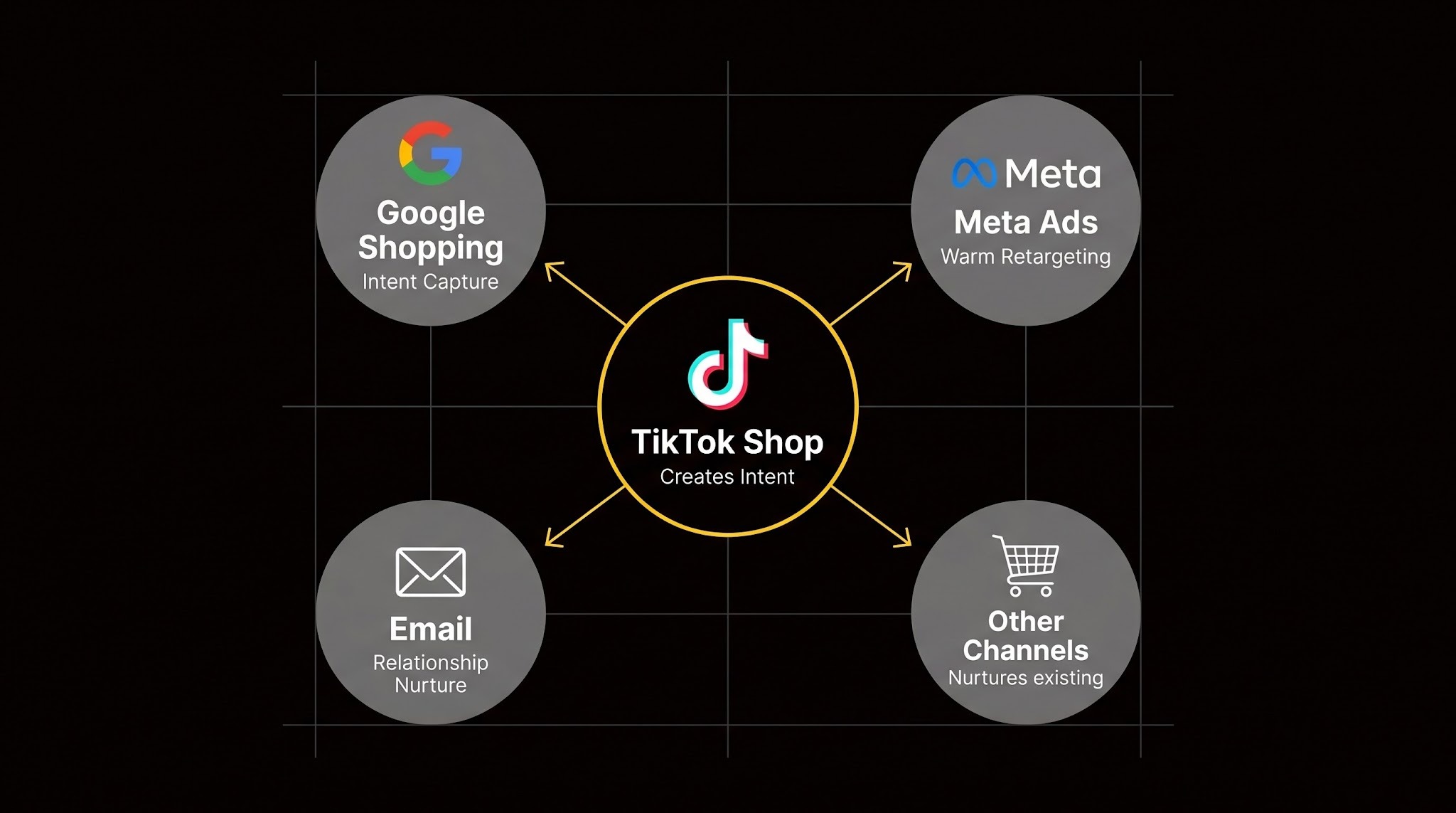
Every sales channel has its own gravity. Google Shopping captures intent that already exists. Meta retargets and converts warm audiences. Email nurtures relationships over time. TikTok Shop does something different: it creates intent where none existed a moment ago.
When someone discovers a product on TikTok Shop, they weren't looking for it. They weren't in a buying mindset. They were scrolling to be entertained, doom-scrolling to forget their worries. The purchase decision forms in real time, mid-content, shaped by emotion and momentum. If your content doesn't account for that psychology, it doesn't matter how good your product is.
The Doom-Scroll Dynamic: Why Commerce Must Feel Like Discovery
TikTok's algorithm is ruthlessly effective at surfacing content users didn't know they wanted, and that same engine powers how TikTok Shop works. Commerce on this platform lives inside the content stream, not alongside it. A product demo that feels like an ad is already dead. The moment a viewer's brain registers "this is a sales pitch," they swipe.
The brands winning on TikTok Shop are creating content that feels like a person genuinely sharing something they love, something that just happens to be purchasable. Aves from Pilothouse frames this as the "stumbled upon" effect: shoppers don't want to feel sold to, they want to feel as though they discovered the product themselves rather than having it shoved down their throat (Ep 44: Stop Running the Same Ad on Every Platform).
The discovery has to feel accidental, even when it's entirely engineered. That's why 71% of social and video platform users say that creator authenticity has motivated them to buy a product or brand, according to TikTok Marketing Science research. The framing that actually matters: think about the moment, not the product. What is this solving in someone's actual life? That kind of narrative-first thinking, grounded in creator authenticity, is what turns a product video into a high-converting piece of discovery commerce.
The Demographic Shift Brands Are Sleeping On
A common assumption is that TikTok is exclusively a Gen Z platform, which leads brands to either dismiss it as irrelevant or dial their content into a narrow aesthetic that doesn't match their product or customer base. Both are mistakes.
TikTok's user base has matured significantly. The 25 to 34 cohort is now the platform's single largest age group at 40.3% of users, surpassing the 18 to 24 bracket, which sits at 25.6% (DemandSage). More than 34% of TikTok's audience is now over 30, and the growth in older cohorts is striking: users aged 30 to 39 are up 86%, ages 40 to 49 up 120%, and ages 50 and over up 240% compared to 2023 (SocialRails). That's purchasing power, not just reach. Home goods, wellness, supplements, and adult fashion are all finding real traction, and brands building audience assumptions from two years ago are working from an outdated map.
Pilothouse's media buyers have flagged the same shift, noting that while TikTok is often dismissed as a young person's game, the over-30 category is the platform's fastest-growing segment and is opening real opportunity for brands with more mature target personas (Ep 45: Platform-by-Platform Guide to Paid Social Ads).
Performance vs. Brand Response: What TikTok Shop Is Actually Building
Evaluating TikTok Shop purely on immediate ROAS misses what's actually happening when content lands well. TikTok Shop builds two things at once: transactional volume in the short term, and brand familiarity at scale. The second is harder to see in a dashboard, but it often compounds more meaningfully over time.
When a buyer watches multiple creators feature the same product, they may not purchase immediately. But the next time they see that product anywhere, they recognize it, and that recognition carries real weight. Performance-focused brands want to see cost per acquisition fall in line with their other paid channels, but TikTok Shop doesn't always cooperate on that timeline. The brands that get this right treat the channel as serving two purposes at once: creator content with affiliate links drives direct GMV, while consistent authentic creator presence builds community association that makes paid amplification more efficient over time. Both require different KPIs, and both matter.
The Creator Brief Problem That Kills Most TikTok Shop Strategies
If there's one place where TikTok Shop strategies collapse, it's the creator brief. More specifically, it's the over-engineered, brand-approval-heavy brief that strips the creator of everything that makes them effective on the platform.
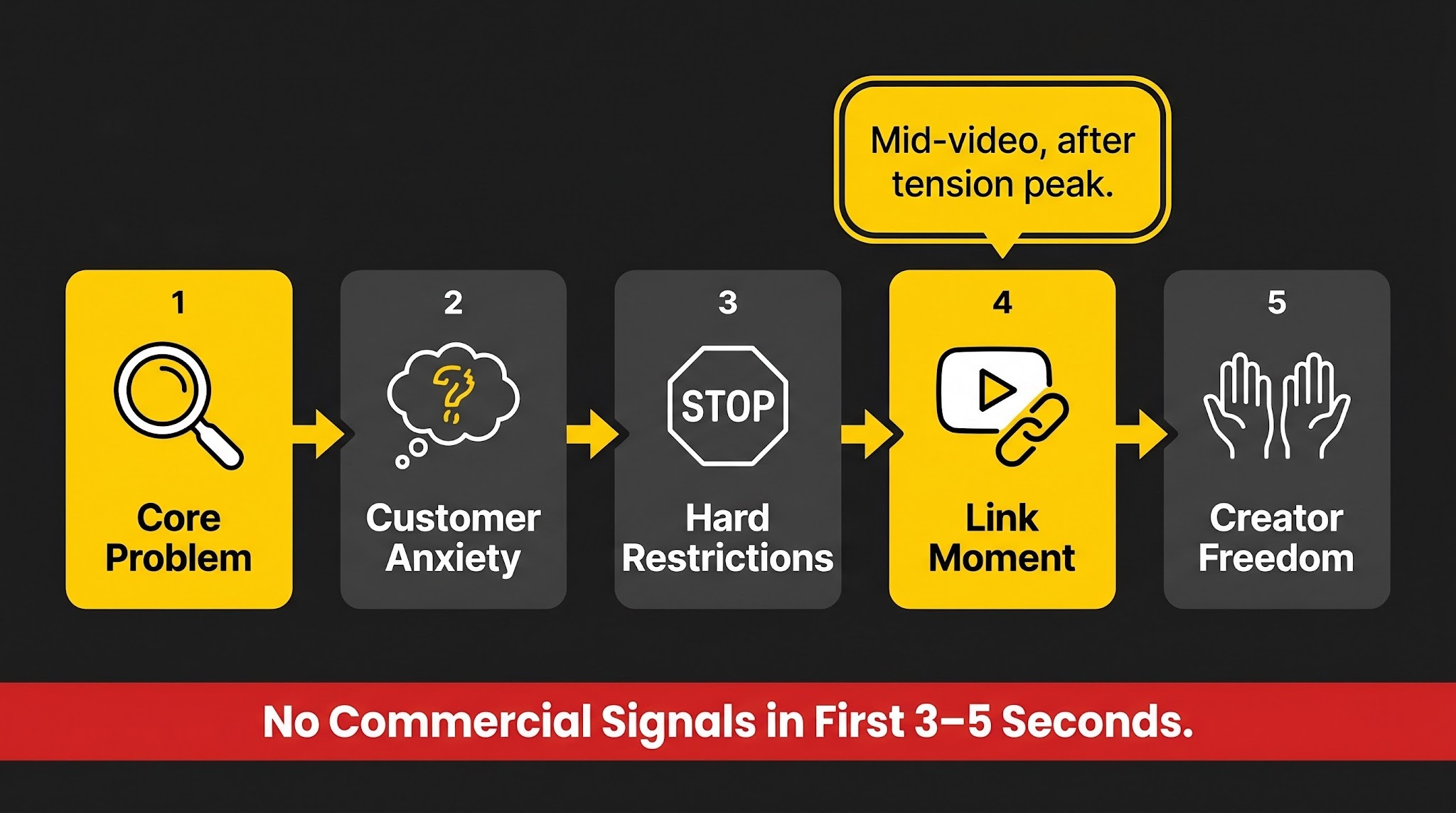
TikTok creators don't build audiences by delivering polished brand ads. They build them by being themselves. When brands force a creative framework onto a creator whose audience trusts their authentic voice, they break the thing that made that creator valuable in the first place. A strong TikTok Shop creator brief communicates the core problem the product solves, the customer anxiety worth spotlighting, and any hard restrictions around claims or visuals. It also specifies a "link moment," the specific narrative beat where the creator references the product link, ideally mid-video after a tension peak rather than tacked on at the end where watch time drops. After that, let the creator interpret.
One rule is non-negotiable: no commercial signals in the first three to five seconds. A branded logo, a product close-up, or a sales-style open kills algorithmic reach before the content has a chance to land. Brands that consistently crack TikTok Shop for brands learned to trust the creator's judgment about their own audience, even when the output looks nothing like what a traditional creative team would produce.
The Halo Effect: What Strong TikTok Shop Performance Does to Your Amazon Numbers
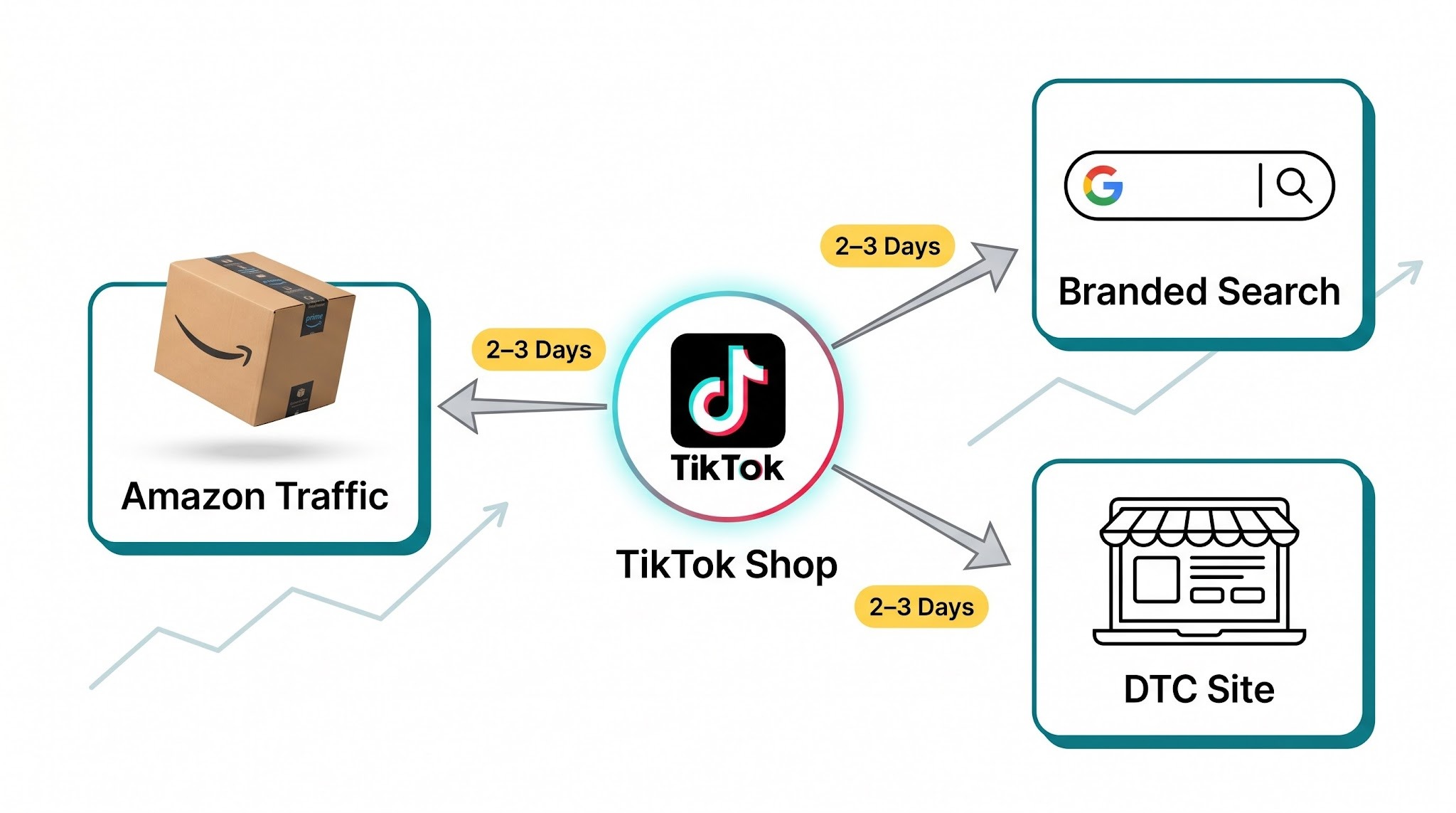
One of the most underappreciated structural effects of TikTok Shop is what it does to other channels. When TikTok Shop starts working, the impact rarely stays contained. Branded search volume climbs. Amazon listings see increased traffic from buyers who discovered a product on TikTok and migrated to a platform they already trust to complete the purchase. That lift typically appears within two to three days of strong TikTok Shop GMV performance, and it often shows up as rising branded search volume without any corresponding increase in Amazon ad spend.
This happens because TikTok accelerates the brand awareness phase of the purchase journey in a way few channels can. A buyer who watches several creators talk about a product develops familiarity that ordinarily takes months of retargeting to build. When they arrive on Amazon or a DTC site, they arrive warm. For brands running TikTok Shop alongside other channels, that cross-channel spillover is a measurable competitive edge, and it should factor into how TikTok investment is justified internally. Pilothouse Digital's case studies illustrate how this pattern plays out across categories when TikTok Shop is integrated with Amazon and paid social.
Moving Beyond Vibes: How to Scale Past the TikTok Shop Plateau
Most brands that achieve early success on TikTok Shop hit a wall somewhere between initial traction and scaled growth. The content that worked in the beginning stops working. ROAS softens. This plateau is predictable and almost always has the same root cause: the brand is still operating on aesthetic and novelty rather than intent.
From Aesthetic Content to Intent Resolution
Early TikTok Shop wins often come from product-market fit with a specific audience or content style. Scaling past that phase requires understanding why people actually buy, and building content architecture around those reasons. TikTok's own 2026 trend forecast, identifies this shift explicitly: 'Impulse will lose to intention in 2026 as shoppers reward the brands that justify the why to buy, first' (TikTok Next 2026).
Intent-resolution content addresses friction directly. It speaks to the skeptic who is almost convinced. It handles the objection before the buyer has a chance to form it. It names the problem so specifically that the viewer thinks, "That's exactly what I've been dealing with." This kind of content doesn't always win on raw view counts, but it converts at a higher rate because it meets buyers at their actual decision point. Duncan Ferguson, Strategy Lead at Pilothouse, makes the same point in DTC Podcast: to turn an entertainment-focused viewer into a buyer, content has to eventually address points of friction like value propositions and specific product objections, rather than relying on vibes alone (Ep 595: 5 Messages That Scale DTC Growth).
Building Strategic Angles and "Why Buys" That Actually Convert
Every product has multiple viable "why buys." The job of a TikTok Shop operator is to map them and test them systematically. A skincare brand might have one buyer motivated by ingredient transparency, another by visible results, and another by how the product fits a specific routine. Each of those requires different creative, different hooks, and different creator profiles. Building this angle map and running it as a structured creative test is how brands move from "we post TikToks" to operating a real TikTok growth system.
The Cheat Code: Turning High-Performing Organic Content Into Paid Growth
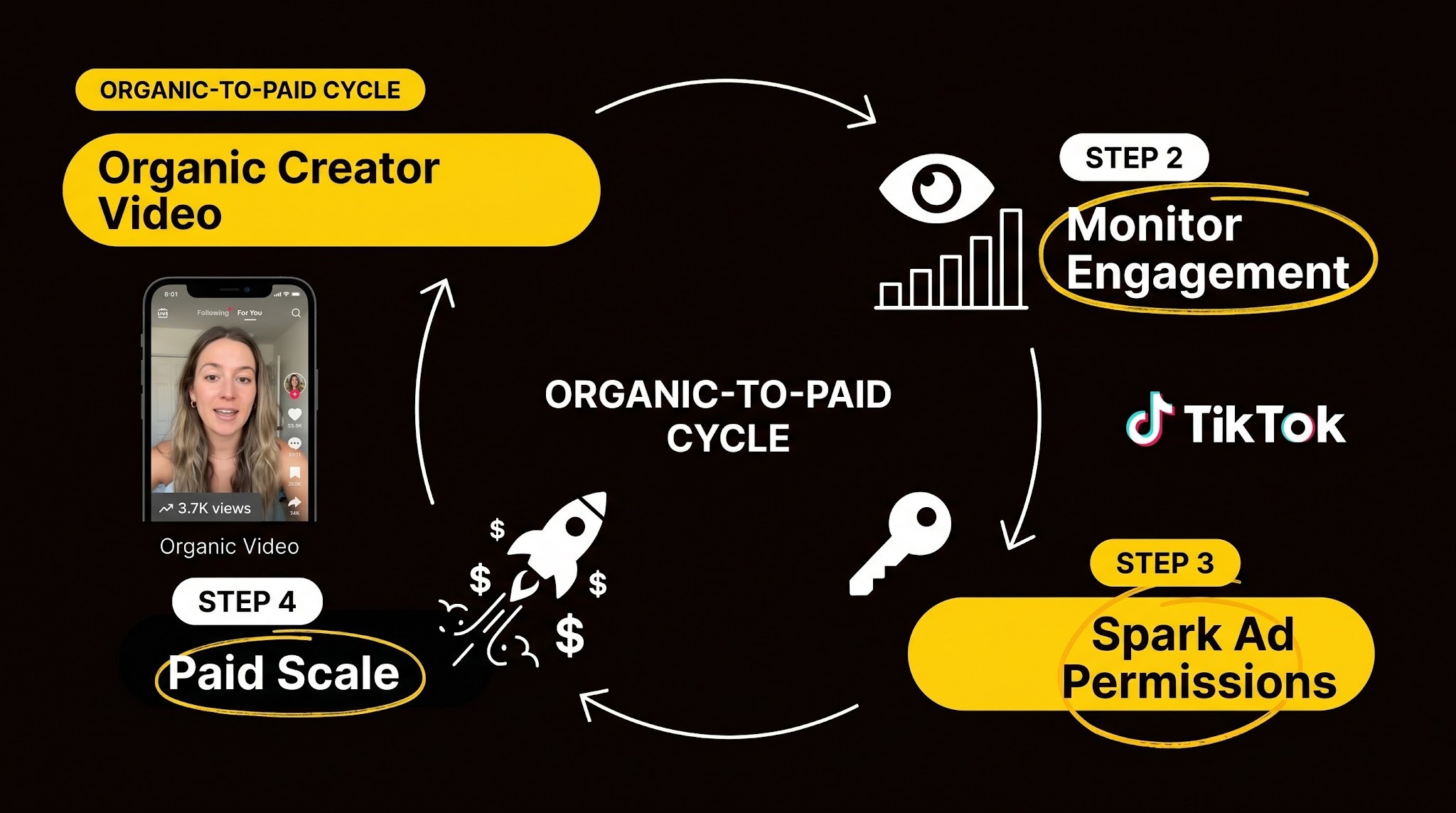
When an organic creator video gains real traction, the most efficient next move is to amplify it with paid spend. Paid creative that looks like an ad carries a trust deficit from the first frame. Paid creative that is a real creator video, with real comments and visible engagement, carries social proof that manufactured content simply can't replicate.
The workflow isn't complicated. Monitor creator content regularly, set thresholds for engagement and watch time that signal strong organic performance, and when content clears those thresholds, move quickly to secure spark ad permissions and scale through paid channels. Organic content tests for free. Paid amplification scales what wins. Each cycle makes the next one more efficient.
How to Make TikTok Shop Feed Your Long-Term DTC Engine
TikTok Shop works best when it's not treated as an isolated channel. The brands that extract the most from it wire it into their broader DTC system, using it to feed email and SMS lists, retargeting audiences, and brand equity that pays out across every channel they operate.
That integration requires intentionality: proper tracking so TikTok-acquired buyers are identifiable downstream, post-purchase flows calibrated for discovery-based buyers rather than intent-based ones, and LTV analysis that captures the full value of TikTok-sourced buyers rather than judging them on first-purchase metrics alone.
The strategic goal is to move buyers from the platform into owned channels where they can be marketed to in perpetuity. Understanding how to sell on TikTok Shop, at scale, means fitting it into the architecture of a scalable DTC business. When that fit is right, TikTok Shop stops being a channel brands experiment with and becomes a customer acquisition engine that continuously feeds their most valuable long-term asset: a growing, loyal customer base.
The brands extracting the most from TikTok Shop right now aren't the ones with the biggest budgets. They're the ones who treat it as a system: creator strategy, paid amplification, cross-channel halo, and owned-channel capture, all wired together. If that's the program you're trying to build, the Pilothouse Digital team can help you get there. Reach out to start the conversation.