


Stop Thinking About Stopping the Scroll: The Intent Resolution Model for Performance Creative
.jpg)
The phrase "stop the scroll" has dominated creative strategy conversations for years. It sounds right. It feels performance-oriented. But chasing a thumb-pause has quietly become one of the most misleading objectives in digital advertising, training teams to optimize for a moment of friction rather than a moment of meaning. The result is creative that interrupts without connecting, and campaigns that rack up impressions without generating real intent.
There is a better model. It starts not with what grabs attention, but with what gets resolution.

Why 'Stop the Scroll' Is the Wrong Objective for Performance Creative
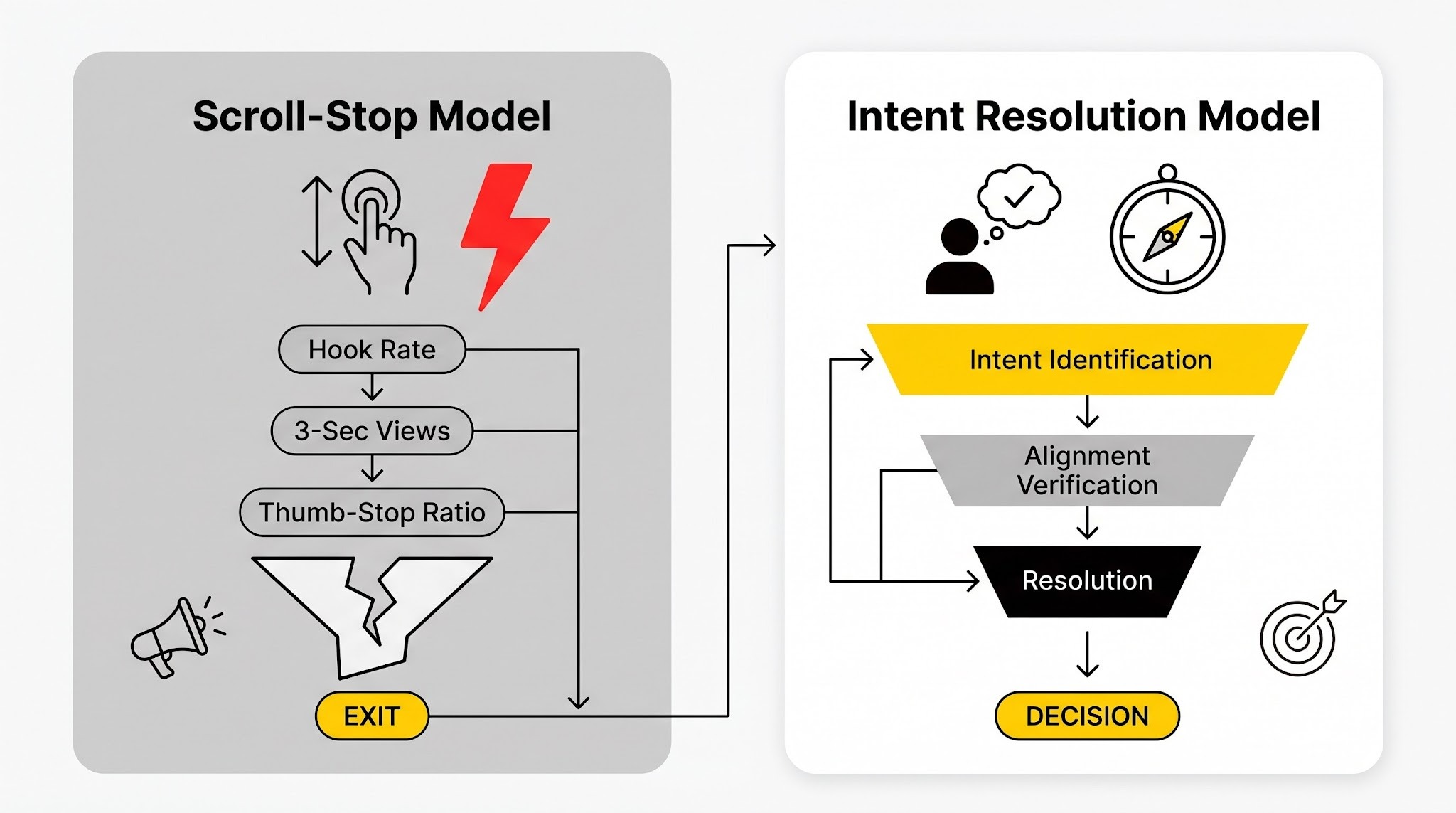
The scroll-stop framework is seductive because it feels measurable. Hook rate, three-second video views, thumb-stop ratio: these metrics look like performance signals. But they measure the beginning of an interaction, not the quality of it. A jarring image stops scrolls. A loud noise stops scrolls. Neither one drives purchase decisions.
What the scroll-stop model consistently misses is intent alignment. When someone pauses on an ad, the only question that matters is whether what they see next matches what they actually need. If the hook creates curiosity about something the product can't deliver, you haven't captured a customer. You've captured a click that exits. Conversion rates suffer, ad spend gets wasted, and the creative team ends up chasing a new hook when the real problem was never the hook at all.
Performance creative should be evaluated on its ability to move someone from an unresolved need to a decision. That's a fundamentally different design challenge than surprise or disruption.
From Persuasion-Based to Resolution-Based Creative
Traditional persuasion frameworks treat the audience as someone who needs to be convinced. Creative gets built to overcome resistance, manufacture desire, or manufacture urgency. This can generate short-term lifts, but it creates a fragile relationship because it's always working against something.
Resolution-based creative works differently. It starts from a genuine understanding of what the customer is trying to solve, then builds assets that position the product as the natural answer to that specific tension. The message doesn't have to work hard to persuade because it's already aligned with what the person is looking for. The audience feels understood rather than sold to.
That shift changes how a performance creative team approaches the entire production process. The question is no longer "what will make someone stop?" but "what does someone in this moment of need actually need to see?" That reframe touches everything from the opening frame of a video to the copy on a landing page, creating a throughline that persuasion-based models often lack.
Search Intent Is Your Most Honest Creative Research Dataset
No dataset tells you more about customer psychology than the unfiltered search bar. When someone types a query into Google, they're not performing for an audience. They're expressing a real need in real language, at the exact moment that need is active. For any performance creative strategy grounded in truth rather than assumption, search data is the place to start.
The value isn't just in finding keywords. It's in reading the emotional and psychological texture underneath the language people use. The difference between "best running shoes for flat feet" and "why do my feet hurt after running" isn't a difference in topic. It's a difference in where someone is in their journey, how much they understand about their problem, and what kind of creative will actually land.
How Unfiltered Queries Map to Psychological Clusters
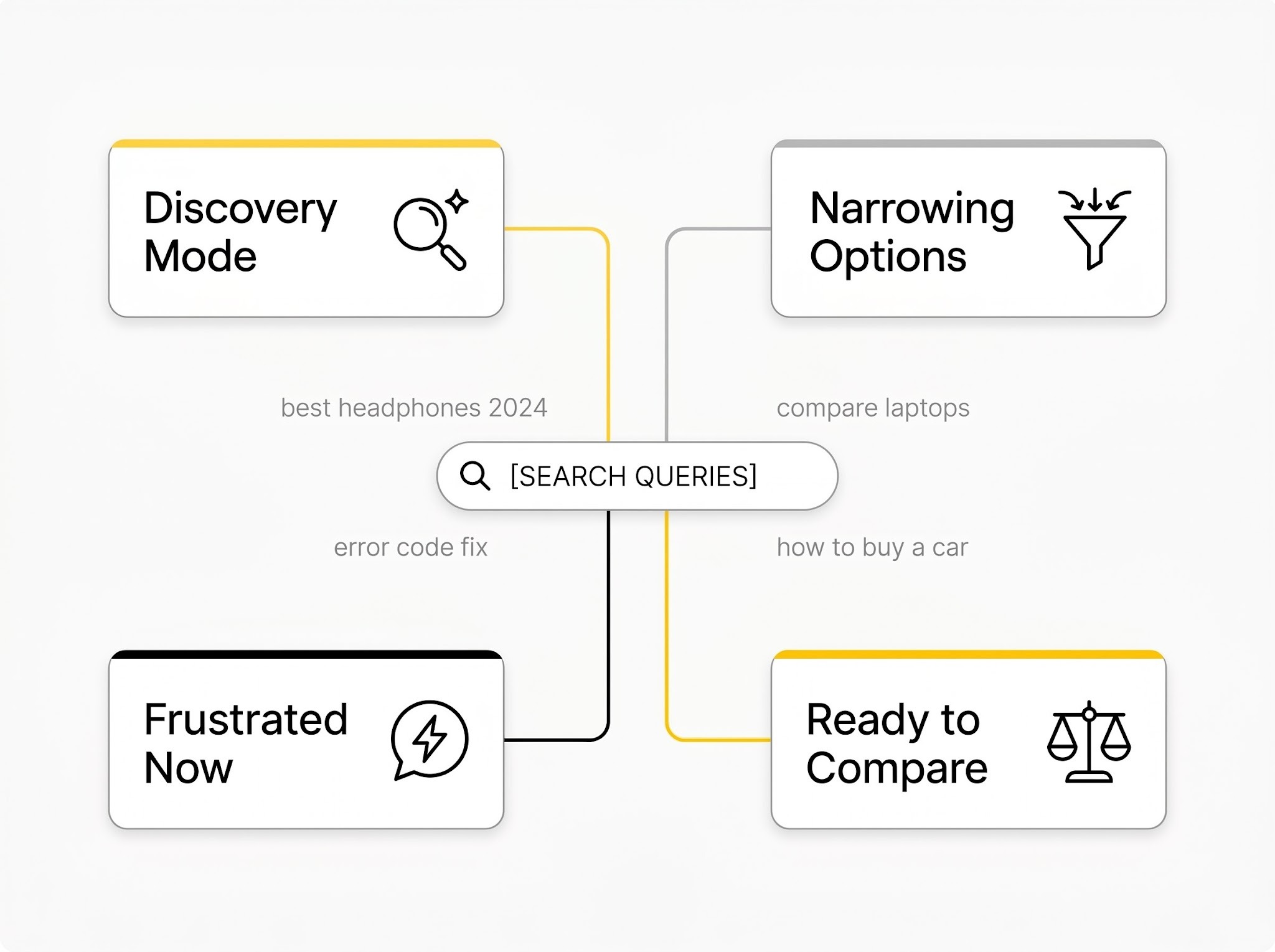
When search data is pulled at scale, patterns emerge that go well beyond category or product type. Queries cluster around psychological states: people researching broadly, people who've narrowed their options, people experiencing frustration right now, people comparing specific solutions. Each cluster reflects a distinct mindset, and each mindset calls for a distinct creative approach.
Consider the difference between "how do I know if my mattress is causing back pain" versus "best mattress for back pain under $1,000." The first is someone in discovery mode, uncertain and seeking information. The second is someone ready to evaluate. Mapping creative to these psychological clusters means teams are no longer guessing what message to lead with. The audience has already said.
This transforms creative research from a brainstorm into a diagnostic process. You're not inventing angles. You're surfacing the angles the audience is already using.
Aligning Creative to Intent at Every Funnel Stage
At the top of the funnel, creative should speak to the tension or category problem without assuming prior knowledge of the brand. Someone encountering a product for the first time needs context before they need a call to action. In the middle, specificity matters: social proof, ingredient claims, comparison content. These assets work because the audience is already curious and wants to validate their interest. At the bottom, the job is to resolve the last objection standing between consideration and conversion, whether that's a guarantee, a specific use case, or a risk reversal.
When creative is mapped to these stages systematically, the entire campaign ecosystem becomes more efficient. Every dollar spent reaches an audience with the right message at the right moment.
The Unifying Model: Search Reveals, LLMs Organize, Creative Translates
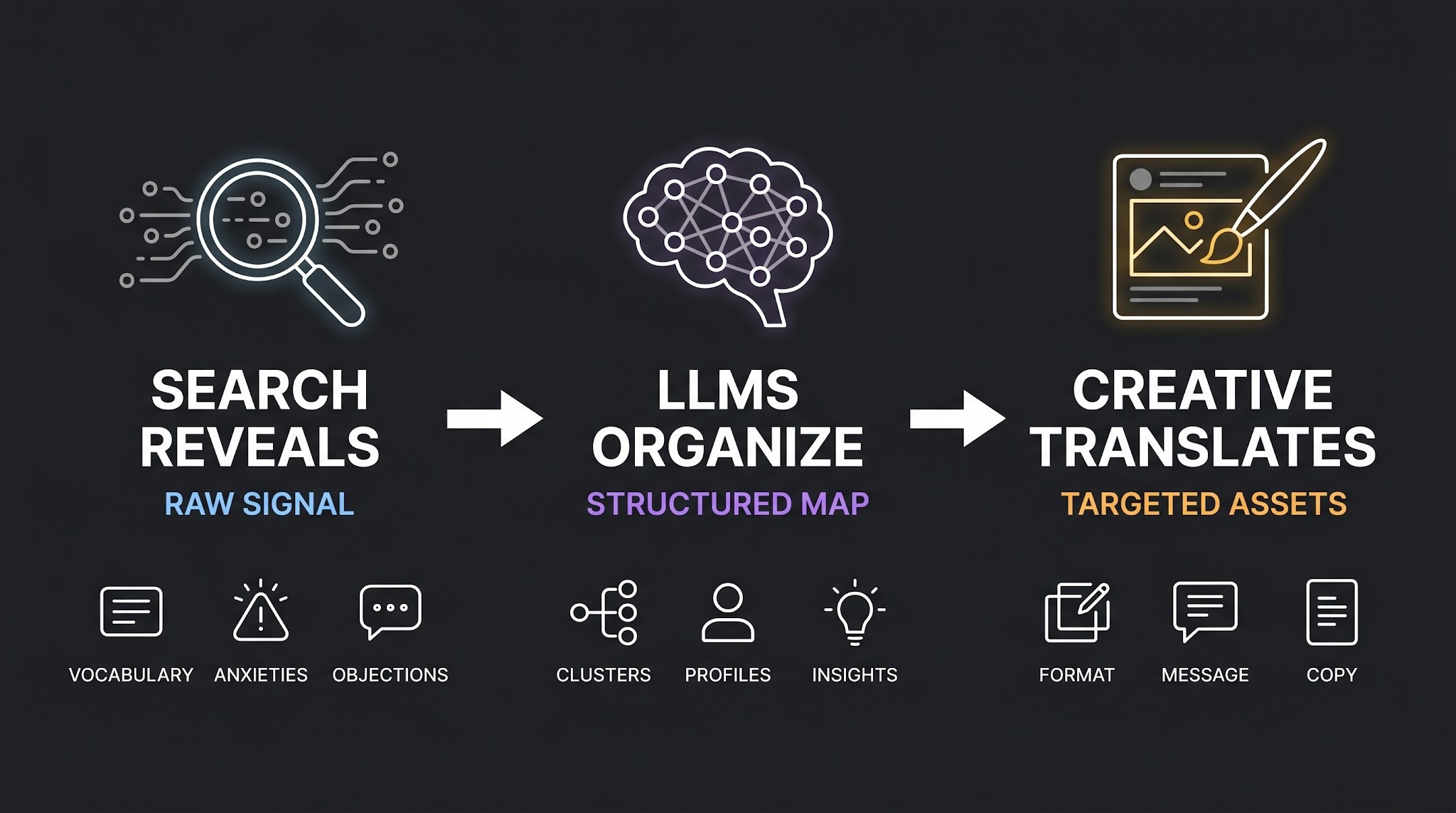
The most effective creative research workflow combines three layers: search data as the raw signal, large language models as the organizational layer, and creative production as the translation layer.
Search reveals what people are actually thinking: the vocabulary, the anxieties, the comparisons, the objections. On its own, that data can be overwhelming. A single product category might generate thousands of distinct query variations. Large language models change that equation. Fed search clusters with the right prompting framework, an LLM can synthesize patterns, group queries by psychological profile, and surface insights that would take a human analyst days to compile. The result is a structured map of the audience's intent landscape, ready to hand off to the creative team.
That's where creative translation begins. The strategist's job is to take that organized intent data and find the format, message architecture, and creative approach that gives each cluster what it's looking for. The starting point is rigorous and grounded in real customer language rather than internal assumption.
Performance Creative as Targeting in the Meta Andromeda Era
Meta's Andromeda system has fundamentally changed the relationship between creative and targeting. Where advertisers once relied heavily on defined audience parameters, the creative asset now does most of the targeting work. Meta's system analyzes the visuals, text, audio, and context of creative to build a semantic fingerprint that determines which users are most likely to respond. Poorly aligned creative doesn't just underperform. It actively misdirects spend by attracting the wrong audience.
Recognition Hooks Over Thumb-Stoppers
Where a thumb-stopper is designed to surprise or disrupt, a recognition hook is designed to generate an immediate sense of familiarity: the phrase or scenario that makes someone think, "That is exactly my situation."
Recognition hooks work because they signal to the viewer that what follows is relevant to them. They reduce the cognitive resistance that comes with encountering advertising, replacing it with genuine interest. For teams that have done the work of mapping search intent to psychological clusters, building recognition hooks becomes a precise exercise. The language is already known. The frustrations are already mapped. The hook practically writes itself.
This is also why trend-chasing creative often underperforms for direct-response objectives. A trend-based hook might stop scrolls broadly, but recognition hooks stop the right scrolls.
Creative Differentiation and Algorithmic Bucketing
When an ad set fills with variations that make the same argument in slightly different formats, the campaign isn't testing. It's saturating. As Braydon Germain, Content Manager at Pilothouse, put it on the DTC Podcast (Ep. 589), the working rule of thumb: unless new creative is roughly 70% different from existing assets, Meta's algorithm tends to treat it as a redundant variant rather than a distinct signal. The result is collapsed differentiation, shortened creative lifespan, and rising CPAs.
An operational principle that addresses this: ensure that a meaningful majority of creative in rotation is testing genuinely different angles, intent clusters, or funnel stages, while a smaller portion holds space for proven performers. This ratio keeps the ecosystem dynamic enough to surface new winners without abandoning what works. It also forces a discipline around creative diversity that teams often resist when a single ad is generating strong returns. Diversity across message architectures and intent clusters isn't optional at scale. It's what sustains performance past the initial campaign spike.
Building a Living Library of Cumulative Creative
Most teams build assets for a campaign, run it, review summary results, and move on. The specific insights about which message themes or offer structures drove performance rarely get captured in a way that informs the next brief.
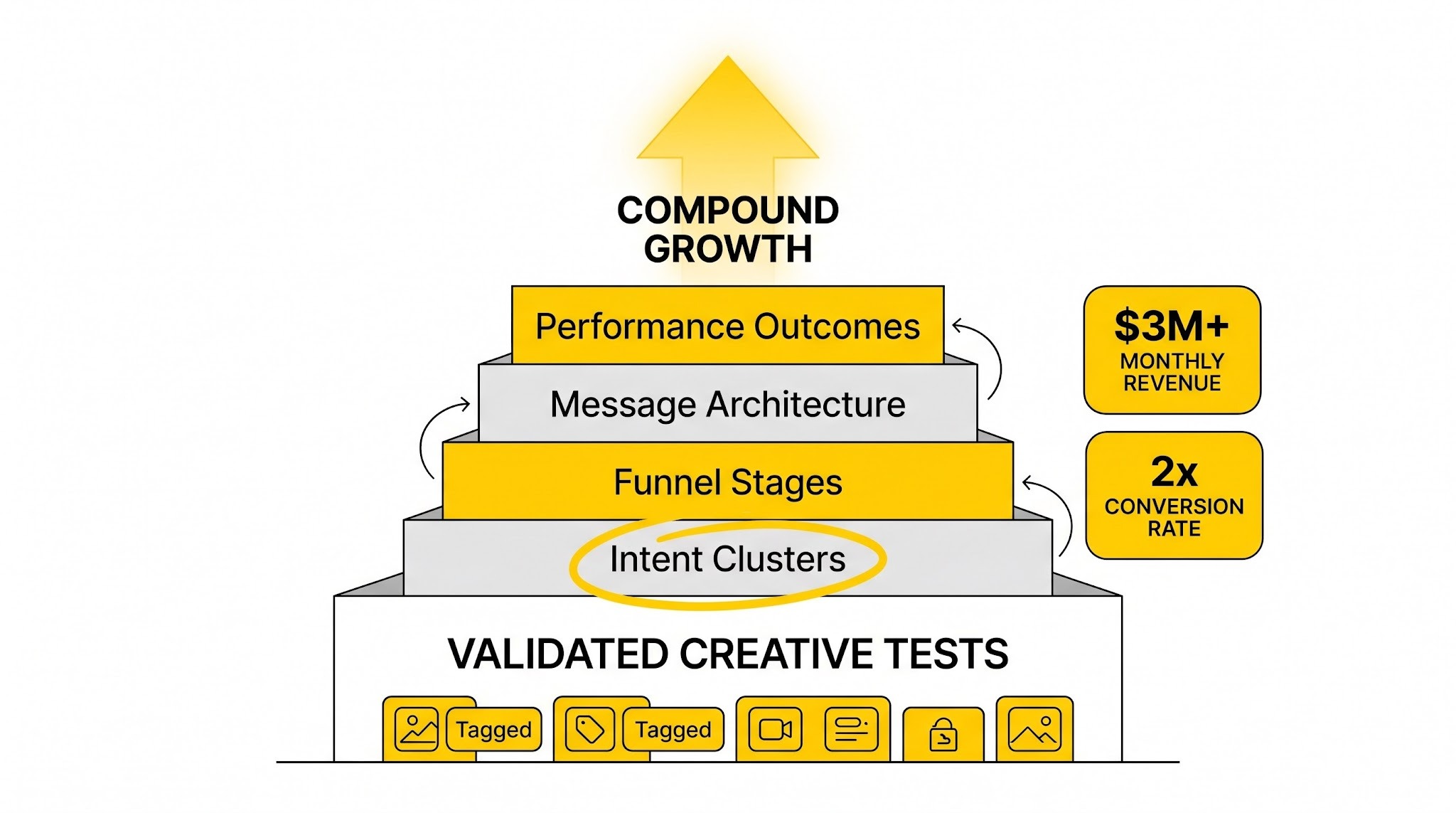
A living library approach changes this. Every creative asset gets tagged by the intent cluster it was designed to address, the funnel stage it occupied, the message architecture it used, and the performance outcome it achieved. Over time, this library becomes a pattern recognition tool. Teams can see that reassurance-based creative outperforms comparison-based creative for a particular audience segment. They can identify which visual and copy combinations compound versus spike and fade.
The compounding effect of this approach is what shows up in long-term brand outcomes. Across Pilothouse case studies, partnerships sustained over multiple years produce results that single-campaign thinking cannot reach: Four Sigmatic scaling to a top-selling Amazon position, Songfinch reaching $3M+ in monthly revenue, Manly Bands doubling conversion rates. These outcomes come from accumulated learning across hundreds of validated creative tests, not from any single winning ad. For a team working across Meta, Google, TikTok, and email, this kind of cumulative intelligence shortens the learning curve on every new campaign. You're building on a foundation of resolved intent, not starting from zero.
The Reassurance Pattern: How Intent Resolution Compounds Into Brand Loyalty
A specific pattern emerges when intent resolution is applied consistently over time. Call it the reassurance pattern. It happens when creative has reliably addressed the right need at the right moment across enough touchpoints that customers develop a conditioned sense of trust toward the brand.
This isn't loyalty built on discounts or email frequency. It's loyalty built on the repeated experience of feeling understood. When an ad speaks precisely to the need a customer is sitting with, when the site messaging continues to resolve their specific concern, when post-purchase communication addresses the questions they were about to ask, a pattern forms. The brand becomes associated with resolution rather than noise.
That compound effect is what separates short-term creative performance from long-term brand equity. The tactics are the same. The difference is intentionality and system design. A team that treats each campaign as an isolated execution will generate results. One that builds toward a cumulative intent resolution model will generate brands.
The scroll was never the point. The person holding the phone is.

