Meme Advertising vs Studio Creative: Which Wins for Your Brand?
.jpg)
Somewhere in a brand's ad account right now, a blurry meme with Impact font is outdelivering a polished studio spot that cost thousands of dollars to produce. In another account, the opposite is happening: a cinematic product film is closing sales that scrappy social content brought in but couldn't convert. Both outcomes are real, and both get used as evidence that one format beats the other.
That framing is the problem. Meme advertising and studio creative aren't competing for the same job. They resolve different frictions, at different points in the buying decision, for different states of mind. Picking a winner in the abstract is the wrong exercise. The useful question is which format wins for your brand, at which stage, and why. Get that right and the two formats stop looking like alternatives and start looking like a system.

The Wrong Question: Why Meme Advertising vs. Studio Creative Is a False Choice

Most brands frame this as a competition. They look at performance data, see memes beating studio content on click-through rate or cost per acquisition, and start asking whether they should cut the expensive stuff. That's the wrong question, and it usually leads to the wrong answer.
The more accurate frame is: what question is the customer holding at this moment, and which format resolves it? Meme advertising and studio creative don't compete. They operate at completely different points in the consumer relationship and resolve different psychological frictions. One is built for ignition, the other for conversion. When brands treat them as substitutes rather than complements, they end up with an ad account that either can't find the right audience or can't close them once it does. The brands that figure this out stop debating format and start thinking about function.
Meme Advertising as a Targeting Fingerprint in the Andromeda Era

Meta's Andromeda algorithm update fundamentally changed how creative content gets distributed. The system now uses the creative asset itself as a core targeting signal, reading content to understand who it should reach rather than relying primarily on manually defined audience parameters. In that environment, meme advertising becomes something more than an engagement tactic. It becomes a targeting tool.
When a brand runs a meme built around a specific cultural reference, a niche frustration, or a particular type of humor, the goal isn't just relatability. The content feeds the algorithm a fingerprint. It tells the system exactly which kind of person should see it, and the system finds them.
How Niche Humor Routes Ads to the Right Persona
Niche humor communicates something precise. A meme that resonates with first-time homeowners struggling with contractor quotes isn't for everyone. It's for a specific person with a specific problem at a specific life stage. That shared context is what makes the joke land, and it's precisely the information the algorithm needs to route the ad correctly. As Aves Valerio, Lead Content Manager from Pilothouse puts it on Ep 46 of the Adventurous podcast, meme creation is fundamentally about building shared language, an internet inside joke that signals belonging to a specific audience.
Generic creative is harder to place because it doesn't signal who it's for. Niche meme content works because the humor is self-selecting. People who don't relate scroll past. People who do engage, click, and often share. That behavioral signal confirms the targeting and reinforces distribution to exactly the right persona.
The Algorithm Advantage: Why Specificity Beats Broad Appeal
Broad appeal sounds like a strength, but in paid media it often produces diluted results. When content tries to speak to everyone, it generates weak signals across many audience segments rather than strong signals within one. The algorithm interprets low engagement as low relevance and pulls back distribution accordingly.
Tightly targeted meme content does the opposite. It generates concentrated engagement from the people who genuinely resonate with it. That density of signal tells the algorithm the content belongs in front of more people like those already engaging, producing stronger delivery, lower costs, and better-qualified traffic without manual audience targeting.
Studio Creative as the Authority Anchor
Studio creative earns its place in the creative stack not by finding the audience, but by converting them once they're found. When a consumer moves from a meme to a product page, or from an interest-level touchpoint to a purchase decision, what closes the gap is trust. Polished production provides that trust. According to a WARC and Kantar analysis matching ~450 ads against profit ROI data, high-quality creative drives more than four times the profit of low-quality creative (profit ROI of 6.62 versus 1.42), which means underinvesting in production-level content carries a real, measurable cost.
A well-produced ad communicates investment. It signals that the brand takes itself seriously and, by extension, takes the customer seriously.
Resolving Deep Conversion Friction That Memes Cannot Fix
Memes can create awareness and drive clicks. They're not built to handle objections, explain product complexity, or rebuild trust with a skeptical consumer. When a purchase decision requires education, high-quality studio content steps in to do that work. A well-crafted video or image sequence can walk a prospect through the value proposition, address hesitation points, and position the brand with enough authority to complete the sale.
This matters especially for products that need to be seen in action before their value is obvious. Treating studio creative as overhead in those contexts is a costly miscalculation. It's doing conversion work that meme campaigns simply weren't designed for.
Why Polished Production Signals Product Legitimacy
Quality creative carries a shortcut signal for consumers: if the brand invested in this, they probably invested in the product too. That association isn't always conscious, but it's real. Low-production content, even when it performs well at the top of the funnel, can introduce subtle doubt at the moment of conversion.
For most DTC brands, the right balance is using meme content to drive interest and polished content to close. The two formats work together across the funnel, each doing what it does best. Pull one out of the stack entirely and that's where performance deteriorates.
Relatability vs. Aspiration: What Each Format Actually Sells

Meme marketing sells relatability. Studio creative sells aspiration. Those are not the same offer, and they don't resonate with the same buyer at the same moment.
Memes and the Commiseration Effect
A brand meme that acknowledges a shared frustration, calls out the absurdity of a common problem, or gently pokes fun at something the audience already complains about creates an immediate sense of alignment. The brand stops feeling like a vendor and starts feeling like a participant in an existing conversation.
That emotional positioning is genuinely difficult to manufacture through traditional creative. For categories where trust is the main barrier to purchase, the shift in brand perception that comes from a well-executed meme can directly move conversion metrics.
Studio Content and the Aspiration Signal That Justifies the Price
Aspirational content does something memes structurally cannot: it creates desire by showing the consumer who they could become with the product. Well-executed studio creative tells a visual story about transformation, quality, and lifestyle alignment. For categories where the price point requires emotional justification, that storytelling is what converts. Meme campaigns can warm the audience, but aspiration-driven studio content is often what finally tips the decision.
High-AOV and Luxury Brands: Where Scrappy Creative Becomes a Liability
Not every brand benefits equally from meme advertising. For high-average order value and luxury brands, the equation shifts significantly. These categories rely on perceived exclusivity and a consistent visual identity that communicates premium value at every touchpoint. When scrappy or low-budget creative appears in that environment, it doesn't just underperform. It actively undermines brand positioning.
A consumer considering a $1,200 purchase is running a legitimacy check at every stage of the experience. If the ad creative looks thrown together, it introduces doubt about whether the brand deserves the price. Meme formats can work in these categories, but they require a level of cultural precision that maintains the premium signal while still landing the humor. Most attempts fall short. For luxury brands, studio creative as the primary format is generally the lower-risk, higher-return decision, with meme formats reserved for top-of-funnel awareness where brand equity is less directly at stake.
The Dialect Problem: Why Bad Meme Advertising Damages More Than It Helps
Memes have a dialect. Every subculture, demographic group, and online community has its own version of what's funny, what references land, and what reads as authentic versus forced. When a brand gets that dialect wrong, the response isn't indifference. It's rejection.
Bad meme advertising signals that a brand is trying too hard, doesn't understand its audience, or is appropriating a cultural reference it hasn't earned. A misdirected meme campaign doesn't fade into irrelevance the way a poorly performing display ad does. It becomes a story people share, and not in the intended way.
Brands that use memes without genuinely understanding the cultural context they're entering often end up paying twice: once for the campaign, and again in reputation repair. Studio content is structurally safer for brands without a confirmed meme-literate voice. Getting the dialect right requires either deep cultural fluency or the willingness to work with people who have it.
Building a Cumulative Creative Library That Scales Your Ad Account
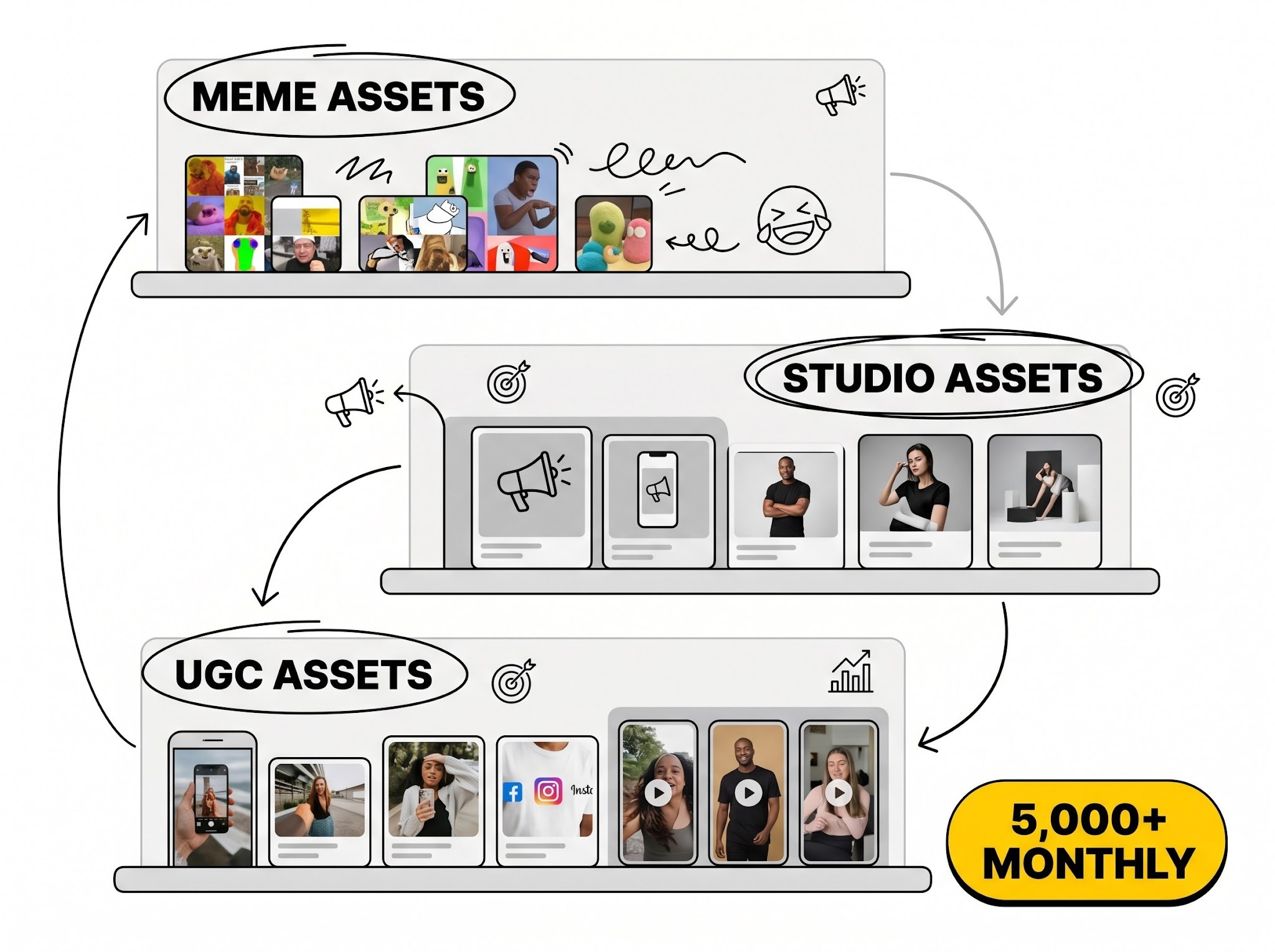
The most durable creative strategy isn't a single viral moment. It's a growing library of assets that covers multiple audience entry points, multiple funnel stages, and multiple emotional tones. Pilothouse produces over 5,000 creative assets monthly, an approach built on treating creative as a compounding system rather than a one-time production sprint. The Pilothouse case studies reflect how creative diversity, not format uniformity, drives sustained performance across accounts.
How the Formats Work Together as a System
A cumulative creative library includes meme campaigns that target specific personas with niche humor, studio content that anchors brand authority and handles conversion-level objections, and UGC assets that bridge the two by combining authenticity with narrative depth. Each format feeds the others. Memes surface new audience segments; studio content converts them; data from both informs the next iteration.
When built this way, an ad account becomes increasingly efficient over time. Signals accumulate about what resonates with which persona at which stage, and that intelligence sharpens the next round of creative.
The Goal Is a Living Library, Not a Format Winner
The brands that scale sustainably aren't the ones that found one format that worked. They're the ones that built a system consistently generating and learning from a diverse range of creative. Memes generate heat, cultural recognition, and algorithmic routing. Studio creative closes the sale, builds trust, and justifies price. Together, they constitute the infrastructure of a scalable ad account.
The goal isn't to pick a winner. It's to build a library where each format earns its place by resolving something the other cannot.


.jpg)




.png)
.png)