Ecommerce Google Ads Strategy: How to Scale Profitably
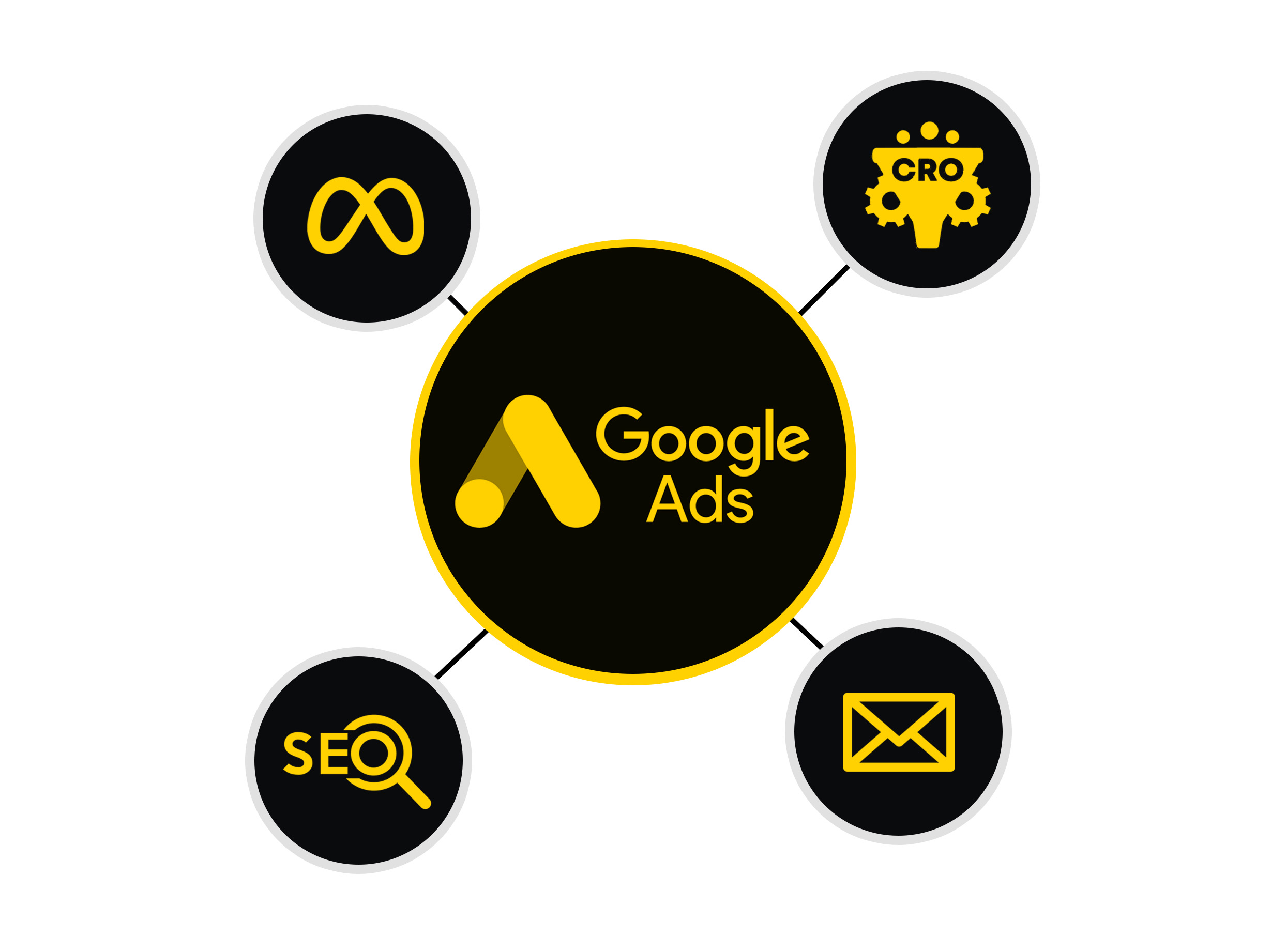
Most ecommerce brands approach Google Ads like it's an island. They pursue platform metrics, testing inside isolated campaigns, and wondering why profitable scale keeps slipping away. But the brands that actually break through treat Google Ads as the central hub of their entire marketing system. They build strategies where data flows between channels, creative insights feed every campaign, and budget decisions are made based on real business impact, not vanity metrics.

Why Most Ecommerce Google Ads Strategies Hit a Wall
The path from decent Google Ads performance to profitable scale breaks down at predictable spots. Most strategies fail because they optimize for signals that lie about business health. A campaign might show strong ROAS while quietly cannibalizing organic traffic or repeatedly hitting audiences that email campaigns are already converting. Without seeing those connections, brands end up making budget decisions based on half the story.
The second breakdown happens when brands treat Google Ads like a closed loop. They test ad copy in Shopping campaigns, get excited about click-through rates, and scale based purely on Google's version of what worked. Meanwhile, they're missing that winning ad angles should immediately inform Meta creative, that product messaging tested in Search reveals positioning gold for the entire brand, and that audience patterns guide strategy far beyond Google's dashboard.
The Standalone Channel Trap and Attribution Blind Spot
Standalone optimization creates blind spots that mess up everything. HBR data shows 73% of ecommerce customers bounce between multiple channels before buying, with the average customer hitting 6.5 touchpoints along the way (Marketing LTB). When you judge Google Shopping performance without considering how those ads play with Meta retargeting, email sequences, and organic search, you're fundamentally confused about what actually drives sales. A customer discovers your product through a Shopping ad, researches via organic search, gets an abandoned cart email, and then converts through a Meta retargeting ad. Single-channel attribution gives credit to the last touchpoint, hiding Google's role in starting the whole journey.
This blind spot makes brands underfund the channels generating awareness while throwing money at final-touch conversion points. The whole system gradually weakens. New customer acquisition slows because you're cutting upper-funnel investment, while retargeting costs spike as your prospect pool shrinks. Brands double down on what looks like it's working based on last-click data, speeding up the cycle.
Building the Foundation: Tracking and Data Infrastructure
Profitable scaling starts with tracking that actually captures what happens across channels and devices. Without enhanced conversions and server-side tracking, you're optimizing blind. Browser restrictions and privacy changes keep eroding cookie-based accuracy, creating bigger gaps between what you see reported and what's really happening. These gaps get worse as you scale, making smart budget allocation nearly impossible.
The product feed is another foundational piece most brands waste. Strategic feed optimization goes way beyond meeting Google's technical requirements. It weaves in customer language patterns from search data, tests product titles against real search behavior, and structures descriptions to match purchase intent at different funnel stages. By aligning keyword targeting, ad messaging, and product feed optimization, Pilothouse Digital helped a home and lifestyle brand generate $900,000 in revenue in Q1 2025.
Enhanced Conversions and Server-Side Tracking
Enhanced conversions use your first-party data to improve attribution when cookies fail or browsers block tracking. You send hashed customer information to Google, letting the platform match conversions that standard tracking misses. Turning on Enhanced Conversions typically delivers an increase in tracked conversions, giving you more reliable signals so you can confidently increase budgets without worrying about optimization drift.
Server-side tracking adds another reliability layer by processing conversion data through your server instead of relying only on browser pixels. This approach captures on average 12% more conversions compared to standard browser tracking, grabs conversions that ad blockers would otherwise kill, and feeds cleaner data to machine learning algorithms (Micky Weis). For ecommerce brands working with thin margins, this accuracy boost directly impacts profitability by preventing budget allocation based on garbage data.
Product Feed as a Strategic Asset
Product feed optimization extends beyond checking technical boxes into real differentiation. Incorporating customer search language into product titles improves relevance matching and quality scores. Testing description formats against conversion rates reveals messaging frameworks that work everywhere. Organizing product categories around shopping behavior rather than your internal taxonomy increases click-through rates and cuts wasted impressions.
The strategic feed also powers sophisticated bidding. When product margin data flows into the feed, Smart Bidding algorithms can optimize for profit instead of just revenue. Seasonal inventory signals enable automated bid adjustments that align with business priorities. This integration transforms your product feed from a static data dump into a dynamic strategic asset guiding algorithm decisions toward actual business goals.
Campaign Architecture for Integrated Growth
Campaign architecture determines how well you can test, learn, and scale. The structure needs to balance machine learning efficiency with strategic control, letting algorithms optimize within guardrails that reflect business priorities. Performance Max campaigns work as testing and learning engines when properly constrained, while Standard Shopping and Search campaigns provide strategic layering that captures intent at different funnel stages.
The architecture should make insights flow between campaign types and across channels. This progression from structured testing to evergreen deployment eliminates lag between discovering what works and scaling it profitably.
Performance Max as Your Testing and Learning Engine
Performance Max campaigns tap machine learning across Google's entire inventory, but without strategic constraints, they often optimize for volume over profit. The smart approach uses Performance Max for specific testing objectives: discovering new audience segments, validating creative approaches, or spotting unexpected product-market fit signals.
Performance Max works best for brands with substantial product catalogs and decent conversion volume (typically 50+ SKUs and at least 30 conversions monthly). Smaller catalogs usually see better results from Standard Shopping with granular control. The trick is interpreting Performance Max signals rather than blindly accepting algorithmic decisions. When a particular asset group drives outsized results, that insight should shape creative testing in Shopping campaigns, inform Meta audience targeting, and guide email segmentation.
Standard Shopping and Strategic Search Layering
Standard Shopping campaigns give you control that Performance Max trades for reach. This control lets you make precise bid adjustments based on product margin, inventory levels, or strategic priorities. Brands scaling profitably use Shopping campaigns to maintain baseline performance while testing expansion through Performance Max.
Strategic Search layering captures customers at different intent levels. Broad match modified campaigns with Smart Bidding identify unexpected search patterns and customer language. Exact match campaigns protect brand terms and high-intent product searches with appropriate bid premiums. Dynamic Search Ads discover long-tail opportunities that manual keyword research misses. This layered approach ensures comprehensive coverage while keeping strategic control over the highest-value traffic.
The Structured Testing Framework That Eliminates Wasted Spend
Unstructured testing burns money on inconclusive experiments and scales tactics before validation. A structured framework sets clear success criteria before launch, isolates variables for clean reads, and progresses from pilot tests to scaled deployment only after statistical significance. This discipline prevents the common pattern of endless testing that never graduates from winning tactics to meaningful scale.
The framework works in stages: hypothesis formation based on data rather than gut feeling, pilot testing with an appropriate budget and duration to reach significance, analysis considering both platform metrics and business outcomes, and deployment into evergreen campaigns with ongoing monitoring.
How RUX Doubled ROAS Through Systematic Cross-Channel Deployment
When RUX partnered with Pilothouse Digital, its Google Ads campaigns were achieving a ROAS of 1.4X, functional but far from the brand’s true potential. Pilothouse’s audit found that Performance Max campaigns were over-emphasizing low-margin products with a flat target ROAS and lacked product-level margin signals.
The team overhauled the infrastructure, implementing margin data within product feeds and setting tailored ROAS targets by product category. They then applied a rigorous regime of creative and messaging tests using Performance Max asset groups, systematically identifying which combinations drove meaningful performance improvements.
A key lever was the cross-channel orchestration: when Pilothouse identified high-performing creative and messaging on Google, those insights were quickly used across additional channels, including Meta and email, providing a unified structure to the customer journey.
By moving only proven tactics from pilot into scaled, always-on campaigns, RUX’s Google Ads account ROAS rose by 111%, reaching as high as 3X. At the same time, Google ad spend increased by 300% over 90 days, transforming what used to be incremental testing into measurable growth. Pilothouse attributes these results to stronger optimization signals (margin-based bidding), robust creative testing, and agile cross-channel execution. This sustainable system continues to help RUX deploy winning campaigns and creative across multiple channels faster than ever before.
Scaling Profitably: Reading Signals and Budget Allocation
Profitable scaling requires reading performance signals accurately and allocating budget based on true business impact rather than what channels report. Brands that scale successfully distinguish between growth opportunities that improve overall marketing efficiency and those that simply shuffle revenue attribution between channels. They understand the difference between horizontal scaling (expanding reach into new audiences) and vertical scaling (increasing investment in proven tactics).
Horizontal vs. Vertical Scaling Approaches
Horizontal scaling expands into new audience segments, geographic markets, or product categories. This approach discovers growth opportunities beyond current campaigns but requires accepting lower initial efficiency as new tactics prove themselves. Horizontal scaling typically shows efficiency drops of 15-30% initially as algorithms learn new audiences. Plan for a 60-90 day optimization period before expecting pilot-level performance. When Journee increased Q4 orders by 80% year-over-year with click-through rates up 354%, horizontal scaling through audience expansion drove much of that growth (Pilothouse Digital).
Vertical scaling increases investment in validated tactics and audience segments. This approach maintains efficiency while capturing more volume from proven opportunities. The risk is reaching saturation points where additional investment yields diminishing returns. Effective scaling strategies balance both approaches, using horizontal tests to discover new opportunities while vertical scaling captures maximum value from validated tactics before efficiency degrades.
Optimizing for Real Profitability: The MER and Blended ROAS Framework
Channel-specific ROAS metrics guide tactical decisions but mislead strategic ones. A Google Shopping campaign might show strong ROAS while cannibalizing organic traffic that would have converted anyway. A Search campaign might look unprofitable on a last-click basis while generating crucial awareness that drives conversions through other channels. Marketing Efficiency Ratio (MER) and blended ROAS frameworks solve this by measuring total revenue against total marketing spend.
MER calculation divides total revenue by total marketing spend across all channels. For ecommerce brands, healthy MER typically falls in the 3.0-5.0 range, though this varies by industry and margin profile (Human Marketing). Beauty and cosmetics brands often see 3.0 as typical, while higher-margin products like fashion commonly achieve 5.0 or above. This metric reveals whether increased Google Ads investment improves overall marketing efficiency or simply shifts attribution between platforms.
Blended ROAS complements MER by tracking channel-specific performance within the system-level context. Together, these frameworks guide budget allocation decisions that improve actual business outcomes rather than optimizing for metrics that don't reflect profitability.
The CorneaCare case demonstrates this principle in action. The brand achieved 3595% revenue growth alongside a doubled profit margin. Those results came from eliminating wasted spend revealed through MER analysis and tighter cross-channel feedback loops. When brands shift focus from channel ROAS to system-level efficiency, they discover optimization opportunities that isolated channel management misses entirely.
Resource Requirements and When This Approach Fits
System-level Google Ads strategy delivers transformational results, but requires specific conditions to execute effectively. This approach demands significant tracking infrastructure investment and typically makes sense for brands spending $15,000+ monthly across channels. Brands with smaller budgets should establish foundational tracking (enhanced conversions, server-side implementation, margin-based product feeds) before attempting full cross-channel orchestration.
What Brands Need in Place to Make It Work
The testing framework requires sufficient conversion volume to reach statistical significance within reasonable timeframes. Performance Max campaigns need a minimum of 30 conversions monthly to optimize effectively. Brands below this threshold should focus on Standard Shopping and Search campaigns that allow more granular control with less data dependency.
Cross-channel insight deployment assumes you're running multiple paid channels. A brand advertising only on Google Ads still benefits from systematic testing and MER tracking, but misses the leverage that comes from deploying winning angles to Meta, email, and other touchpoints within days of validation.
Team bandwidth matters too. This approach requires someone who can analyze performance across platforms, spot patterns, and coordinate deployment. Smaller teams might implement the testing framework but delay cross-channel orchestration until they can dedicate proper attention to insight translation.
When to Hold Back and Focus on the Fundamentals
The payoff scales with complexity. Brands with 50+ SKUs, multiple audience segments, and established multi-channel presence see the largest returns from an integrated strategy. Single-product brands or those just starting paid acquisition should build the foundation (proper tracking, margin-based optimization, systematic testing) before layering on cross-channel coordination.
How Pilothouse Digital Approaches Ecommerce Google Ads Strategy
Pilothouse's approach centers on system-level orchestration rather than isolated channel optimization. Every implementation begins with a cross-channel tracking infrastructure that captures accurate attribution. Campaign architecture balances machine learning efficiency with strategic control that reflects business priorities. Testing frameworks progress from structured pilots to scaled deployment only after clear validation.
The methodology emphasizes extracting maximum insight value from every test. When ad copy performs in Google Search campaigns, those insights immediately shape Meta creative, email subject lines, and product descriptions. When audience segments respond to specific messaging angles, that learning expands targeting across every channel. This transforms Google Ads from an acquisition channel into a strategic learning engine that improves performance across the entire marketing ecosystem.
Scaling ecommerce profitably through Google Ads requires moving beyond tactical channel management into system-level strategy. The brands that achieve sustainable growth understand that their Google Ads performance exists within an interconnected marketing ecosystem. They invest in tracking infrastructure that captures accurate signals, implement testing frameworks that eliminate waste before scaling, and measure success through metrics that reflect actual business impact.
Explore detailed case studies and methodology at Pilothouse's case study library to see how system-level Google Ads strategy drives transformational ecommerce growth.


.jpg)
.jpg)




.png)


.png)