DTC Marketing Strategy: When Optimization Becomes a Tactical Spin Cycle

Teams move fast. CPMs fluctuate. ROAS holds steady. Creative rotates. Everything looks efficient on paper, yet revenue growth flatlines for quarters straight. This is the tactical spin cycle, when a dtc marketing strategy becomes a collection of optimized channels rather than a unified growth system.
Most direct-to-consumer brands hit this wall between $5M and $15M in revenue. The tactics that worked in the past are no longer delivering results. Teams know how to buy media, but the strategic connective tissue between channels has disappeared. Breaking free requires seeing the entire consumer journey as one system and distinguishing between outputs measured daily and outcomes that actually drive business value.

What Is the Tactical Spin Cycle in DTC Marketing?
The tactical spin cycle happens when optimization becomes the strategy itself. Teams tweak ad copy, adjust bids, test audiences, and refresh creative on a predictable cadence. Every action feels productive because something is constantly moving, yet the business isn't growing as quickly as it should.
This pattern emerges when brands confuse activity with progress. Teams become excellent at managing inputs like spend, impressions, and click-through rates. They build dashboards tracking dozens of metrics across multiple channels. But tactical excellence doesn't translate into sustainable, profitable growth.
The Positive Feedback Loop That Kills Growth
Good tactics create dangerous feedback loops. Teams test five ad variations, one wins, so they scale it. ROAS holds steady, so they allocate more budget. The short-term signal says they're winning, so they keep doing exactly what they're doing.
This loop feels rational because the data supports it. Performance metrics hold or improve incrementally. But brands optimize toward a local maximum while missing the bigger picture. The problem compounds when this pattern repeats across every channel—Facebook runs one playbook, Google runs another, and email operates independently. Each team hits its targets, yet the business underperforms.
Confusing Outputs for Outcomes
Outputs are what teams measure daily: impressions, clicks, conversions, ROAS. Outcomes matter: customer lifetime value, market share growth, sustainable margin expansion. Most teams spend 95% of their time optimizing outputs while outcomes drift.
This confusion happens because outputs are concrete and immediate. Teams can test creative variations and see results within 48 hours. They can adjust bids and watch CPA move in real time. Outcomes take months to materialize, requiring patience, strategic coordination, and willingness to make short-term tradeoffs for long-term gains.
The shift from output optimization to outcome orientation changes everything. Instead of asking "How do we lower CPA on Meta?" the question becomes "How do we acquire customers who actually stick around and buy again?" Instead of "What creative hook drives the highest CTR?" it's "What message attracts our ideal customer profile and sets proper expectations?"
From Easy Mode to Hard Mode: Why 2020 Playbooks No Longer Work
Every DTC marketer remembers when Facebook and Instagram ads worked almost magically. Testing was fast, scaling was predictable, and customer acquisition costs stayed manageable. According to Business of Apps, CPMs averaged around $5.31 in 2020, when brands could scale from $1M to $10M in months with relatively simple tactics (Business of Apps).
That era ended when iOS 14.5 changed everything overnight. Apple's App Tracking Transparency framework required apps to request permission to track users explicitly, and adoption rates plummeted. Initial data showed worldwide opt-in rates around 25% in mid-2021, while other studies reported just 16.8% of iOS 14.5 users authorized tracking (InMobi; Singular). Facebook implemented Aggregated Event Measurement, limiting brands to tracking a single highest-priority event per user within a 24-hour attribution window, versus the previous multi-event tracking across longer periods. By 2024, average CPMs had climbed to approximately $9, a 70% increase from 2020 levels (Business of Apps).
The brands that are still growing profitably shifted from reactive execution to diagnostic strategy. They think about the entire consumer journey, build hypotheses about what drives tangible business outcomes, and test systematically rather than randomly. This approach requires different skills: diagnosing why specific customer segments convert, developing creative strategies rooted in customer psychology, and orchestrating channels as one cohesive system.
The How We Win Statement: Unifying Siloed Channels
Most DTC strategies are tactical plans stapled together. Facebook runs campaigns. Google manages search. Email sends promotional calendars. Creative produces assets on demand. Each function operates independently, optimizing toward its own metrics, celebrating its own wins.
This fragmentation kills efficiency. Brands spend on Meta awareness while running aggressive email promotions that train customers to wait for discounts. Google Shopping campaigns bid on product terms while brand messaging emphasizes lifestyle and values. Nothing connects because there's no unifying strategic narrative.
The solution starts with a single statement: How We Win. This is a clear articulation of competitive advantage and the specific mechanism through which brands acquire and retain customers more effectively than alternatives. A strong How We Win statement includes a unique value proposition, target customer profile, primary acquisition channels, conversion mechanism, and retention strategy.
For example: "We win by dominating YouTube consideration content for performance athletes aged 25-40 researching recovery supplements, converting them through scientific validation and practitioner endorsements, then retaining them through subscription convenience and community engagement."
Making 1+1=3 Across Your Marketing System
Channel synergy isn't about running the same campaign everywhere. It's about designing each touchpoint to compound the effectiveness of others. Meta campaigns seed brand awareness. Email nurture provides social proof. Landing pages reinforce the value proposition. Each element makes the others work harder.
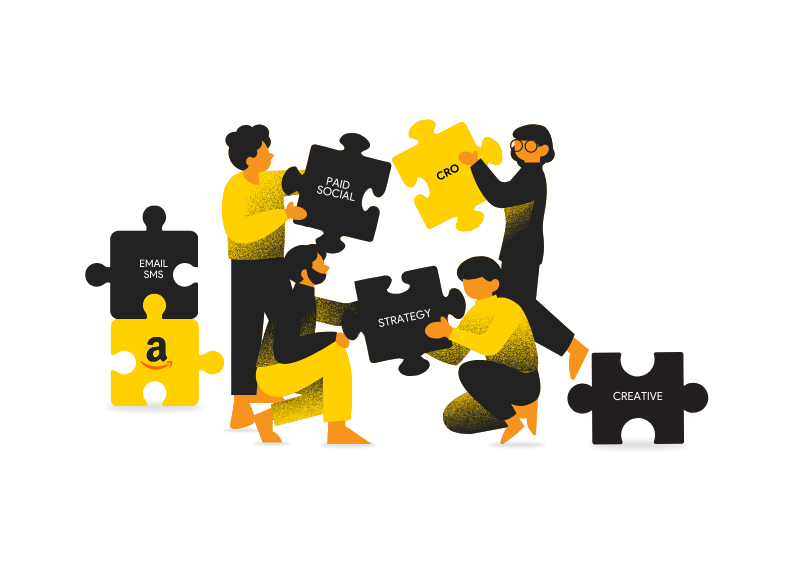
This compounding effect occurs only when brands treat their dtc marketing as a single interconnected system. Teams need to map the actual customer journey, understand which touchpoints typically appear together, recognize where friction occurs, and design each channel to hand off customers smoothly to the next stage.
Testing becomes more sophisticated in this model. Instead of testing ad variations in isolation, brands test how different messages in prospecting affect conversion rates on site. Instead of optimizing email send times independently, they coordinate them with paid media flight schedules. The focus shifts to optimizing the system, not the parts.
Performance measurement must track touch-to-conversion, channel sequence patterns, cross-channel ROAS, cohort LTV by acquisition path, and system CAC trends. This perspective changes budget allocation entirely. Instead of funding channels based on last-click attribution, brands invest based on each channel's role in the overall journey. Pilothouse's case studies demonstrate how this systematic approach creates measurable improvements in overall customer acquisition efficiency.
Why Meta's Andromeda Engine Changed the Creative Game
Meta rolled out Andromeda in late 2024 and early 2025, with global rollout completed by October 2025. This new ad-retrieval engine fundamentally altered how Meta selects and delivers ads across Facebook and Instagram, enabling a 10,000x increase in the complexity of models used for ad retrieval (Meta Engineering).
The core shift: rather than asking "who should see this ad?", Andromeda asks "which ad should this person see?" The algorithm interprets thousands of engagement and behavioral signals in real time to match users with the most relevant creative variation, rather than relying on manual audience segmentation.
Rewarding Conceptual Diversity Over Minor Iterations
Andromeda penalizes redundancy. Instead of creating 25 slight variations in font or color, brands should develop contrasting concepts for different personas and motivations. Conceptual diversity means testing fundamentally different approaches: product demo video, founder story, customer testimonial, lifestyle imagery versus problem-solution narrative.
This approach requires strategists who can develop distinct creative angles rooted in customer psychology and producers who can execute those concepts efficiently. Industry sources consistently report that 5-10 distinct creative variations with different messages, tones, and visual styles per ad set now drive optimal performance.
Brands that embrace conceptual diversity experience creative fatigue less frequently. They're finding new winning concepts in places their iterative testing never explored. Meta's internal testing shows that Andromeda achieved 6% improvement in retrieval recall and 8% improvement in ad quality across selected segments (Meta Engineering).
Post-Click Optimization: The Overlooked Conversion Multiplier
Most brands obsess over paid media performance while systematically neglecting everything after the click. They'll test dozens of ad variations but run the same landing page for months. They'll optimize bids hourly but ignore site speed issues that kill conversion rates.
The average conversion rate for Google Ads is 7.52% across all industries in 2025 (WordStream), meaning over 92% of paid search clicks don't convert into leads or sales. Despite this, brands continue to pour budget into traffic acquisition without addressing the post-click experience. Personalized CTAs on landing pages convert 202% better than generic ones (HubSpot). Landing pages with a single CTA convert at 13.5% on average, compared to 10.5% for pages with 5+ CTA links, a roughly 28% lift (Unbounce).
Landing pages function as the salesperson, bridging ad hooks to product details. The ad is the sign on a closed door. The landing page overcomes objections before users reach the technical Product Detail Page. Funnel congruency matters: if an ad speaks to style but the page speaks to functionality, the journey is disjointed and conversion rates drop.
Brands should track conversion rates by traffic source and creative theme, identify where post-click drop-off happens for different segments, and test site changes specifically for paid traffic. Treating landing experience as part of a media buying strategy rather than a separate function creates immediate returns.
Breaking Free: From Tactical Marketer to Strategic Growth Driver
The tactical spin cycle is comfortable: clear tasks, measurable performance, tangible progress. But comfort keeps brands stuck between $5M and $15M while competitors break through to real scale.
Diagnostic questions reveal whether brands are trapped:
- What percentage of marketing time is spent on optimization versus strategy development? If above 80%, teams are caught in tactical execution.
- Can the competitive advantage be articulated in a single statement that dictates channel priorities?
- Do channels operate independently or as an integrated system?
- Are teams measuring system efficiency or just channel performance?
- When did the brand last challenge a "winning" tactic to ask whether it still serves growth goals?
Breaking free requires embracing strategic discomfort: questioning tactics that "work" but don't compound, investing time in diagnostic thinking that doesn't show immediate results, and coordinating across teams that prefer operating independently.
The shift starts with changing what brands optimize toward. Stop celebrating tactical wins that don't move the needle on business outcomes. Start measuring whether the entire marketing system is becoming more or less efficient at acquiring valuable customers. This evolution demands strategic growth drivers who diagnose problems, design systems, and coordinate across functions to create compounding advantages.
Partner with Pilothouse to Build Your Growth System
Breaking out of the tactical spin cycle requires more than better execution. It demands a partner who understands the difference between managing channels and building growth systems. Pilothouse Digital works with DTC brands, navigating the transition from $5M to $30M+ by integrating media buying, creative strategy, and full-funnel optimization into one cohesive engine.
Pilothouse doesn't just run campaigns. We diagnose what's actually blocking growth, design systems where channels compound rather than compete, and coordinate creative, media, and landing experiences into a unified strategy. Our approach combines diagnostic rigor with systematic testing, ensuring every dollar works harder across the entire customer journey, not just in individual channels.
If your metrics look healthy but revenue growth has stalled, we can help you see the system clearly and rebuild your DTC marketing strategy around how you actually win. Let's talk about what's holding your growth back.


.jpg)
.jpg)



.png)

.png)