Meta Conversions API: Setup Guide and Why Server-Side Tracking Wins
.png)
Meta's advertising ecosystem has changed how it evaluates and responds to signal quality. The brands winning on the platform right now aren't simply spending more or targeting sharper audiences in the traditional sense. They're feeding the algorithm cleaner, more reliable data than their competitors. The Meta Conversions API makes this possible, and understanding how it works matters for any DTC brand serious about defensible growth.

The Andromeda Shift: Why Meta Conversions API Matters Now
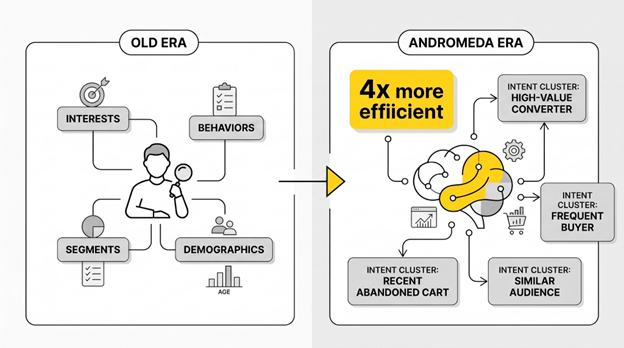
Meta's platform has moved away from manual audience selection toward an AI-driven model known internally as Andromeda, where signal quality is now the primary lever. That changes how brands should think about tracking and data hygiene, not just how they think about targeting.
From Interest Targeting to AI-Inferred Intent
For years, Meta advertisers competed on audience construction. The best results came from finding the sharpest interest stacks or most precise lookalikes. That era is largely behind us. In the Andromeda environment, the platform reads intent instead: creative does the targeting, and clean signals act as the fingerprint teaching the algorithm which psychological intent cluster a given user belongs to, as Daniel Sendecki, VP of Brand and Performance at Pilothouse, explains on Ep 581: Meta Ads Aren't About Targeting Anymore. Meta has publicly stated that GEM, the generative ranking model powering its Andromeda-era ad system, is 4x more efficient at driving ad performance gains for a given amount of data and compute than its original ads recommendation ranking models (Meta's Generative Ads Model (GEM)). That efficiency depends entirely on creative and tracking signal being aligned to actual user intent, a point Jacob Geary, Head of Socials at Pilothouse, makes on Ep 609: The New Rules for Meta Attribution.
Why Browser Pixels Create Noisy, Unreliable Signals
The traditional Meta Pixel fires from a user's browser, which is a problem given how many browsers now block third-party cookies by default, how ad blockers intercept pixel calls, and how privacy changes like iOS 14.5 and Safari's Intelligent Tracking Prevention (ITP) have degraded browser-level attribution. Standard browser-based tracking often feeds "low-hanging fruit" data to the pixel, such as people who like or comment but never buy, which can back the algorithm into a corner and push optimization toward engagement instead of revenue, as Jacob Geary, Head of Socials at Pilothouse, describes on Ep 591: Meta Andromeda Updates: CASC + AI Assistant + Creative Testing. Server-side tracking through the Meta Conversions API fixes this by capturing events at the origin, before browser-level interference can strip the signal.
Conversions API vs. Pixel: Understanding the Core Differences
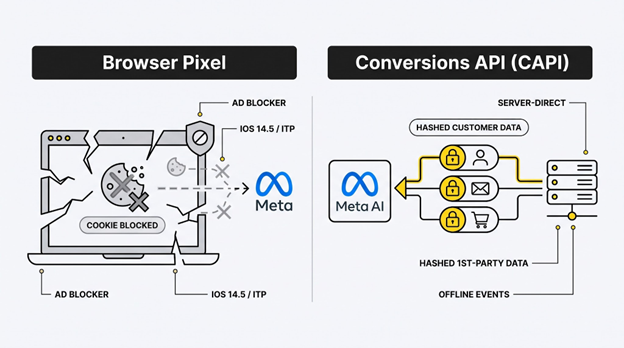
Most brands run both the Meta Pixel and the Conversions API in parallel, which is Meta's recommended setup. Neither method fully replaces the other; each contributes a different layer of data.
What Each Method Tracks and Reports
The Pixel captures real-time, client-side, on-page behavior like page views and add-to-cart events. It's cookie-reliant, fast to implement via tag managers, and useful for upper-funnel interactions where browser-level data loss matters less. CAPI works differently: it sends event data from a server or data warehouse directly to Meta, bypassing the browser entirely and often using hashed first-party customer data to improve matching. Events that would have been lost to ad blockers or ATT restrictions reach Meta's systems reliably. Beyond purchases, CAPI can also send offline conversions, subscription renewals, or CRM-based signals, building a more complete picture of the customer lifecycle. Comparing conversions API vs pixel data side by side, the practical difference comes down to event match quality (EMQ) and attribution reliability, both of which improve when server-side data supplements or replaces browser-only tracking.
Ground Truth Data as Fuel for Meta's AI
This matters because of how Meta's AI actually works. The algorithm is a prediction engine, constantly asking who is most likely to convert given available signals. The better the historical conversion data feeding it, the more accurate those predictions get. Ground truth data, meaning verified, server-confirmed purchase and conversion events, is the highest-quality input available. Running CAPI properly improves the foundational dataset that determines how budget gets allocated across audiences.
Why Server-Side Tracking Wins for Performance and Profitability
The case for server-side tracking isn't purely technical. For brands at the $10M+ growth stage, the performance and profitability implications are often significant enough to meaningfully shift ROAS outcomes.
Fixing the Signal-to-Noise Ratio for Better Optimization
Browser-based tracking introduces noise alongside signal loss: duplicate events fire when users navigate back and forward, JavaScript errors cause misfires mid-session, and page load timing issues drop checkout events. Every one of these anomalies skews the data Meta's algorithm uses to optimize. Server-side tracking cleans up that signal-to-noise ratio, reporting the real questions and frictions people bring to the funnel directly to Meta's AI, so ads reach the users whose inferred state actually matches the message. As Jacob Geary, Head of Socials at Pilothouse, and Eric Dick discuss on Ep 609: The New Rules for Meta Attribution, switching to server-to-server tracking for qualified actions rather than standard pixel signals can make a big difference in performance, since it ensures the algorithm is fed high-quality signals rather than noisy, unqualified data.
Incremental Attribution: Proving Causation Over Correlation
One of the most underappreciated benefits of clean CAPI data is what it does for incrementality testing. Meta is shifting attribution rules to focus strictly on meaningful link clicks and incremental attribution, meaning purchases that wouldn't have happened without the ad click, which makes server-side data even more vital for verifying causation rather than just correlation. With solid server-side conversion data, brands can run proper geo-based or holdout incrementality experiments that isolate the actual lift Meta generates, rather than simply noting that sales rose while ads were running. That distinction matters when defending budget decisions to stakeholders.
Matching Third-Party Reporting Tools Like Triple Whale
Clean CAPI signals also resolve one of the most frustrating problems growth teams face: data discrepancies between platforms. While standard browser pixels are increasingly limited by privacy changes like iOS 14.5, the Meta Conversions API allows server-side conversion data to be compared accurately against third-party reporting tools like Triple Whale, producing a consistent source of truth, as Chris Richards, Account Strategist at Pilothouse, explains on Ep 605: Meta Attribution Change – Why ROAS Dropped 40%. When CAPI events line up with Shopify order data and a third-party attribution tool, decision-making gets faster and more confident across reporting surfaces.
Setting Up CAPI for Accurate Audience Segmentation
Beyond optimization and attribution, the Conversions API plays a major role in audience quality. The integrity of customer and conversion audiences depends directly on how accurately events are tracked.
Distinguishing Prospecting Audiences from Existing Customers
Setting up audience segments properly in the background matters for CAPI to accurately distinguish net-new prospecting traffic from existing customers. Skipping this step produces alarming frequency rates where the same ad gets hammered against already-engaged users, as Abby, Strategist at Pilothouse, points out on Ep 587: Meta Andromeda Strategy: 5 Creative Testing Shifts for $5M+ DTC Brands. If purchase events fail to reach Meta reliably, existing customers stay in prospecting audiences, and brands pay full prospecting CPMs to show acquisition ads to people who already bought. CAPI fixes this by consistently capturing purchasers and excluding them from prospecting pools, improving both efficiency and customer experience.
Preventing Ad Fatigue Through Clean Data Structure
A related issue is ad fatigue at the audience level. When conversion signals are incomplete, Meta's frequency management degrades, and users who converted weeks ago keep seeing conversion-focused ads because the system doesn't know they've already acted. Clean CAPI data enables proper suppression logic: existing customers move into retention-focused lifecycle flows, high-intent non-converters get the right follow-up, and prospecting audiences stay fresh. This structural cleanliness reduces fatigue and keeps engagement metrics healthy over time.
How Clean CAPI Signals Power Creative as a Library of Answers
Winning creative today resolves real human concerns rather than chasing novelty or aesthetics, and it's the ground truth data from advanced tracking signals that fuels this. When conversion signals are clean, Meta can accurately attribute which ad variants drive purchases versus which merely generate clicks. This feedback loop turns a creative library into a genuine library of answers: which messages convert cold audiences, which formats reactivate lapsed buyers, and which emotional hooks outperform rational ones across specific customer cohorts. Reliable server-side signals turn creative strategy from guesswork into something closer to empirical testing.
Step-by-Step Meta Conversions API Setup
Setting up CAPI correctly requires careful attention to a few key technical decisions. The setup itself isn't necessarily complex, but implementation errors can undermine the very signal quality improvement the whole effort is meant to deliver.
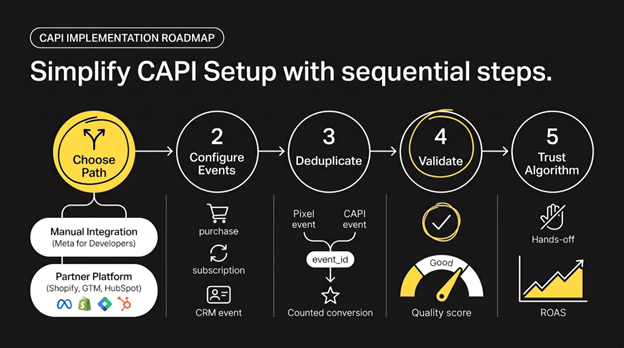
Manual Integration vs. Partner Platforms
There are two primary paths to CAPI implementation. Manual integration, built through Meta for Developers and configured in Events Manager, gives full control over what events are sent, when, and with what parameters. It requires developer resources and a solid understanding of Meta's event schema, but produces the cleanest results when done correctly. Partner platforms, such as Shopify's native CAPI integration, GTM Server Side, WooCommerce plugins, HubSpot, or Meta's own CAPI Gateway, offer a faster route with managed infrastructure that handles the server-side connection and event formatting. For most DTC brands, a partner platform integration is the practical starting point, with custom manual layers added as data sophistication grows.
Event Deduplication Between Pixel and CAPI
Running both Pixel and CAPI simultaneously means the same event, a purchase, for example, can arrive at Meta from two sources. Without deduplication, Meta counts both as separate conversions, doubling attributed revenue and corrupting optimization data. Deduplication is managed through the event_id and event_name parameters. Every event fired by the Pixel should include a unique event_id, and the corresponding CAPI event should carry the same identifier so Meta's system recognizes the duplicate and counts only one event. Failing to deduplicate properly is one of the most common mistakes brands make when adopting CAPI, and the resulting data inflation can lead to poor bidding decisions.
Adopting a Hands-Off Mentality: Trusting the Algorithm
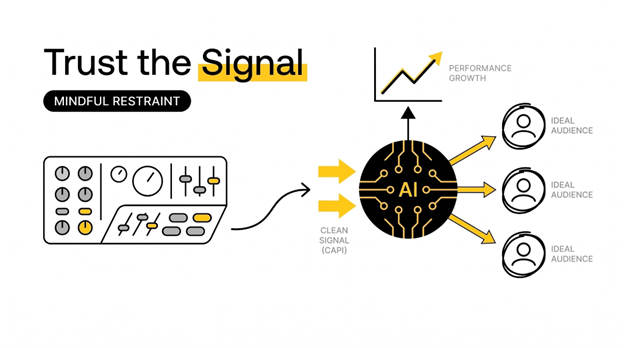
Once CAPI is implemented correctly, one of the most counterintuitive shifts required is stepping back. Many performance marketers are conditioned to intervene frequently, tweaking bids or swapping out creatives at the first sign of a dip. When signal quality is high and optimization events are reliable, excessive manual intervention often does more harm than good, since constant campaign changes reset learning phases and prevent the algorithm from capitalizing on the conversion patterns the CAPI data has taught it. Advertisers should move toward an approach that trusts the signal. The real shift, as Daniel Sendecki, VP of Brand and Performance at Pilothouse, frames it on Ep 581: Meta Ads Aren't About Targeting Anymore, is moving from clever manual targeting to providing a clean enough signal that Meta's AI can do the heavy lifting of finding the right people. The goal is to shift from tactical micromanagement to strategic oversight: build the structure, set the guardrails, and let the algorithm do what it's genuinely good at.
Partner with Pilothouse Digital for Expert CAPI Implementation
Getting CAPI right takes more than technical know-how. It takes understanding how clean signal infrastructure connects to creative strategy, audience architecture, media buying, and incremental testing. These systems compound on each other, and misconfiguring one affects the performance of all the others. Pilothouse Digital treats tracking infrastructure as part of a broader diagnostic, covering business economics, customer journey, and data quality, before optimizing spend.
Get Started
Pilothouse Digital is an integrated growth agency built for DTC eCommerce brands scaling past $10M toward $50M+ in revenue. With over 160 specialists, the agency produces more than 5,000 creative assets each month and has driven over $1B in attributable revenue for its clients, managing Meta, Google, TikTok, YouTube, Amazon, and more under a single P&L-driven growth system. For brands ready to build the data infrastructure that makes Meta investment actually work, Pilothouse can implement and manage CAPI as part of a fully integrated performance ecosystem, one where tracking, creative, media, and customer journey all pull in the same direction.