Holiday Ecommerce Marketing: Beyond BFCM Into Q5


Holiday Ecommerce Marketing: Beyond BFCM Into Q5
Most holiday ecommerce marketing gets judged on one week of revenue. The season actually runs from October into January, and the weeks after Cyber Monday often decide whether a brand keeps the customers it paid to win. At Pilothouse Digital, an integrated growth agency for DTC brands at the $10M+ inflection point, we treat creative, paid media, email/SMS and CRO/retention as one system across the customer journey. This piece lays out how that system runs through Q5.
Holiday Ecommerce Marketing Doesn't End on Cyber Monday
The season is big enough to support a long view. Adobe reports that 2025 US online holiday spend (Nov 1 to Dec 31) reached $257.8B, up 6.8% year over year, with 25 days above $4B versus 18 in 2024 (Adobe). Cyber Week 2025 added its own $44.2B, a 7.7% increase (Adobe). For 2026, Adobe forecasts online spend growth of 6.7%, with ecommerce at $1 of every $4 spent on retail goods in the season (Adobe).
What Q5 Means and Why the Term Caught On
Q5 is an informal label for roughly Dec 26 to mid or late January. No financial calendar includes it, and brands draw its edges differently. Meta titles its holiday dataset "Q4/Q5 Holiday 2025 Performance Trends," with data from Oct 1, 2025 to Jan 15, 2026 (Meta).
The term stuck because gift-card money arrives and holiday-acquired customers are worth keeping. Q5 works as a planning frame, and it doesn't promise a sales window. Whether it pays depends on how relevant the product is, how much demand exists and what continued promotion costs.
Start Earlier: The Season Is Longer at Both Ends
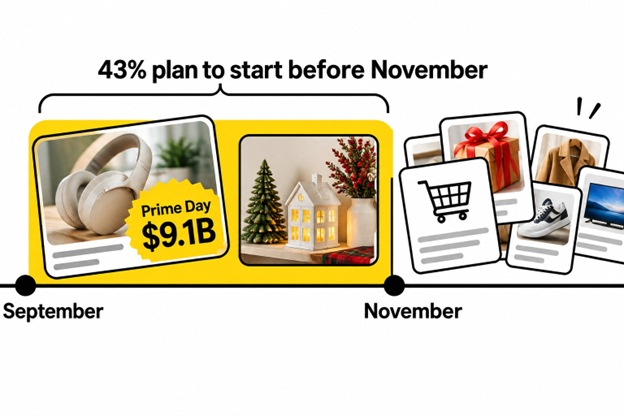
Shoppers begin well before November. Adobe's October 2025 data shows US online spend of $88.7B, up 8.2%. Prime Day (Oct 7-8, 2025) drove $9.1B with discounts peaking at 18%, and holiday decor sales ran 130% above average September levels (Adobe). NRF's 2026 survey finds 43% plan to start before November (NRF). In Meta's November 2025 global survey, 14% began before October and 54% in November (Meta).
Jacob Geary, Head of Meta at Pilothouse, covers preparation in Ep 637: Black Friday Prep in 8 Weeks: "Find Them Now, Sell Them in November". He suggests building warm audiences in August and September with cheap engagement and lead-gen campaigns, before peak competition. Those campaigns optimize for engagement, so Meta delivers cheap eyeballs that become warm retargeting audiences in November. His example budget is 5% of total ad spend or less, and he offers it as a suggestion rather than a reported result.
His bigger point is that preparation means testing the offer along with the ads. Jacob Geary describes comparing discount structures before peak promotions: "let's do a little split test let's you know for two weeks do a sitewide percentage discount 15% off all products sitewide let's look at how the math is going to back out on that". He also cites $20 off $100+ as an alternative, and stresses checking unit economics along with appeal.
Ad Costs Across the Holiday Season
Paid media costs move with competition, and the best evidence is scoped to specific conditions. The Meta findings below cover purchase-optimized campaigns from Oct 1, 2025 to Jan 15, 2026, normalized to an Oct 1 baseline. Use them as context for testing. They won't forecast how any one account performs.
CPM, Conversion Rate and CPA Trends From October to January
US Black Friday conversion rates ran 120% above the Oct 1 baseline (Meta). Pullback later in the season looked different. In Western Europe, CPMs fell 15-30% in mid-to-late December as advertisers retreated, but conversion rates fell too. Cheaper impressions only matter if people still buy.
Christmas week cost per result rose roughly 50% for 18-24-year-olds, while older cohorts held steadier. The 55-64 group bounced back fastest, up approximately 60% by mid-January (Meta). Format and structure mattered as well:
- Advantage+ sales campaigns saw ROAS rise 29% on Black Friday versus 8% without, then fall 8% in the Christmas downturn versus 13%.
- With 9:16 vertical video with sound, Black Friday CPM inflation was 48% versus 61% for other formats. At Christmas, conversion rates dipped only 18% for the stronger creatives versus 33% for non-performant creatives.
Budget Pacing: Keep Spending or Go Dark?
No blanket rule applies. The decision should rest on marginal CPA against contribution margin and payback. If the next dollar of spend still acquires customers at a cost the margin can carry after discounts, fulfillment and expected returns, keep it running. If it can't, trim the weakest audiences before shutting everything off.
Test post-peak cost relief before counting on it. A small, capped prospecting test while demand and inventory still fit will show whether Q5 pays for a given brand.
What Shoppers Do After Christmas
Shopper motivation shifts once gifting ends, so pre-Christmas messaging shouldn't roll forward unchanged. Landing pages and navigation need to reflect what customers can buy or use now, and offers should follow. Browsing behavior and purchase history help separate relevant follow-ups from noise, as do stated preferences.
Gift Cards, Self-Purchases and Boxing Day Sales
Gift cards represent a large pool of money. NRF's 2025 survey found 43% of shoppers planned to buy at least one gift card, with $29B in expected spend. Shoppers 65+ expected to spend $58 per card and were the group most likely to plan a purchase (NRF).
Deloitte's 2026 survey finds 50% plan an experience gift, and self-gifting is rising, especially among younger generations (Deloitte). That argues for separate messaging for gift recipients and self-purchasers, easy redemption paths and honest deadlines. Boxing Day is market-dependent, so timing and language should match local expectations.
Returns and Exchanges as a Revenue Opportunity
Returns can drive real revenue in Q5. NRF and Happy Returns put 2025 returns at 15.8% of US retail sales ($849.9B), or 19.3% of online sales, with 17% of holiday sales expected to come back (NRF). Adobe found 2025 US online returns down 1.2% year over year across the season, but up 4.7% from Dec 26-31, when one in seven season returns occurred (Adobe). NRF notes the vast majority of holiday returns occur in January, and some shoppers use them to make another purchase or catch post-holiday sales (NRF).
Experience matters. In the same NRF/Happy Returns research, 82% cite free returns as a major consideration, 76% are more likely to choose an instant refund or exchange option, and 71% are less likely to shop with a retailer again after a poor returns experience (NRF). Exchange incentives and store credit can keep revenue, as can post-return flows, provided teams weigh them against service cost and satisfaction.
Email and SMS in Q5: Keep Sending to the Right People
Q5 messaging works when it goes to the right people. Jordan Gordon, Head of Email, Retention and CRO at Pilothouse, observes in Ep 629: 85% of Your Email Revenue Comes From One Segment that 85% of campaign revenue comes from people recently active on site. That's his own observation and shouldn't be read as a universal benchmark. As Jordan Gordon explains: "85% of the revenue from your campaigns are people who've been on the site recently yet most campaigns go to people who've opened they might have subscribed or purchased like a year and a half ago and you're still emailing them three times a week".
He contrasts 24 campaigns a month with a selective 8 to 12, and points to a high-value group: two or more purchases, at least one in the last 90 days, buying three to four times a year. A simple Q5 segmentation map follows from this: gift buyers versus self-purchasers, first-time versus repeat, discount-driven versus full-price, engaged versus at-risk. Email permission does not authorize SMS: marketing email falls under CAN-SPAM's opt-out rules, while texts sent through automated systems require consent under the TCPA, so SMS needs its own opt-in.
Turn Holiday Buyers Into Repeat Customers
A first holiday purchase starts a relationship, but loyalty still has to be earned. Follow-up should carry useful product information, responsive support and recommendations tied to demonstrated interests. Loyalty benefits need to be clear and reachable, and not every customer needs another discount. Gifting complicates this, since the buyer and the product user may be different people.
Jordan Gordon gives the metric in Ep 484: How to Track Lifecycle Metrics Not Just Revenue. He defines the base this way: "well anyone who's purchased in the last 365 and has purchased two or more times ever is your base right that's the number you want to go up". The episode also covers spotting margin erosion in a discounting strategy, and notes a growing revenue line can be a red flag.
The Q5 Playbook: Campaigns, Margin, Measurement and Calendar
This table pulls the season into one working plan. Podcast insights above inform prep, email and measurement; the Q5 applications here are our own editorial synthesis.
Part
What to do
Campaigns
Post-Christmas sale, gift card redemption, "treat yourself," New Year, clearance, VIP/loyalty early access, cheap prospecting while CPMs are low, retargeting holiday site visitors
Inventory and margin
Decide where clearing stock beats protecting margin; plan cash flow going into Q1
Measurement
Read contribution margin or MER instead of in-platform ROAS; set attribution windows for the full holiday period
Calendar
Phase 1: audience building and offer tests. Phase 2: peak. Phase 3: Dec 26 to mid-January. Then a bridge to Valentine's Day
Set margin floors before launch, and include fulfillment and payment processing costs, plus returns and promotions. A sale credited to a campaign may not be a sale it caused, so incrementality checks belong in the plan.
Judge the Season by Repeat Customers and BFCM Revenue Together
BFCM ROAS can mislead. Discount-heavy cohorts may buy cheaply, then repeat less. Revenue looks strong while contribution margin stays weak. A cohort scorecard tells the fuller story:
- New-customer share
- 60/90-day repeat rate
- Contribution margin by cohort
- Payback
Whether holiday-acquired customers stay, when they buy a second time and what their LTV looks like are questions for that scorecard, and the answers aren't settled in advance. Compare cohorts over equal windows so earlier buyers don't look better simply because they had longer to return. Loyalty and referral activity are supporting signals, and they can't replace repeat purchases.
What the Holiday Season Should Leave Brands With
The question for any board is whether the holiday grew the active repeat-customer base or produced only a revenue spike. Holiday ecommerce marketing that runs as one system, from early audience building through Q5 follow-up, answers it with margin and cohorts instead of one week's sales. Brands that want to build that system can talk with Pilothouse Digital.