Black Friday Marketing Strategy: A Last-Minute Sprint Plan That Still Works


Black Friday Marketing Strategy: A Last-Minute Sprint Plan That Still Works
Adobe forecasts $275.1B in U.S. online holiday sales for Nov 1 to Dec 31, 2026, up 6.7% YoY, with Black Friday online sales at $12.9B, up 9.2% YoY. That's a large pool of demand, and DTC brands at the $10M to $50M stage can still reach it with a focused Black Friday marketing strategy. Black Friday lands Nov 27 and Cyber Monday follows on Nov 30.
The plan below covers the days before the sale, the sale itself and the Cyber Monday checkpoint. Every move gets judged on contribution margin and payback, with incrementality as the check on both. Revenue and in-platform ROAS alone don't make the cut.
Why a Last-Minute Black Friday Marketing Strategy Still Matters This Year
Shoppers weren't waiting for any sprint. Adobe projects October online spend of $95.8B, up 8% YoY, so plenty of buying happened before any late campaign went live. A sprint captures the intent that remains and leaves demand creation to earlier work.
That sets the scope. A sprint works when it concentrates on a few high-leverage moves: simplify the site, iterate on existing creative, keep the offer adjustable and clean up the catalog. Each move below ties to this year's market, and each should be judged by what it does to the P&L.
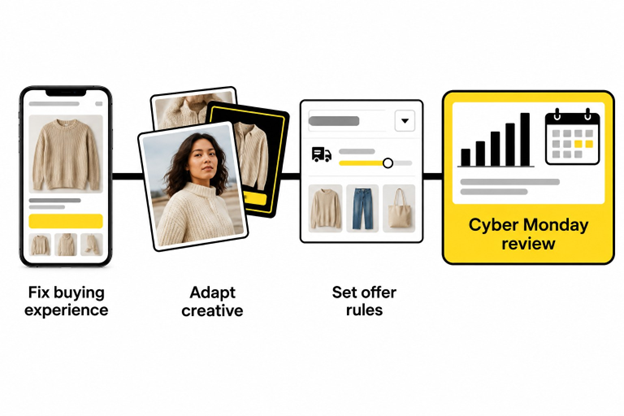
A rough order for the remaining days: fix the buying experience this week, adapt creative before spend ramps, set offer rules before launch and hold a formal review on Cyber Monday.
Simplify the Site Before Adding Complexity
Removing complexity is cheap, and leaving it in place is costly. Every extra banner, overlapping promotion or buried button gives a shopper more to work through before buying. Jocelyn Hyslip, Ecommerce Strategist, explains the goal on Ep 563: 3 Moves to Win Black Friday While It’s Happening as trying to "just try to alleviate, um, how much brain energy someone has to use and, like, get them as clear to the page to check out."
Her practical advice is to use a static, prominent sale banner and a simpler offer, so shoppers have less to process. A shorter path to checkout protects conversion rate when paid traffic is at its most expensive.

Make Mobile Shopping Effortless
Mobile conversion is the reason to care here. Mobile made up 55.2% of U.S. online sales on Black Friday 2025, or $6.5B, up 10.2% YoY. Adobe forecasts mobile at 57.4% of 2026 holiday online spend.
Hyslip advises checking desktop and mobile separately. If the header button sits below the fold on desktop, move it above the fold. She says this bumps conversion the same day, which makes it one of the fastest fixes available this week. Brands should complete a full purchase on a phone before driving traffic.
Show Shipping Costs and Keep One Clear Offer
Extra costs are a known cause of lost checkouts: 40% of users abandoned a checkout because of additional costs. Baymard recommends showing the full order cost in the cart and integrating free-shipping information into the cart summary.
A simple checklist covers the work:
- One static banner, matching across email and social as well as the site.
- One clear offer, with exclusions and end dates stated plainly.
- Shipping costs and thresholds visible before checkout.
Iterate on Existing Creative Instead of Rebuilding
Launching untested concepts at peak prices is a poor use of budget. Lebesgue's dataset, drawn from $22.6M in Meta spend from September to November 2025 among its biggest spenders, shows median CPMs 59% above September across Black Friday week and 84% above on Black Friday itself. It's one vendor's dataset, so don't read it as a universal benchmark, but the direction is clear. Impressions cost more, which makes learning from an untested idea pricier too.
Hyslip says evergreen creative can outperform Black Friday-specific ads. She also describes adding a black Black Friday border in Canva to a scrappy organic product image and seeing purchases within hours. Treat that as an illustration of the tactic; nobody should expect the same result. The argument is about risk: a quick iteration on proven creative is safer than a new concept at peak-priced impressions.
In practice, brands should pull their best-performing existing assets, add clear sale framing and keep the message consistent with the site. Small edits to what already works give teams more than a rebuild they can't test.
Keep the Offer Adjustable While the Sale Is Live
An offer is more than a discount. It combines price, added value, eligibility and timing, and good teams set rules for changing it before launch. Adjustments should happen behind the scenes, so shoppers always see one simple version of the deal.
Klaviyo's data supports restraint. Overall ecommerce discounts fell from 29.6% in 2024 to 26.2% in 2025, while same-site sales rose 11% YoY during BFCM 2025. Brands offering the smallest discounts were among the strongest growers.
Pivot the Offer Beyond the Discount
When an offer stalls, change what it is instead of making it deeper. The shipping threshold and the urgency or framing are the usual places to start. On Ep 565: BFCM + Meta in 2025: Shorter Promo Windows and Scrappy Pivots That Crushed, guests described a client that adjusted its free-shipping threshold and added a discount to a bundle after a price reduction made the bundle less attractive. They say it helped performance, though no result was quantified. The same episode describes countdown timers and stock counts as urgency treatments, and warns against stacking several offers in a way that makes the deal harder to understand.
Decision rules keep these moves disciplined. Signals such as conversion rate, AOV, inventory and contribution margin per order should trigger a move from discount depth to bundles or threshold offers, with gifts-with-purchase as another option. Deeper discounts can pull demand forward and compress contribution margin. The Baymard extra-costs finding above supports the shipping-threshold lever, since shoppers react to the total cost they see.
Use Cyber Monday as the Second Checkpoint
Cyber Monday is a second peak. Adobe forecasts over $15B in a single day ($15.1B, up 6.2% YoY), which would be a first for U.S. e-commerce. Supermetrics' Meta retail data comes from $675M in spend across 5,000+ advertisers, and it shows 2025 Cyber Monday week spend at 56% to 79% of Black Friday week spend, depending on sector. Again, it's the vendor's own dataset and can't stand in for a universal benchmark.
The review should cover offer performance, inventory and email list engagement, plus how new customers compare with returning ones. From there the decision is simple: extend the offer, narrow it or end it.
Make the Catalog Readable for AI Shopping Tools
AI-referred traffic is growing fast from a small base. Adobe reported AI-driven visit share to U.S. retail sites up 805% YoY on Black Friday 2025. For 2026, Adobe forecasts AI traffic to U.S. retail sites up 130% YoY, and Black Friday up 95%, as shoppers click through from AI chat and browser services. These are growth rates, so the claim stays modest. Cleaning up data is a sensible task, though it guarantees no channel.
Dougie Bedell, Pilothouse's Head of Google, frames feed cleanup as practical work. Audit the product feed first, fill every relevant attribute and map the store backend, such as Shopify, correctly into Google Merchant Center. A short checklist helps:
- Clear product titles.
- Attributes filled in completely.
- Accurate availability and pricing.
- Consistent offer details across feed, product pages and ads.
These fixes are quick, and they matter most when sale prices and stock change during the event.
Be Honest About the Limits of a Sprint
A sprint sharpens execution, but a fully prepared campaign is a different thing. Offer testing and preparation belong before the peak buying period. Jacob Geary makes the point on Black Friday Prep in 8 Weeks: "Find Them Now, Sell Them in November": "you don't want to be running through roadblocks and doing the prep during Q4, right? You want all your focus on maximizing value, maximizing purchases, maximizing revenue growth."
Late-stage work also struggles to answer incrementality questions cleanly. Revenue during Cyber Week looks healthy almost regardless, so the useful question is what the spend and discounts added at an acceptable margin.
Why Testing at Peak Prices Is Costly
Supermetrics' data shows Black Friday week CPMs 16% to 41% above September and CPC 10% to 31% above, depending on sector. Costs held steady through October in every sector, and Supermetrics recommends finishing main creative and audience tests in October, before costs climb.
Lebesgue's data adds a wrinkle. Its Black Friday week median conversion rate ran 48% above September, with cost per purchase 20% lower and Meta-reported ROAS 19% higher. Reported efficiency can look strong while costs rise, which is why in-platform ROAS alone is a weak guide to margin. A test run at peak prices buys expensive, noisy answers.
Start Next Year's Plan in August
Geary treats preparation as an eight-week process, with a window of August and September that spills into October. Spend should ramp from two months ahead by 10% to 15% a week rather than leaping 500% on November 1. Offers should be tested early, with 5% or 10% off in an end-of-summer sale instead of a 40% discount for the first time in November.
A testing calendar, with incrementality thinking built in, turns those lessons into a system. Brands should record what launched, what changed and how customers responded, so next year starts with usable knowledge instead of memory.
Next Steps: Launch the Sprint or Get Expert Support from Pilothouse Digital
The remaining days favor a short sequence: confirm the offer's economics, check the mobile purchase path, adapt proven creative, set the rules for changing the offer and review everything on Cyber Monday. A narrow scope that a team can deliver reliably beats several half-finished initiatives.
Pilothouse Digital is an integrated growth agency helping DTC eCommerce brands at the $10M+ inflection point scale with defensible growth. It aligns creative, media and lifecycle around the customer journey and P&L impact. Brands unsure where to focus, or short on execution capacity, can book a free exploratory call to talk through priorities.
The strongest Black Friday marketing strategy this late is simple: make buying easy, adapt the creative brands already have and stay willing to change the offer while the sale is live. A sprint sharpens execution, but it is no substitute for preparation. Pilothouse's advice is to build the testing calendar in August, treat incrementality as the standard and choose systems over hacks.