


Choosing a Facebook Ads Bidding Strategy That Protects Your Margins


Choosing a Facebook Ads Bidding Strategy That Protects Your Margins
Most media buyers treat bidding strategy like a checkbox: pick Highest Volume, glance at ROAS, move on. That habit costs money. A facebook ads bidding strategy is tied directly to contribution margin and breakeven cost per result. It's not a settings menu item you set once and forget. In-platform ROAS tells you nothing useful if it ignores what a brand actually keeps after cost of goods, shipping, and fulfillment. Real margin protection starts with knowing the breakeven cost per purchase before touching a single bid setting, then using Meta's constraint tools to enforce it.
Why Bid Constraints Are Your Best Defense Against Margin Erosion
Meta's default bidding option, Highest Volume (formerly Lowest Cost), spends a budget as fast as possible while maximizing results if no other strategy is selected (Triple Whale). It has no concept of a brand's contribution margin. Left unconstrained during high-demand periods, it will happily pay more per purchase than a product can afford, because the algorithm's only mandate is volume.
Bid constraints exist to correct that gap. Cost Cap sets a target average cost per action, a goal rather than a guarantee, and may make it harder to spend the full budget, while Bid Cap sets a hard ceiling per auction (Jon Loomer). Neither works as a "set and forget" switch. Both require marketing teams to calculate breakeven math first, apply the constraint second, and then monitor delivery closely, since auction dynamics shift by the day and by the season.
The breakeven calculation itself is straightforward. Take the average order value and subtract the total landed cost, meaning goods, shipping, payment processing, and any overhead tied to the sale. What's left is the margin available to fund that purchase's acquisition cost. If a $60 AOV product carries $35 in landed costs and fees, a brand has $25 of margin to spend acquiring that customer before the sale turns unprofitable. That $25, or a lower figure if profit targets demand it, becomes the number entered into a Cost Cap or Bid Cap field, not a guess pulled from last month's ROAS report.
The Bid Constraint Hierarchy
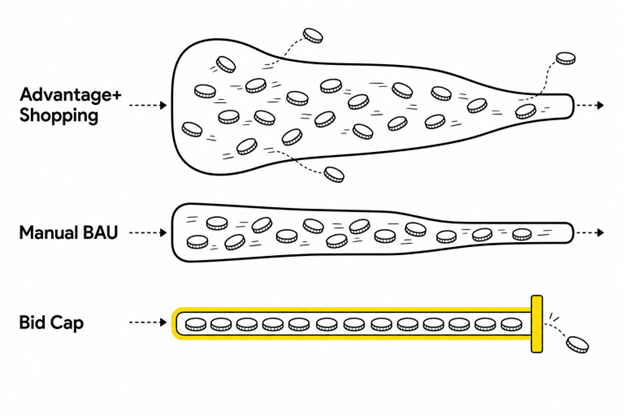
There's a clear hierarchy in how tightly Meta lets advertisers constrain delivery, and understanding it matters more than picking a single "best" meta ads bidding strategy. As Taylor Cain, Senior Ecommerce Strategist at Pilothouse, explains, Advantage+ Shopping Campaigns apply a looser, more flexible cost cap, traditional business-as-usual campaigns offer a tighter cost cap, and Bid Cap is the tightest of the three, keeping delivery extremely close to the specified target (Ep 490: Meta’s New Advantage+ Update: What It Means for Advertisers & How to Win).
Advantage+ Shopping Campaigns and Their Looser Cost Cap
Advantage+ Shopping Campaigns are typically limited to Highest Volume or Cost Cap bidding, since broad delivery needs looser constraints (Stackmatix, Adstellar). Even when a Cost Cap is applied, ASC gives Meta more latitude to overshoot the target in pursuit of scale. That looser leash suits ASC fine for top-of-funnel volume plays, but it's a poor fit for brands that need CPA discipline enforced consistently.
Manual Business-as-Usual Campaigns and Tighter Cost Caps
Manual campaigns support tighter caps because targeting already constrains the audience, leaving the algorithm less room to drift toward expensive placements (Top Growth Marketing). This is where most brands should hold the line on breakeven-based Cost Caps once they've moved past the testing phase and built up enough conversion data to trust the target.
Bid Caps: The Tightest Layer of Spend Control
A Bid Cap is Meta's advanced method: a hard maximum bid per auction, with a capped CPA and variable spend, meant for advertisers who know their target CPA with precision (Jon Loomer, Adsuploader). The recommended progression is to test with Highest Volume, scale with Cost Cap, and refine with Bid Cap only once enough data has accumulated to set the number confidently (AdManage, Best Ever). Bid capping too early, before a brand actually knows its breakeven, tends to choke delivery rather than protect it.
Segmenting Campaigns by Product AOV for Precise Profitability
Blending products with different margins and AOVs into a single campaign skews the average cap for at least one segment, undermining the entire point of setting it (2Point Agency). Taylor Cain notes that segmenting campaigns by product when using cost caps is an important strategy for protecting margins and baking in specific profitability targets when AOVs differ, even as Meta continues pushing advertisers toward broader campaign consolidation (Ep 490).
In practice, this means a brand selling a $40 accessory and a $200 bundle shouldn't share one Cost Cap. The bundle can likely absorb a higher cost per purchase and still hit its margin target, while the accessory needs a much lower cap to stay profitable. Consolidating them forces one product to subsidize the other's inefficiency, the same blended-metric blindness that makes ROAS misleading at the account level.
The Hidden Risk of Over-Relying on Cost Caps
Cost caps are a genuine lever for margin control, but they aren't a substitute for ongoing oversight, and treating them as one is a common failure mode.
How Excessive Constraints Choke Delivery and Miss Opportunities
Taylor Cain points out that cost caps remain a powerful lever in standard BAU campaigns for maintaining margin control, but becoming over-reliant on them can restrict delivery and cause brands to miss valuable market opportunities (Ep 490). An overly tight cap slows spend, delays exit from the learning phase, and produces the telltale "limited by bid strategy" warning alongside low impression volume (Jon Loomer, Best Ever). Advertisers can confirm this by raising the cap slightly and watching spend and impressions over the following 24 to 48 hours. Over-constraining during the testing phase carries a particular cost: it can kill breakthrough creative before it ever gets the delivery needed to prove itself (AdManage).
Navigating Meta's Removal of Customer Caps in ASC
Meta removed the Existing Customer Budget Cap from Advantage+ Shopping Campaigns in early 2025, replacing it with an "Engaged Customers" segment and pushing advertisers toward customer-list exclusions at the campaign or ad-set level instead (Foxwell Digital, Flighted). That's more than a minor settings tweak. It creates a real incrementality problem.
The 13% Cost-Per-Purchase Drop and Its Overspend Risk
An EMEA study cited by Direct to Consumer found that removing customer budget caps produced a 13% lower cost per purchase compared with capped campaigns, but that efficiency comes with a catch. One US agency audit of 42 accounts found 38 of them spent up to 45% of their daily budget on returning customers (Enalitica, Wicked Reports). Jacob Geary, Leader of Pilothouse's Meta Program, explains that removing the customer cap forces all budget into a simplified campaign flow, which can lower cost per purchase but risks overspending on warm, existing customers at the bottom of the funnel rather than driving incremental top-of-funnel traffic (Ep 490). A cheaper cost per purchase looks good on a dashboard, but if that cheaper conversion comes from a customer who was going to buy anyway, the brand isn't generating incremental revenue. It's just paying Meta to take credit for organic demand, and the gap between those two outcomes separates a real margin win from a vanity metric.
Building a Manual BAU Structure With Two Ad Sets
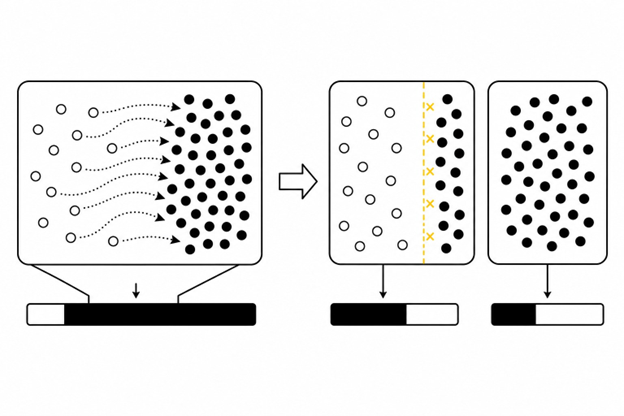
Jacob Geary and Taylor Cain describe the fix as a manual BAU setup with two ad sets, one for net-new customers with exclusions, one for returning customers, letting advertisers maintain control over messaging and funnel-stage budget allocation (Ep 490). This mirrors Meta's own recommended workaround: a manual sales campaign with one ad set excluding existing-customer audiences, functionally a 0% existing-customer cap, and a second ad set targeting existing customers directly, built on Advantage Campaign Budget with ad-set spend limits (Jon Loomer, Madgicx). Some brands go a step further and optimize the net-new ad set against a custom purchase_NC event isolated to new customers, keeping acquisition spend cleanly separated from retention spend (Wicked Reports). It's a disciplined structure that Meta's own consolidation push has made necessary, not a workaround hack.
Q4 Momentum Strategy: Trojan Horse Creatives and Learning Phase Preservation
Q4 rewards brands that build momentum early rather than launching cold in November. Peak-season CPMs climb sharply, Meta's own benchmarking data show CPM inflation of up to 61% on Black Friday alone (Meta for Business), so seeding creative earlier, while auctions are still cheap, pays off in accumulated social proof.
Using Broad Urgency Creatives to Build Early Social Proof
Jocelyn Hyslip, Senior Strategist on the Pilothouse team, recommends "Trojan horsing" creatives with broad urgency and promo messaging, without specific discount details, during earlier seasonal sales like Labor Day or Halloween, letting ads build social proof and historical performance data on-platform (Ep 548: Strategic Levers to Build Massive Meta Momentum Throughout Q4). By the time Black Friday arrives, those broad urgency and evergreen creatives frequently outperform and scale more heavily than Black Friday-specific creative, because Meta's algorithm trusts the historical data and social proof already built behind them.
Duplicating Winning Ads by Post ID Without Resetting Learning
Jocelyn Kell, Senior Media Buyer at Pilothouse, points to rebuilding standard BAU sales campaigns with maximum exclusions and duplicating winning ads using Post IDs as an effective foundation for carrying social proof forward without resetting learning (Ep 548). Duplicating by Post ID preserves the accumulated engagement on that creative, but it doesn't skip the learning phase itself, since learning status is tied to the ad set, not the ad (Graphed, Blip). Ads that fully exit the learning phase see roughly 19% lower cost per conversion, which is why the practical framework is to duplicate for testing and lean on Post IDs when scaling proven winners. Kell also advises running a single, flat, simple offer through all of November starting November 1st, avoiding the confusion of stacked promotions and the customer-service backlog that comes with post-purchase frustration.
Advanced Horizontal Scaling for Peak Sales Periods
Vertical scaling, simply raising budgets, has a hidden cost: any budget change greater than 20% resets the learning phase, even when the change is an increase (Sagum). Horizontal scaling avoids that trap.
Lifetime Budget Campaigns With Defined End Dates
Jacob Geary, Head of Meta and Jocelyn Kell, Senior Media Buyer, describe lifetime budget campaigns with specific end dates as a strong horizontal scaling strategy, forcing Meta to distribute spend dynamically across the weekend when conversion intent is predicted to peak (Ep 565Ep 565: BFCM + Meta in 2025: Shorter Promo Windows and Scrappy Pivots That Crushed ). Lifetime budgets require defined start and end dates in exchange for letting the algorithm shift spend toward the highest-opportunity hours, which makes them well suited to fixed-duration promotions like BFCM (Graphed, Coinis).
Day-Parting Around Historical Peak Hours
Day-parting, configuring campaigns to deliver only during historical peak hours of Shopify sales, is the second horizontal lever, and it requires a lifetime budget to function (Coinis). Kell emphasizes that both horizontal strategies need close monitoring and should be cut early if they underperform, rather than left to run on assumption (Ep 565). She also notes that during BFCM, lighter exclusions, excluding only past purchasers while consolidating cold traffic, engagers, and site visitors into one campaign, have proven effective, since Meta natively directs most spend toward cold, net-new audiences within the first 48 hours regardless. Jacob Geary and Kell add that the brands that win during Black Friday and Cyber Monday are the ones willing to pivot offers on the fly, whether that means dropping prices further, adjusting free shipping thresholds, or adding bundle discounts to capture conversion rate in real time.
Split-Testing Landing Pages With Unique Funnel Links
Optimization doesn't have to stop at the ad level during high-momentum periods. Kell explains that using Warp Drive to run landing page and pre-sell split tests on unique funnel links lets brands optimize conversion rate on the post-click side in real time during Q4, without disrupting or resetting the learning phase of high-performing Meta ads (Ep 548). This distinction matters technically: changing a live ad's URL, or duplicating it into a new ad set, triggers the learning phase, while redirect-based, server-side split testing keeps the ad's URL intact and preserves the winning ad's learning status (Bigflare, Adamigo). Unique UTM parameters still allow full tracking of which landing page variant converts best.
Partner With Pilothouse Digital to Protect Your Ad Margins
A facebook ads bidding strategy only protects margins when it's built on real unit economics, not platform-reported ROAS. Pilothouse Digital works with DTC brands at the $10M+ inflection point precisely because that's where activity-driven growth stops working and defensible, margin-aware growth becomes the only path to $50M and beyond.
A Business-First, Full-Funnel Diagnostic
Pilothouse's approach starts with a full-funnel diagnostic that assesses unit economics before a single media dollar is adjusted, ensuring every Cost Cap, Bid Cap, and campaign structure is grounded in actual contribution margin rather than guesswork.
Proven Results Without Added Spend
The agency's VSSL case study shows how this discipline translates into efficiency gains without adding spend, the kind of margin protection this article has walked through. Brands can review more outcomes across Pilothouse's case studies to see how these meta ads bidding strategies play out across different account structures and margin profiles.

