


Why Your Email Marketing Attribution Numbers Are Lying (And How to Calculate True Contribution)

Email platforms often show strong revenue-per-send figures, healthy open rates, and dashboards full of green arrows. But when brands zoom out and look at actual business growth, something doesn't quite add up. That disconnect isn't a coincidence. It's a fundamental flaw in how most brands approach email marketing attribution, and it's quietly steering budget decisions in the wrong direction.
The numbers look good because they're designed to look good, not because they're designed to tell the truth. Understanding what they're actually measuring, and what they're missing, is how brands stop optimizing for the wrong outcomes.

Email Attribution Is Stuck in a Tactical Spin Cycle
Most email programs operate on a narrow feedback loop: send a campaign, measure clicks, track revenue, repeat. It feels productive because it generates constant data. But what it's actually measuring is short-term transactional behavior, not the real role email plays in building customer relationships and driving long-term value.
The core problem is attribution modeling. Most email service providers default to last-click or last-touch attribution, which assigns full conversion credit to whatever the customer interacted with immediately before purchasing. In practice, email frequently takes credit for sales that were already in motion, while its actual influence on earlier-stage behavior goes completely unmeasured. This isn't just an analytics inconvenience. It's a systemic misrepresentation that inflates vanity metrics while hiding email's true contribution to growth.
Here's a pattern worth recognizing: when attribution becomes the primary focus of a growth strategy, it often signals something deeper. Teams that don't know where their next dollar should go tend to retreat into metric-fiddling rather than addressing the real question of who their ideal customer is and how to earn their trust. The tactical spin cycle is a distraction from that more important work.
How Platform Over-Attribution Steals Credit From Email
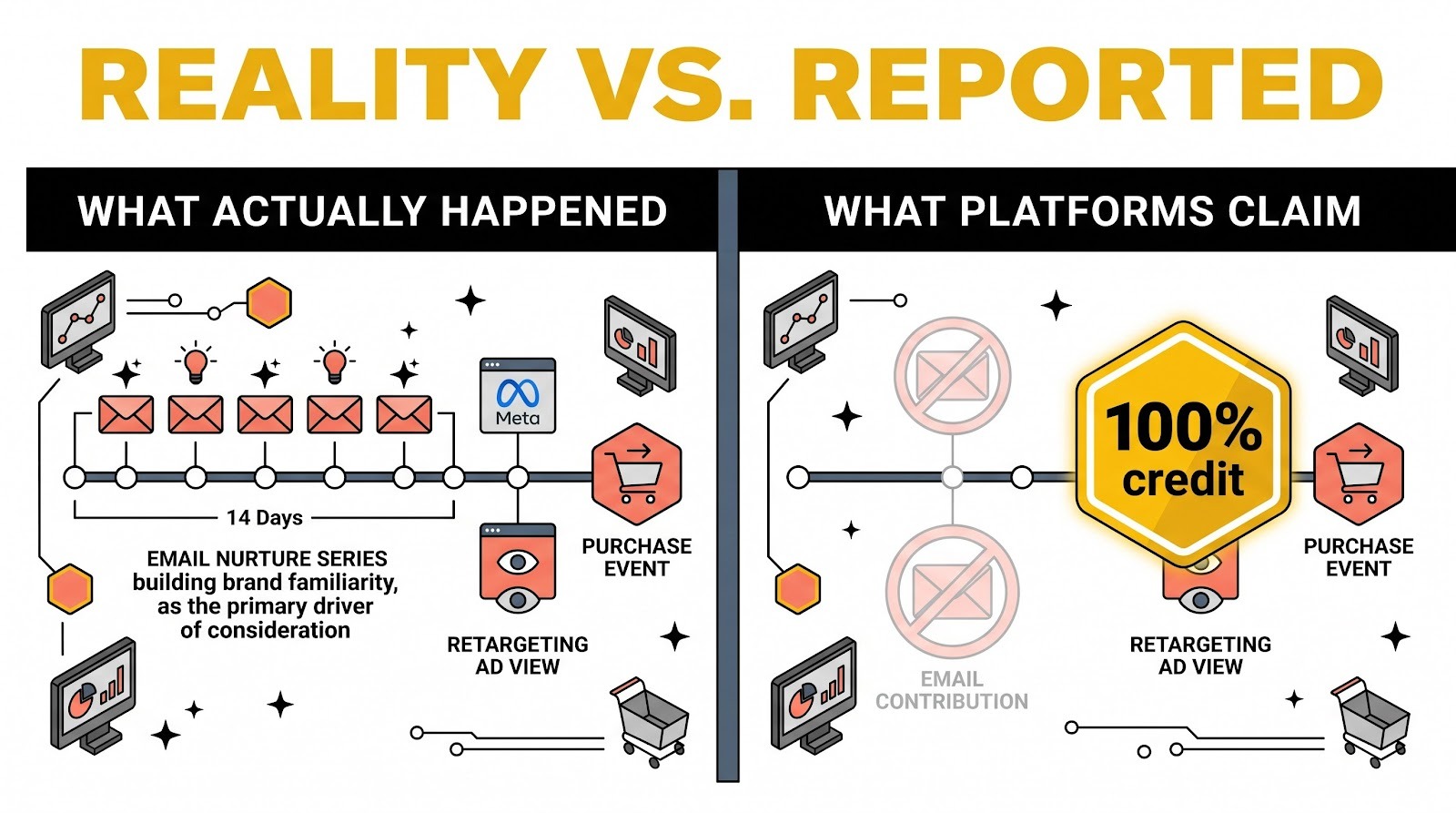
The problem compounds when you factor in how platforms actually report attribution. And platforms have a financial incentive to report favorably.
Consider a concrete scenario: a customer receives an email nurture series over two weeks, building familiarity with a brand and its value proposition. On day fourteen, they scroll past a retargeting ad on Meta and later complete a purchase. Under Meta's attribution windows, which include view-through credit, Meta claims 100% of that revenue, even though no ad click occurred and the email sequence drove the consideration that made the purchase possible.
Most ESPs pile on with their own generous attribution windows; for example, Klaviyo's default is 5 days for email opens or clicks, claiming any revenue that occurs during that period. Stack attributed revenue across all channels under these models and the total routinely exceeds actual revenue. That arithmetic alone confirms the reporting has a structural problem.
For growing DTC brands, misattributed data leads directly to misallocated budget. Teams double down on campaigns that appear to produce revenue but are really just capturing intent that already existed. The genuine audience-building work email does quietly in the background, warming leads, reactivating lapsed customers, reinforcing brand trust, never gets measured or rewarded with proper investment. Third-party attribution tools like Triple Whale and Northbeam exist specifically to surface this distortion, providing a channel-agnostic view with no platform loyalty built in.
Why Standard Email Performance Metrics Lie When Engagement Is the Goal

Open rates, click rates, and revenue-per-send are the three metrics most email teams live by. They're also the three least suited to understanding whether an email program is actually building something valuable.
Open rates became especially unreliable after Apple's Mail Privacy Protection (MPP), which rolled out in 2021 with iOS 15, iPadOS 15, macOS Monterey, and watchOS 8, began preloading tracking pixels on Apple's proxy servers regardless of whether a user actually opened an email (Postmark). A metric that measures machine-triggered pixel loads is not a proxy for engagement, let alone purchase intent.
Revenue-per-send is arguably worse. It encourages volume-over-value thinking, pushing teams to send more frequently to pump short-term numbers even when that behavior erodes the audience relationship through fatigue and unsubscribes. There's also a counterintuitive dynamic worth understanding: when brands send non-promotional, engagement-focused emails, whether educational content, brand storytelling, or value-driven material that isn't pushing a product, performance metrics typically dip. But these sends build the habit of opening. Over time, they raise click-through rates across all future sends, including promotional ones. Optimizing solely for immediate transactional return sacrifices that compounding benefit.
There's one more distortion that rarely gets discussed: list hygiene. When teams suppress disengaged subscribers, a recognized best practice for deliverability and engagement quality, attributed revenue numbers mechanically decline. That decline gets misread as underperformance, when it actually reflects a healthier, more accurate list. Standard reporting has no mechanism to distinguish between the two.
The Real Asset: Why Owned Audience Growth Increases Business Value
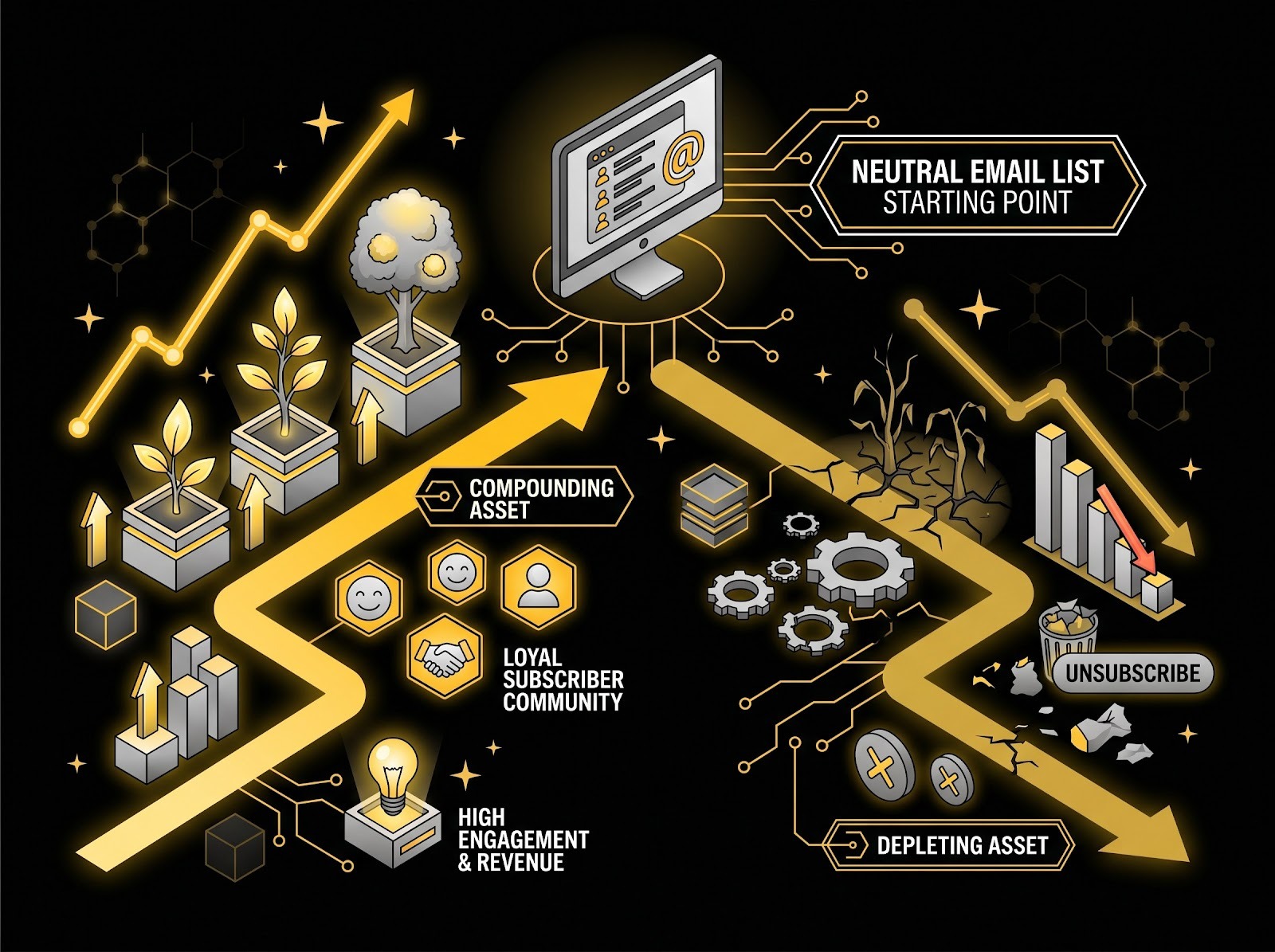
An email list is not a revenue lever. It's a business asset. And like any asset, its value should be measured by quality, health, and growth trajectory, not just by what was extracted from it last week.
Owned audiences are fundamentally different from the rented audiences built on social platforms or reached through paid media. When a brand builds a relationship with a subscriber, it owns that connection. No algorithm decides whether the message gets seen. That ownership translates directly to business resilience, and for any DTC brand in a growth phase, resilience compounds the same way revenue does.
A list growing with high-intent subscribers, maintaining strong engagement over time, and consistently delivering qualified traffic is worth considerably more than a large but disengaged list propped up by heavy promotional volume. The first is a compounding asset. The second is a depleting one. In acquisition contexts, email list quality and engagement health show up consistently as valuation multipliers, because buyers understand that owned reach has durable future value. Standard attribution rarely captures this distinction, which is why so many brands optimize their way into an audience health crisis without seeing it coming.
The Site Funnel Strategy: Email Develops the Audience, the Website Closes the Sale
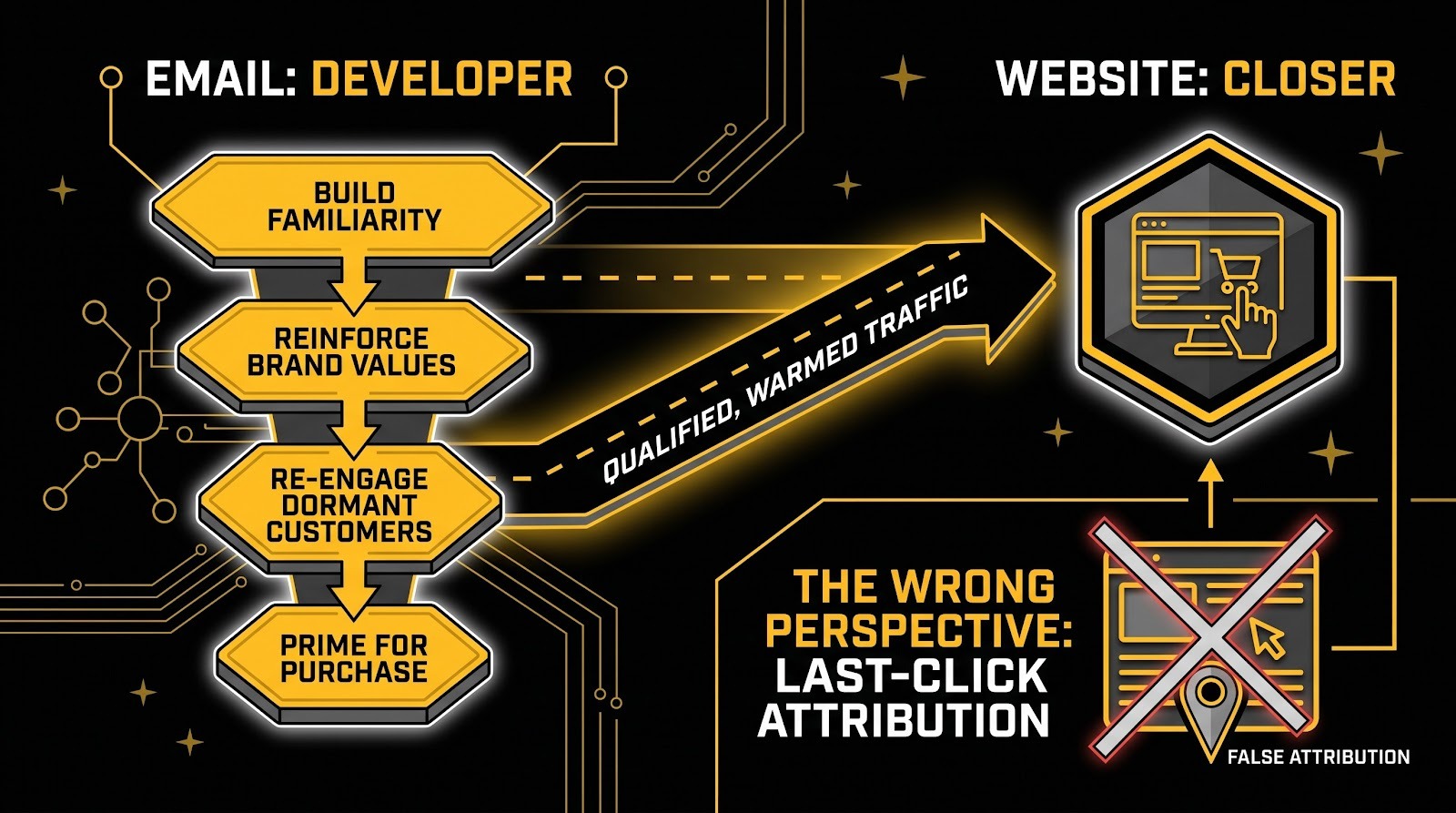
For most DTC brands, email is not the closer. It's the developer. Email builds familiarity, reinforces brand values, re-engages dormant customers, and creates the conditions for purchase. The website is where the sale actually happens, through conversion-optimized landing pages designed to remove friction and close warmed traffic.
This explains why last-click attribution so consistently undervalues email. If email's primary job is to bring qualified, primed audiences to the website, then measuring email's success purely by the revenue it captures at send time misframes the entire channel. The ROI lives in the synergy between the two, and no single-platform attribution report can capture that.
The right question isn't "how much revenue did this email generate?" It's "did this email create the conditions that led to a conversion?" That shift in framing forces teams to track behavior downstream, connect email engagement to on-site activity, and evaluate email as part of a system rather than a standalone transactional tool. It also changes which campaigns get investment. The campaigns that build audience trust and deepen subscriber relationships deserve the same attention as the ones that drive immediate clicks.
How to Actually Measure Email's True Contribution
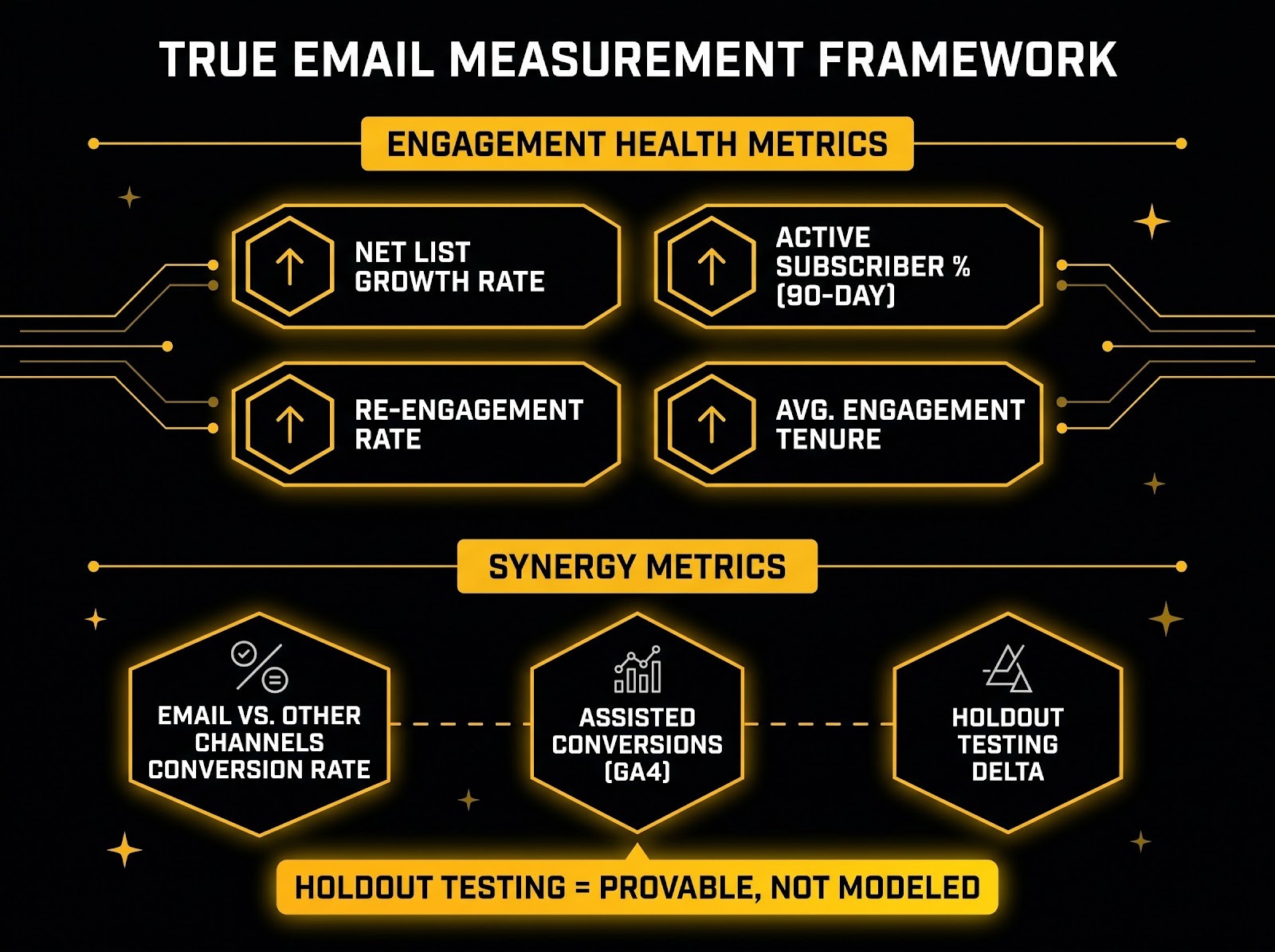
Rebuilding an email attribution framework means replacing metrics that flatter with metrics that inform, across two categories: engagement health metrics that indicate whether the audience relationship is strengthening, and synergy metrics that connect email behavior to on-site conversion outcomes.
Engagement Health Metrics That Replace Revenue-Per-Send
Engagement health metrics focus on the quality and trajectory of the audience relationship over time. The most informative include net list growth rate, active subscriber percentage within a 90-day window, re-engagement rate from dormant segments, and average engagement tenure. If the active subscriber percentage is declining, the list is losing value regardless of what this month's revenue-per-send shows.
Customer lifetime value segmented by acquisition source is another essential metric. If email-acquired subscribers retain longer and purchase more frequently than those acquired through paid channels, that difference represents real economic value that standard attribution will never surface. These are the leading indicators that predict future revenue more reliably than immediate attributed sales.
Synergy Metrics: Connecting Email Engagement to On-Site Conversion
Synergy metrics bridge the gap between inbox behavior and website outcomes. Segment site analytics by traffic source and compare behavioral quality: time on site, pages per session, add-to-cart rate, and conversion rate for visitors arriving from email versus other channels. If email-driven visitors convert at a higher rate or generate higher average order values, that differential is evidence of email's contribution to purchase intent, even when the final click came from somewhere else.
Track assisted conversions in GA4 as well, filtering for email touchpoints that appeared earlier in the path to purchase. Klaviyo's integration with Shopify can surface this journey-level data, while Northbeam and Triple Whale provide cross-channel attribution that avoids the platform bias baked into native dashboards.
The gold standard, though, is holdout testing. By suppressing email sends to a randomly selected control group and measuring the revenue gap between that group and the exposed segment, brands can isolate email's true incremental contribution with a level of certainty no attribution model alone can provide. The delta is provable, not modeled.
Rethinking Email Attribution With Pilothouse Digital
Fixing an email attribution framework isn't just an analytics exercise. It's a strategic realignment that changes how brands invest in and evaluate one of their most important owned channels.
Pilothouse Digital approaches email and SMS strategy for DTC brands with this systems-level thinking at the center. The brands that compound results over time aren't sending more. They're measuring more honestly, investing in audience health, and treating email as the qualification engine it actually is rather than a short-term revenue dial.
Accurate email attribution requires the right goals, not just better tools: audience quality, engagement health, and full-funnel synergy. If email numbers look strong but overall business growth feels stuck, the gap between those two realities is exactly where the real work begins. Connect with the Pilothouse team to explore what that framework looks like in practice.

