


UGC vs. Influencer Marketing: Gifting, Paid UGC, and Creator Partnerships - How to Choose for Your DTC Brand

Most DTC brands run into the same wall: they know content matters, they know creators are part of the mix, but they can't quite articulate why certain campaigns perform and others don't. Often, the problem isn't the budget or the creator. It's that the brand never got clear on what type of content it was actually buying, or what job that content was supposed to do.
The debate around UGC vs. influencer marketing is real, but it's more layered than most discussions give it credit for. True user-generated content, employee content, and paid creator assets all operate differently and require different strategies. Getting this right is less about picking a trend and more about building a content system that keeps delivering returns over time.

UGC, Employee Content, and Paid Creator Assets: Clearing Up the Confusion
These three content types get lumped together constantly, and that confusion leads to misaligned briefs, content that never quite fits the channel it's placed in, and wasted spend.
User Generated Content: Organic Trust From Real Customers
True User Generated Content (UGC) is content customers create without being paid to do so: a review video filmed on a bathroom counter, a photo tagged in an Instagram story, a Reddit thread where someone recommends a brand unprompted. Its power comes entirely from the fact that nobody paid for it. Consumers have finely tuned filters for sponsored content, and organic customer voices cut through in a way polished ads simply can't replicate.
Employee Generated Content: Authenticity From Within the Brand
Employee Generated Content (EGC) occupies a middle ground. A team member walking through how a product is made, or sharing their honest experience with it, humanizes the brand in a way corporate messaging never could. EGC is particularly useful for brands where internal culture is part of the product story. The risk is keeping it genuine; if employee content starts to feel managed or scripted, it loses the authenticity that made it worth producing in the first place.
Creator Generated Content: Paid Assets Built for Performance
Creator Generated Content (CGC) is where the definition gets murky for most brands. As Avery Valerio from Pilothouse breaks down on the Ad-venturous podcast (Ep 40: How to Write Creator Briefs That Actually Perform), a paid CGC creator is a content professional, not an influencer in the traditional sense. Their social following may be small or nonexistent, because audience reach isn't what they're selling. What they offer is content that looks and feels like authentic consumer video while being built for performance.
When a brand hires a paid CGC creator, it's buying a creative asset, not a distribution channel. That distinction changes how to brief them, how to measure success, and how to deploy the work.
Why Paid Creator Content Should Scale Winners, Not Test New Ideas
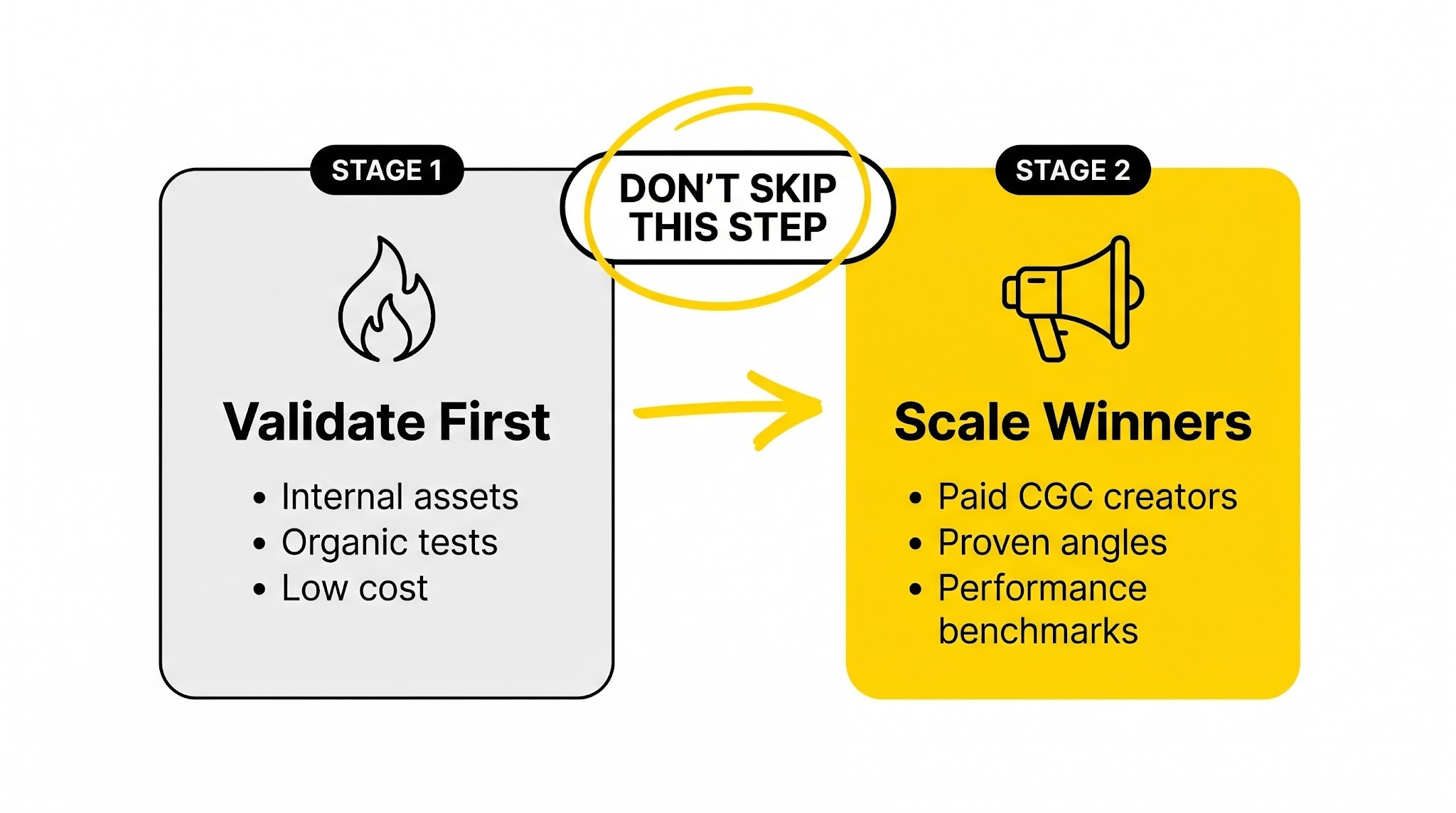
One of the most common and costly mistakes DTC brands make is using paid creator content to explore creative concepts they haven't validated yet. This approach gets the logic backwards. As Aves explains on Ad-venturous (Ep 40), creator production carries real costs in fees and turnaround time, and using it as a discovery mechanism burns resources without generating reliable learning.
The smarter model is to use lower-cost internal assets or simple organic tests to identify what messaging, hooks, and angles connect with an audience. Once a concept starts performing, that's the signal to bring in paid CGC creators and build it into a scalable creative package. Creator content should amplify what's already working. This discipline separates brands with efficient creative pipelines from those constantly chasing the next winning ad.
Brands that get the most from creator partnerships arrive with proven angles and clear performance benchmarks, not open-ended creative briefs.
How Creator-Led Creative Works as a Targeting Lever in the Meta Andromeda Era

Meta's Andromeda framework has changed how creative functions in paid media in a significant way. According to Daniel Sendecki, VP of Brand + Performance at Pilothouse, speaking on the DTC Podcast (Ep 581: Meta Ads Aren't About Targeting Anymore: How $5-50M Brands Win with Intent-Based Creative), Meta now assigns each piece of ad creative an Entity ID rather than relying on demographic or behavioral targeting alone. This Entity ID functions as a semantic fingerprint generated through analysis of how the creator speaks, contextualizes the problem, and frames the solution. The algorithm uses that fingerprint to retrieve the ad for people whose expressed desires, lifestyles, and problems match what the creative signals.
This means creator identity encodes who an ad is for. A creator who authentically connects with endurance athletes or new parents carries audience signals into the creative itself, and Meta routes that content accordingly. Choosing creators based purely on cost or availability misses this entirely. The right creator for a performance campaign is the one whose natural voice already reflects the target customer's world.
The practical shift for DTC brands is moving from design diversity toward idea variety, where different pieces of creator content serve as specific answers to different customer questions, as Sendecki notes in the same episode.
How to Write Creator Briefs That Actually Perform
A brief that over-specifies kills creative performance. One that under-specifies delivers content that misses the mark. Most brands err toward over-control.
Lead With a Visual Hook in the First 3 to 5 Seconds
Every brief should be explicit about the opening. Scroll behavior on social feeds is fast, and if an ad doesn't earn attention within the first three to five seconds, the rest of the content doesn't matter. As Aves (Avery Valerio) from Pilothouse explains on the Ad-venturous podcast (Ep 40: How to Write Creator Briefs That Actually Perform), Meta's algorithm prioritizes structural creative diversity, meaning visual signals are a core component evaluated before advertiser-defined audiences, so rather than asking for three different voiceover hooks, brands should ask for three visually distinct openings: pouring coffee, packing the product, a reaction shot. Brief creators on the outcome the hook needs to achieve, not a word-for-word script.
Beyond the hook, strong-performing creator content refreshes information, visuals, or narrative roughly every four to six seconds, delivering a clear payoff at a steady cadence. Brands should communicate this pacing expectation in the brief without dictating every cut.
Give Creators Natural Language, Not Robotic Scripts
Scripting every word produces stiff, unnatural content that audiences immediately recognize as inauthentic. Briefs should provide the key claim and the product feature worth noting, along with the emotional angle and the natural language the target persona actually uses. Then the creator puts it in their own words (Ep 40). The resulting content sounds like a real person talking, which is exactly what drives performance in paid social environments where trust signals determine whether someone clicks or scrolls past.
Influencer Partnerships for DTC: Problem Agitation Over Vibe Marketing
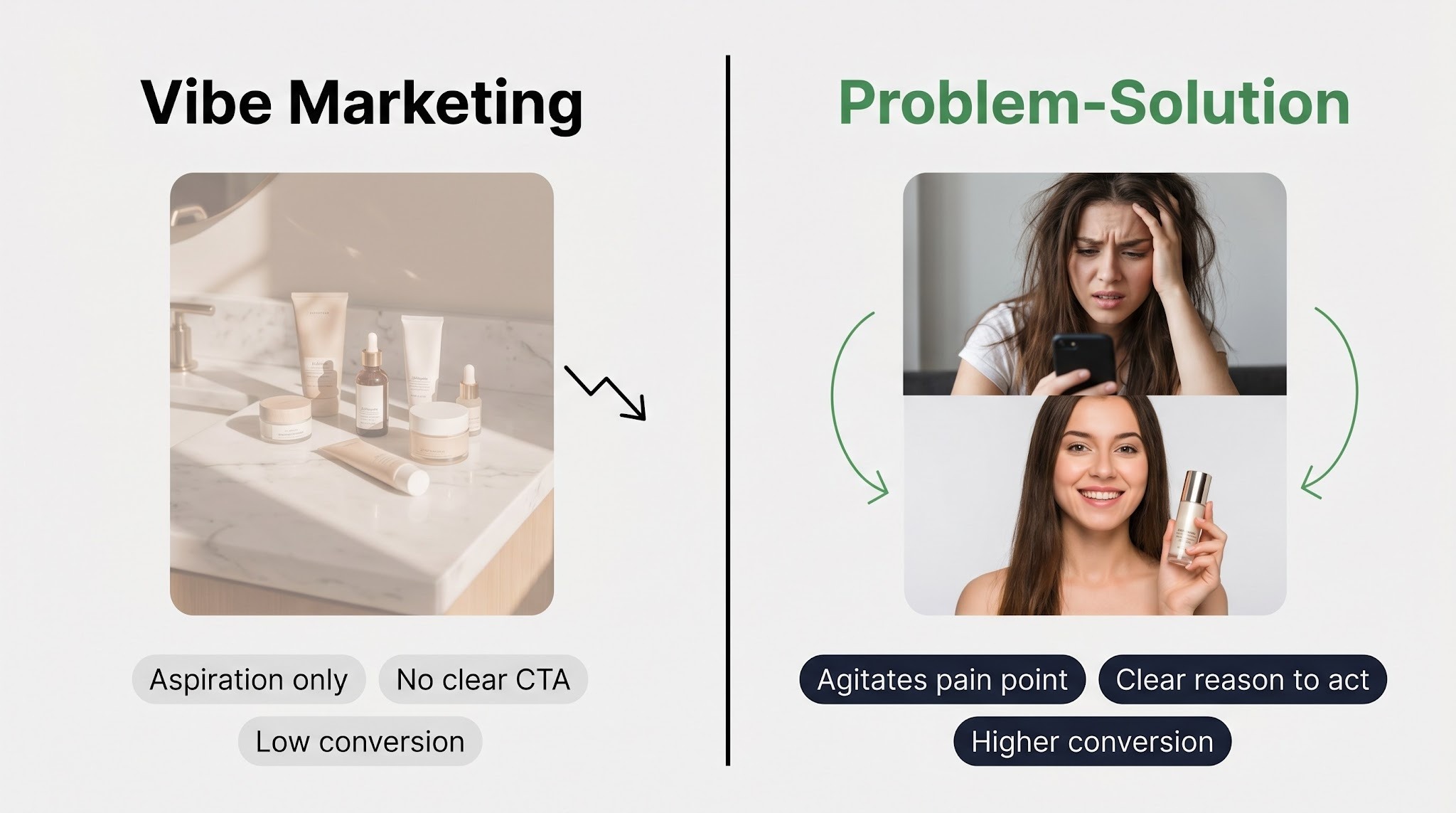
The most common failure mode in DTC influencer partnerships is vibe marketing: beautiful content that communicates lifestyle aspiration but never gives the viewer a clear reason to act. Brands that rely solely on this approach tend to underperform unless they have a massive, legacy spokesperson to carry the social proof. Advertisers have grown more selective over time, prioritizing clear ROI over reach, and vibe-only partnerships have borne the brunt of that shift.
As Aves (Avery Valerio) and Daniel Sendecki from Pilothouse discuss on the DTC Podcast (Ep 593: 3 Rules for Culturally Relevant DTC Ads That Still Convert on Meta), for most DTC brands, influencer partnerships perform best when the creator leads with a problem their audience faces and positions the product as the most credible solution. That structure, problem agitation followed by product resolution, mirrors how purchase decisions actually happen.
Gifting and Social Swarms for Lower AOV Brands
For brands with lower average order values, gifting strategies can generate meaningful volume without a significant upfront budget. Sending product to a broad pool of relevant creators produces a swarm effect where multiple voices talk about the brand simultaneously. This volume of social proof builds credibility and supports conversion. The key is curating creators whose audience demographics match the customer profile; misaligned audiences generate content without commercial value regardless of volume.
Selective Partnerships and Intent-Based Creative for Higher AOV Brands
Higher AOV products require a different approach entirely. When a customer is considering spending several hundred dollars or more, enthusiasm isn't enough. Detailed, credible creator content that addresses real hesitations, grounded in honest experience, converts far better than polished brand advertising. For these partnerships, selectivity matters: creators with credibility among audiences that have purchasing power aligned to the price point, producing intent-based content that speaks to durability or value, consistently outperform broad lifestyle content (Ep 40).
Foundational Content Formats Every DTC Brand Should Produce
On the Ad-venturous podcast (Ep 48: Unboxings, B-Roll, and 3 More Video Styles That Scale), Aves (Avery Valerio) from Pilothouse breaks down several creative formats every DTC brand should have in rotation. Three stand out for their performance and versatility.
Unboxings for Bottom-Funnel Clarity
Unboxing content resolves uncertainty right when a buyer is closest to pulling the trigger. A customer seriously considering a purchase wants to know what they'll actually receive. Creator-led unboxings, filmed with natural lighting and genuine reactions, deliver that confirmation more credibly than product photography and are well-suited to bottom-funnel applications.
Scrappy iPhone B-Roll for High-Velocity Feed Performance
Highly produced content sometimes works against itself in paid social environments. When an ad looks too polished, it signals "advertisement" before the viewer registers the message. Simple 10 to 15-second iPhone B-roll blends into the organic feed and earns attention before ad filters activate. This format also enables high-frequency testing because production costs are low and turnaround is fast.
Why Ads Featuring the Giftee Often Outperform Ads Featuring the Buyer
When a product is positioned as a gift, the most emotionally compelling story often belongs to the person receiving it, not the one buying it. Content that captures genuine surprise or appreciation creates an emotional pull that buyer-centric content rarely achieves. Ads featuring the giftee tend to have longer shelf lives as evergreen assets because they connect with both the buyer and the end user. Brands with gifting use cases should brief creators to capture the recipient's experience alongside the purchase journey.
Four Ways to Iterate on Winning Creator Assets
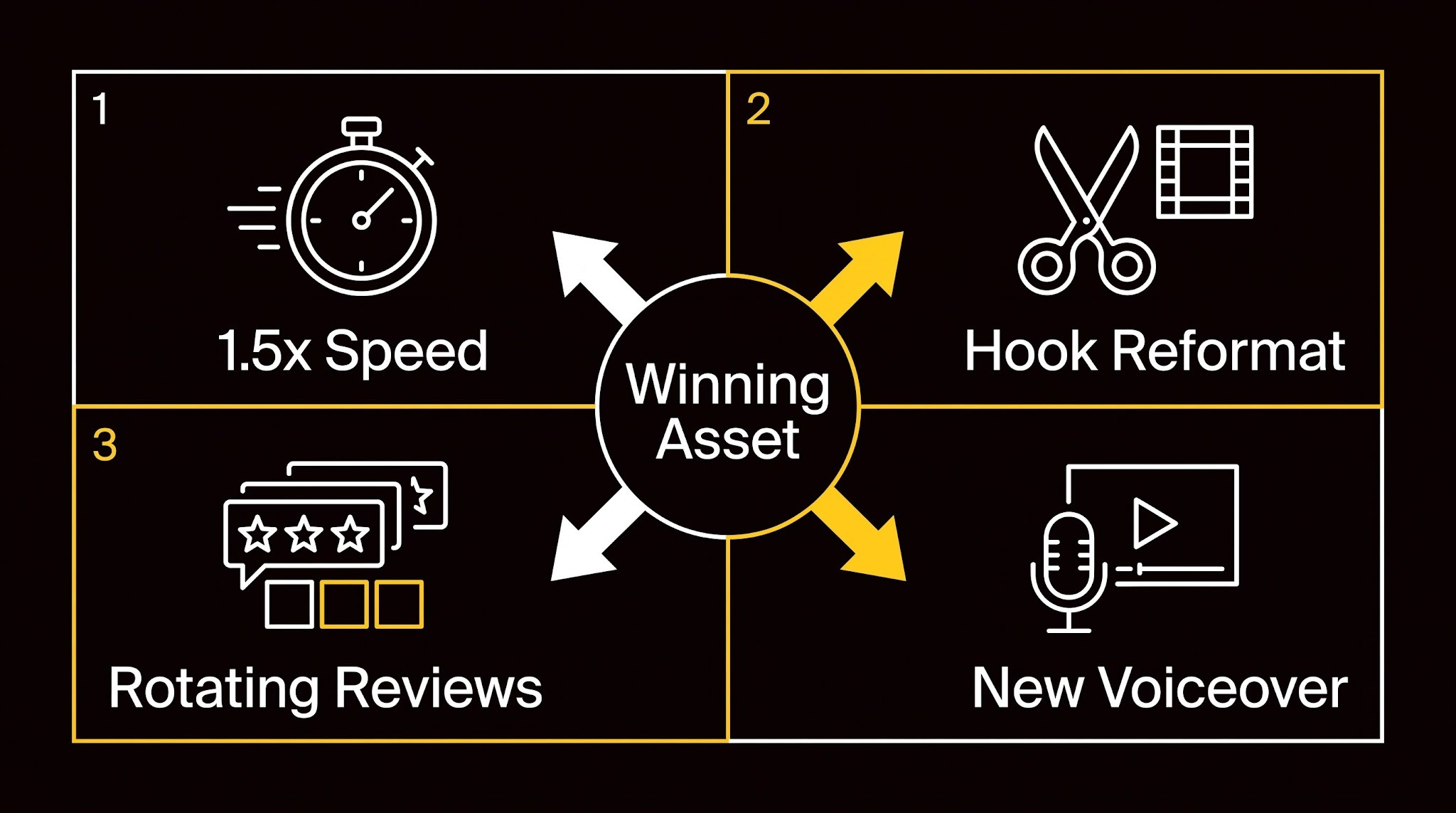
Finding a creative asset that performs is only the beginning. Building systematically on that winner is where brands move ahead. Four specific iteration approaches extract more value from proven creative (Ep 52: When You Find a Winner: Four Ways to Iterate on Creator Content):
- Test the asset at 1.5x speed, or accelerate only the slower segments while keeping the voiceover at 1x. This delivers the same information more succinctly and often lifts completion rates.
- Take the first five to seven seconds of a winning creator video and reformat it with concise, culturally relevant captions for short-form placements.
- Add a color block to the video displaying rotating customer reviews or platform-specific discount codes, adapting the same asset for platforms like Pinterest without a full reshoot.
- Create a mashup of winning creator visuals with a new voiceover that specifically addresses conversion friction, whether that's price sensitivity, objections around guarantees, or hesitation about commitment.
Each approach maps to a specific friction. Brands that treat a winning asset as a starting point rather than a finished product extract compound value from every creator investment. Pilothouse Digital's integrated media and creative model is built around exactly this loop; more detail on the approach is available through Pilothouse's case studies.
Frequently Asked Questions About UGC vs. Influencer Marketing
What is the main difference between UGC and influencer marketing?
UGC is organic content created by real customers without payment. Influencer marketing involves compensating creators with product or money to promote a brand to their audience. True UGC carries no built-in reach guarantee; influencer content includes the creator's audience as part of the value.
What are CGC creators, and why do brands hire them?
CGC creators are content professionals who produce authentic-looking video and photo assets for use in paid advertising. They're hired for their ability to create high-performing creative, not for their social following. The goal is content that feels organic while being built for conversion.
Is UGC or influencer marketing better for DTC brands?
Both belong in a well-structured DTC content strategy, and they serve different functions. UGC builds trust through peer validation across multiple funnel stages. Influencer partnerships expand reach and drive awareness for new audiences. The choice is rarely either/or; it depends on which tool fits the specific job at hand.
Should a brand start with gifting or paid CGC creators?
For lower AOV brands with tight budgets, gifting programs create content volume with lower upfront costs. For brands ready to invest in performance creative, paid CGC creators deliver more consistent, brief-aligned output that integrates cleanly into paid media campaigns. Once proven angles emerge from either approach, scaling those winners with additional creator production is the natural next step.




.jpg)
