


Gen Z Advertising vs. Millennials: Identity, Stability, and How to Write DTC Ad Copy for Each

Most DTC brands treat generational targeting as a media buying problem. Slice the audience by age, assign the right platform, call it a strategy. But the real gap between Gen Z advertising and Millennial ad copy isn't about where the ads run. It's about what the audience needs to feel before they'll trust a brand enough to buy. Understanding the psychological intent behind each generation's scroll is what separates copy that connects from copy that gets ignored.

The Shift From Persuasion to Resolution in DTC Advertising
Advertising used to run on a simple premise: show the product, state the benefit, make the ask. That model worked when consumer attention was captive and brand trust came with the territory. Today, neither condition exists.
Younger consumers don't respond to traditional persuasion. They've processed too many promises, seen too many campaigns, and developed sharp instincts for anything that feels manufactured. What works now is resolution-oriented messaging: copy that identifies a real tension in someone's life and positions the product as what makes it better. The consumer's problem leads; the brand follows.
This shift changes what copy leads with and what it leaves unsaid. It also requires recognizing that Gen Z and Millennials aren't arriving at that tension from the same place.
The Core Psychological Gap: Identity Wounds vs. Stability Seeking
On the surface, these two generations share real similarities. Both are digitally native in meaningful ways. Both have been shaped by economic disruption. Both respond poorly to inauthentic brand behavior. But the emotional engine behind their purchasing decisions is fundamentally different, and treating them as one audience produces copy that resonates with neither.
Gen Z advertising works best when it speaks to identity. Millennials respond most strongly when copy addresses stability.
Gen Z Advertising and the Resolution of Identity-Based Wounds
Gen Z grew up forming their identities in public, online, and in real time. They've watched brands co-opt subcultures, perform allyship, and weaponize identity language as a conversion tactic. According to Numerator, 27% of Gen Z say brands don't connect with them in ways that feel genuine, making them 23% more likely than average consumers to switch to a competitor simply because they grew tired of a brand.
Good Gen Z advertising doesn't just represent identity. It resolves something. The best work acknowledges a specific friction, whether that's feeling misrepresented, overlooked, or caught between conflicting expectations, and offers the product as part of a resolution. The brand becomes a mirror reflecting who the consumer is becoming, not a megaphone telling them who they should be. Kantar BrandZ data shows Gen Z are 1.5x more likely than older cohorts to expect brand values to align with their own.
Gen Z branding that earns genuine loyalty treats inclusivity and representation as operational commitments, not campaign themes. When Gen Z culture shows up in creative, it should be because the brand actually lives there, not because a trend report said it was the right time.
Millennial Ad Copy and the Deep Need for Stability and Comfort
Millennials entered adulthood during the 2008 financial crisis, came of age during peak hustle culture, and are now carrying the full weight of adult responsibilities. Their relationship with brands is shaped by that history. According to the Bank of America Better Money Habits Study, 55% of Gen Z adults in 2025 lack three months of emergency savings, and 72% of young adults took action to improve their financial health over the past year due to rising living costs. That's not background context. It's the active frame through which they evaluate every purchase.
Millennial ad copy performs best when it leans into reliability and comfort. Messaging that acknowledges life's difficulty without being patronizing, and frames the product as a meaningful source of stability, connects quickly. Research into financial anxiety trends in 2025 shows consumers moving away from prestige labels and focusing on durability, transparency, and cost savings, favoring clear reliability signals (Snapcart, 2025). Testimonials, social proof, and real-life product applications matter here because Millennials aren't just evaluating a product. They're evaluating whether they can trust the brand not to let them down.
How to Write Gen Z Advertising That Actually Lands
Effective Gen Z advertising doesn't feel like advertising. That's not a platitude; it's an executional standard.
Organic-Feel Creative, Brain Rot Humor, and High-Intent Platforms Like Pinterest
One of the clearest Gen Z marketing trends right now is the rise of "brain rot" humor: absurdist, lo-fi, self-aware content that deliberately rejects polish. For a generation raised on algorithmic feeds, highly produced creative reads as corporate. Raw or playfully chaotic content reads as real.
This doesn't mean low effort. It means intentional informality. The copy still needs a clear idea at its center, but the execution should feel closer to something a person made than something a brand manufactured. Pinterest deserves more credit than it usually gets in these conversations. It's a high-intent platform where users arrive already looking for inspiration and solutions. Visually compelling, product-forward content there reaches a Gen Z audience in a discovery mindset, which shortens the distance between inspiration and purchase.
Gen Z tone guide: Structures that build credibility include "honestly," "the way," self-referential humor, and cultural shorthand tied to current behavior patterns. What actively undermines credibility: forced slang past its cultural shelf life ("giga good" used without irony), corporate-sounding benefit stacks, and any phrasing that signals the brand is performing relatability rather than actually demonstrating it.
Key mistakes to avoid: Using Gen Z slang after its cultural moment has passed signals exactly the kind of trend-chasing this audience punishes. Performance-first creative that strips identity entirely, sacrificing cultural fluency for click-through optimization, consistently underperforms with this cohort.
CTAs That Don't Feel Like CTAs
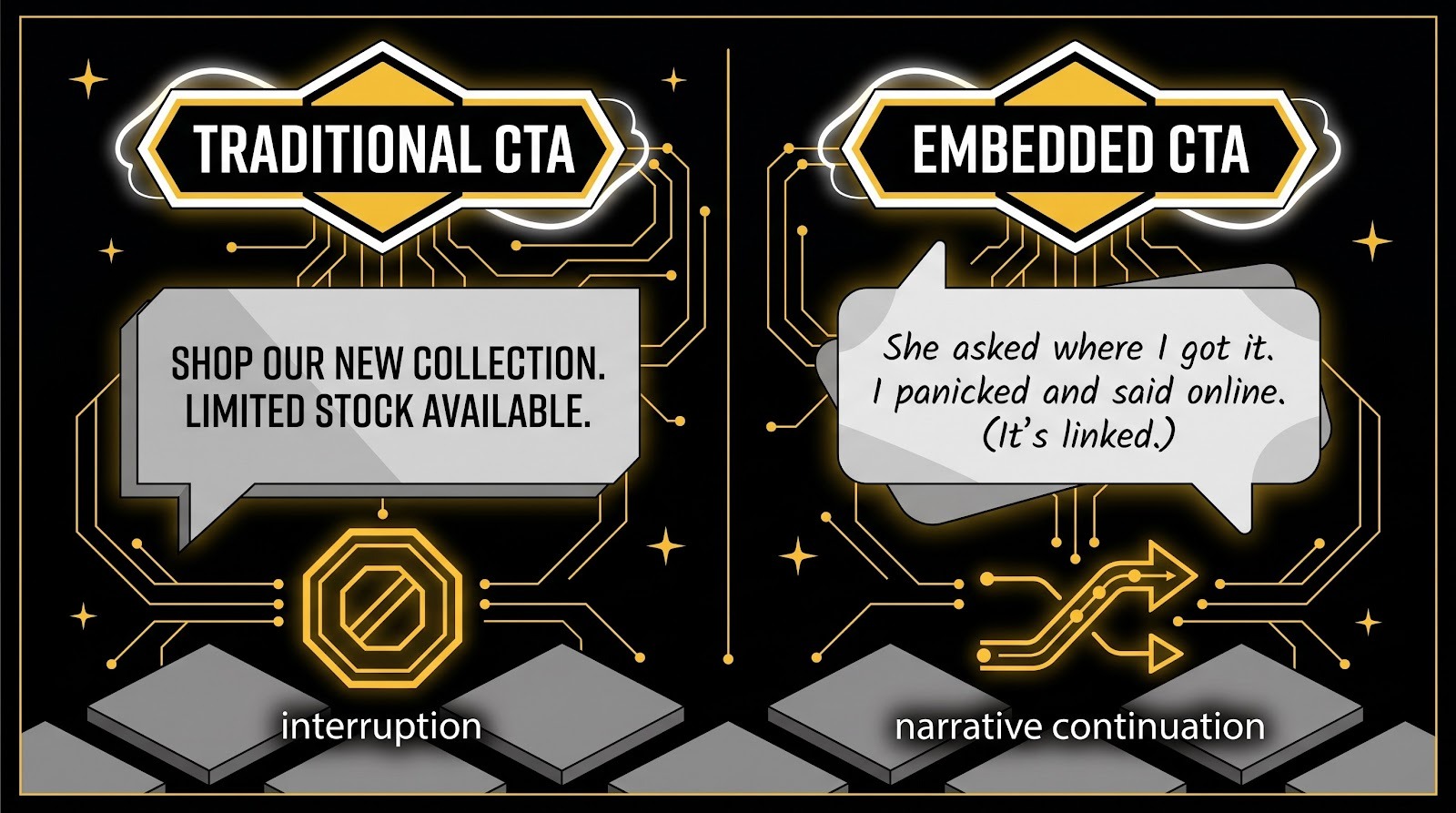
Gen Z processes traditional calls to action as interruptions. The moment copy shifts into overt sales language, the spell breaks. A traditional CTA reads: "Shop our new collection. Limited stock available." An embedded one reads: "She asked where I got it. I panicked and said 'online.' (It's linked.)" The second extends the narrative rather than breaking it. The product is still the destination, but the reader arrives through curiosity rather than command.
How to Write Millennial Ad Copy That Converts
Millennials don't need to be dazzled. They need to feel understood. The most effective Millennial-targeted campaigns are built on recognition, the sense that the brand actually gets what this person's life looks and feels like.
Commiseration, Nostalgia, and Owning the Meta Ecosystem
Millennial consumers respond to copy that doesn't shy away from the hard stuff. Acknowledging that adulthood is expensive, exhausting, and occasionally absurd isn't a negative signal; it's an entry point into genuine connection. Brands that lean into shared struggle with humor and honesty tend to outperform brands projecting aspirational perfection at this audience.
Nostalgia is a secondary but powerful layer. References to early internet culture or the specific emotional memory of a simpler time can unlock real engagement, including visual anchors like retro emojis (🙌 💯 ✨) used as familiarity signals rather than irony. It's not about pandering; it's about speaking the generational language fluently.
Millennial tone guide: Structures that build credibility include commiseration openers, social proof, plain-language reliability claims, and humor grounded in shared generational experience. What undermines credibility: over-promising lifestyle without proof, aspirational framing that ignores financial reality, and campaigns that feel like they're trying too hard to seem cool to an audience that no longer needs that validation.
Key mistakes to avoid: Millennial campaigns that project aspirational perfection without grounding the product in real-life utility consistently fall flat. This audience has processed enough brand disappointment to be deeply skeptical of anything that over-promises.
The Meta ecosystem, spanning Facebook, Instagram, and Meta's broader ad infrastructure, remains the primary arena for reaching Millennials at scale. Over 50% of Facebook's user base is between 25 and 44 years old, making it a dominant environment for this audience (Hootsuite). Owning that ecosystem means building sequential creative that tells a coherent story across formats, investing in retargeting that adds value rather than simply repeating the ask, and using social proof strategically across placements. Pilothouse's work with Four Sigmatic demonstrates how a wellness DTC brand can use emotionally grounded creative across the Meta ecosystem to build sustained trust with an adult audience rather than chasing short-term conversion spikes.
Gen Z vs. Millennial Copy Principles: A Side-by-Side Framework
To make the distinction concrete, consider a functional beverage, an adaptogenic focus drink. Here's what genuinely distinct copy looks like for each audience.
Gen Z execution: "my 9am used to be a crisis. now it's a ritual. still not a morning person but I'm pretending. (the link does something)" - No benefit stack, no feature list. The product is implied through identity framing. The CTA is embedded and non-demanding.
Millennial execution: "You've already done the hard part. Getting up, showing up, making it work. This is the part of your morning that actually feels like yours. Real adaptogens. Real focus. 🙌 [See what people are saying.]" - Commiseration leads, social proof closes. The CTA is direct but earned through emotional setup.
The difference isn't word choice. It's psychological architecture. The Gen Z version resolves an identity tension (the person who wants to be the type who has a ritual). The Millennial version provides stability signals: reliability, proof, the earned reward framing.
For Gen Z, copy foundations are identity resolution, cultural fluency, embedded CTAs, and platforms including TikTok, Instagram Reels, and Pinterest. For Millennials, copy foundations are emotional reliability, commiseration-led structure, direct CTAs once trust is established, and platforms including Facebook, Instagram feed, and email.
Creative as the Primary Targeting Lever: Idea Variety in the Age of Meta's Andromeda
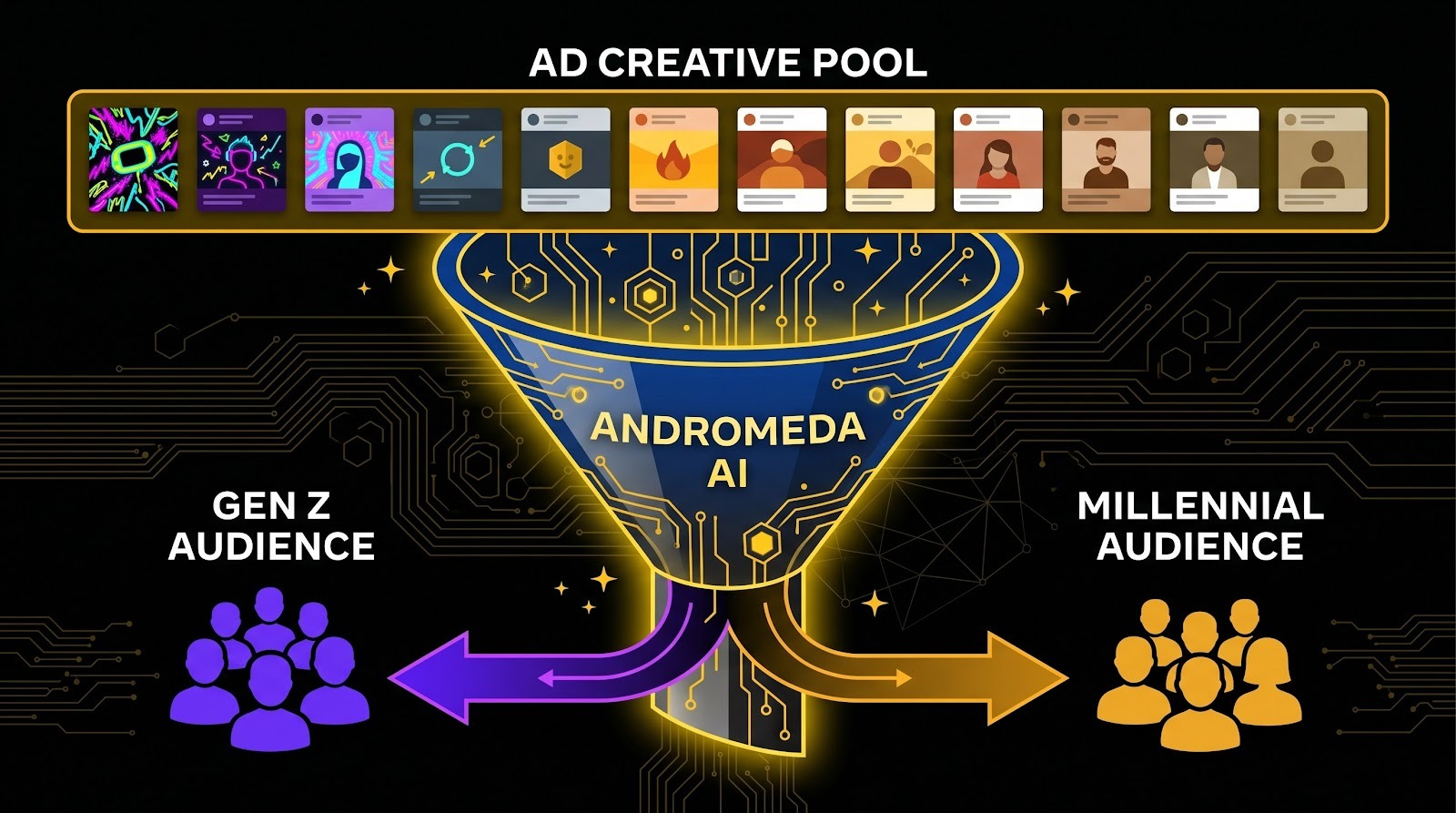
Meta's Andromeda system has fundamentally changed how ads get matched to audiences. The algorithm now pulls from a broader pool of potential viewers and serves creative to those most likely to respond based on behavioral signals, not just defined audience parameters. In practice, the creative is doing the targeting.
If an ad speaks specifically to a Gen Z identity concern, the algorithm finds Gen Z users processing that concern. If copy addresses the Millennial need for stability, Andromeda routes it toward Millennials primed to receive that message. The sharper and more specific the creative idea, the more precisely the system can match it.
This is why idea variety is a targeting strategy, not just a testing habit. Running three versions of the same concept limits reach. Running ten distinct ideas, each rooted in a different psychological tension or cultural moment, multiplies the chances of hitting the right nerve for the right person. More distinct concepts in market means more surface area for Andromeda to work with, and that approach consistently outperforms variations on a single idea.
Write for Psychological Intent, Not Just Demographics
Age cohorts give brands a starting point. Psychological intent gives them the message. For Gen Z, that tension is often rooted in identity: who am I, where do I belong, and does this brand reflect something true about my experience? For Millennials, it runs through a different register: is this worth my limited money and time, and will this brand actually deliver?
The copy that earns conversion answers those questions before the consumer has to ask them. The brands that grow aren't the ones with the biggest budgets; they're the ones with the sharpest understanding of who they're talking to and why it matters. For DTC brands working to get this right across both generations, the Pilothouse case study library offers a broader view of how psychological intent shapes creative strategy at scale.


.jpg)
