


Product Bundling Strategy for DTC: How Pilothouse Uses Bundles to Drive Repeat Purchase Without Discounting

Most DTC brands treat bundling as a markdown in disguise. They group two or three products together, knock a few dollars off the total, and call it a promotion. The result? A short-term bump in units moved, a permanently compressed margin profile, and customers trained to wait for the next sale. That is not a product bundling strategy. That's a clearance tactic with better packaging.
The brands that actually use bundling to build sustainable revenue treat bundles as a value architecture decision, not a pricing one. Done correctly, bundling improves the customer experience, increases average order value, accelerates repeat purchase behavior, and introduces customers to products they'd never have found otherwise. None of that requires a discount. It requires thinking carefully about what customers need, when they need it, and how different bundle types serve different goals across the customer lifecycle.

Bundling Is a Strategic Alignment Tool, Not a Discount Mechanism
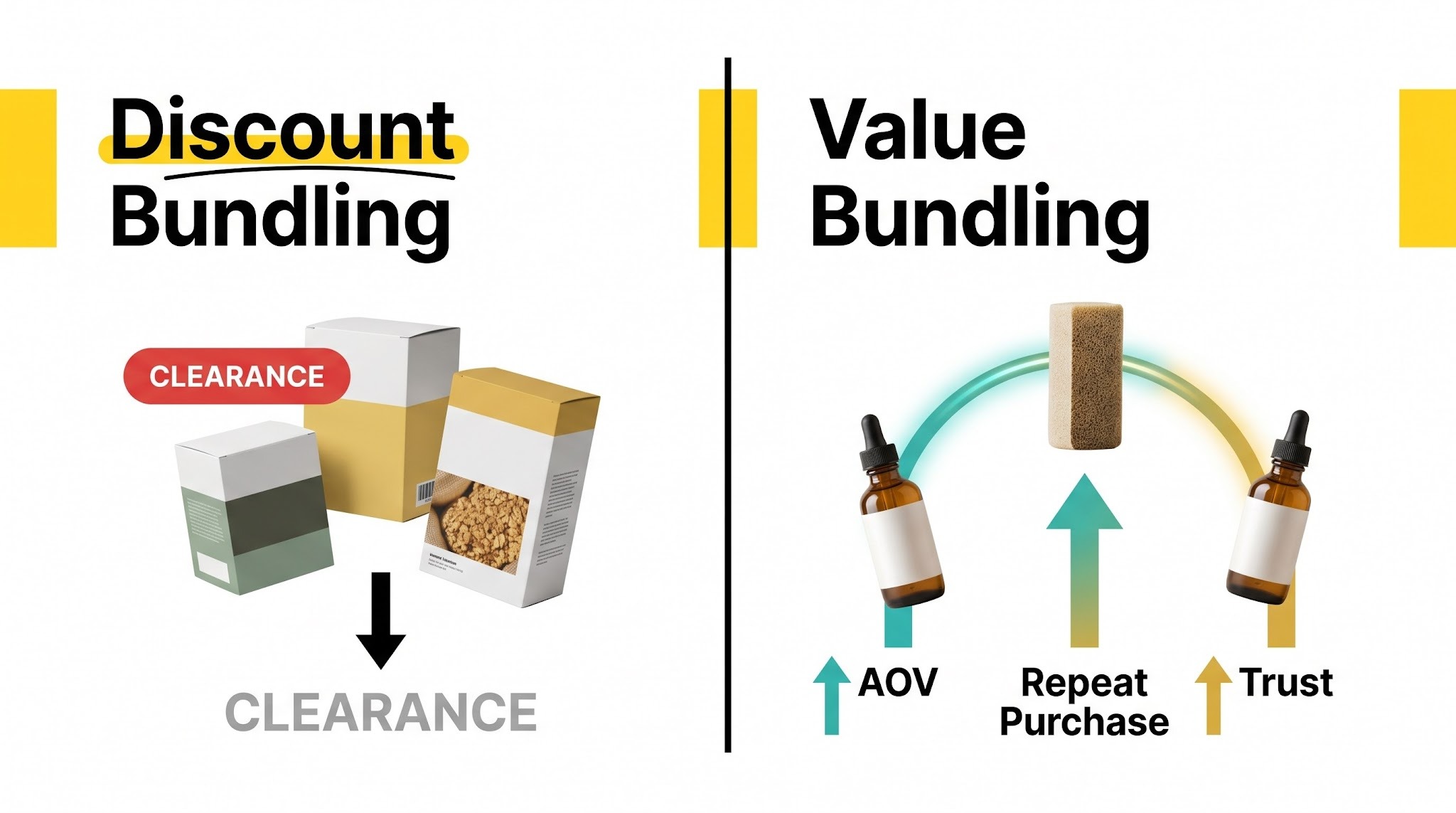
The reason most bundling strategies underperform is pretty straightforward: they're designed around the brand's inventory or margin needs, not around how customers actually make decisions. A bundle built to move overstock isn't going to resonate. A bundle built because two products genuinely complement each other and solve a real problem together will.
The framing shift that changes everything: bundles should add value, not subtract price. Convenience, completeness, and curated relevance are worth more to a motivated buyer than a 15% markdown. Leading with those qualities means competing on experience rather than cost, which is a far more defensible position in any DTC category.
Why Single-Product Mastery Must Come First
Before a bundling strategy can work, the individual products in the bundle have to work. If a standalone product hasn't proven its value, adding it to a bundle doesn't fix the problem. It moves the problem downstream and attaches it to a stronger product, diluting trust in the process.
This is where the presenter's paradox becomes relevant. This well-documented psychological phenomenon, identified by researchers Weaver, Garcia, and Schwarz, shows that when products are added to a bundle without proven individual demand, they can actually reduce perceived value rather than boost it (Journal of Consumer Research). Customers unconsciously average the bundle's worth rather than summing it. Single-product mastery means validating that an item meets real customer expectations, generates strong reviews, and earns repeat purchase on its own merit. That foundation is what makes bundling additive rather than compensatory. As Aves from the Adventurous podcast puts it bluntly: "If you don't know how to sell a single product, you shouldn't even think about bundling" (Ep 39: Bundles Aren’t Discounts. They’re Strategy). The logic holds regardless of category. Adding products to a bundle doesn't fix a conversion problem. It relocates it.
When customers already trust Product A, their openness to Product B increases significantly, especially when the combination is framed with clarity and intent.
The more common failure mode is subtler: brands group products that make logical sense on paper but don't reflect how customers actually use them. Without a genuine understanding of purchase patterns and real use-case overlap, even a well-intentioned bundle will struggle to convert.
Acquisition Bundles vs. Lifecycle Bundles: Two Completely Different Jobs
Not all bundles serve the same purpose. Acquisition bundles and lifecycle bundles have fundamentally different objectives, different audiences, and different success metrics. Mixing those goals into a single bundle type is a reliable way to do neither job well.
Acquisition Bundles for Cold Traffic: Reduce Friction, Increase Exposure
When someone encounters a brand for the first time, they're evaluating whether it's worth trusting at all. An acquisition bundle should meet that moment by reducing friction and simplifying the decision.
The best acquisition bundles accomplish two things at once. First, they give a new customer a complete, high-value entry point that feels low-risk. Second, they expose that customer to multiple products in a single purchase, shortening the time it takes to build cross-category familiarity. Rather than hoping a one-SKU buyer discovers other products organically over several months, an acquisition bundle does that work at first conversion. McKinsey research indicates cross-selling can increase revenue tenfold, and acquisition bundles do that work at the moment of first purchase rather than relying solely on post-purchase sequences.
The goal of the first order is not to maximize margin. It's to build the behavioral foundation that makes a second, third, and fourth order more likely.
Lifecycle Bundles for Returning Customers: Let Behavioral Data Lead
Once a customer has made a purchase, behavioral signal replaces demographic assumptions. Lifecycle bundles should be built from that data. A returning customer who purchased a skincare starter set three months ago doesn't need another brand introduction. They need a bundle that anticipates their next logical step, whether that's a replenishment kit, an add-on routine, or a seasonal variation.
When a lifecycle bundle is timed correctly and built around observed behavior, it feels like a recommendation from someone who actually knows the customer. That experience drives retention and increases lifetime value far more reliably than a standing discount. A 5% increase in retention can boost profits by as much as 95% (Bain & Company), which frames lifecycle bundling as one of the highest-ROI levers available to a DTC brand.
Building Bundles Around Customer Personas, Not Averages
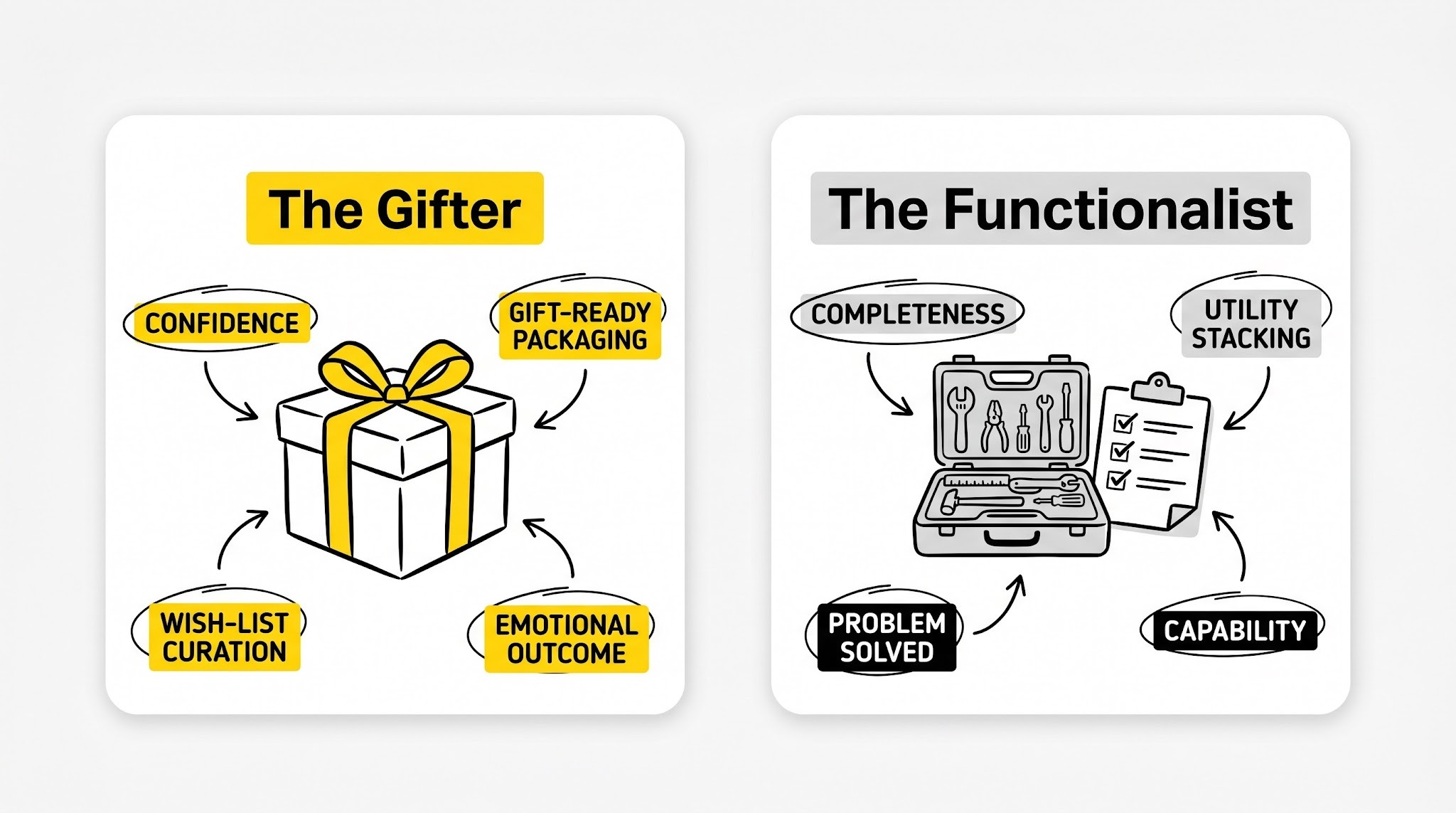
Bundles built for the average customer are compelling to no one in particular. The bundles that drive real conversion are built for a specific type of person, with a specific mindset, shopping for a specific reason. Two of the most commercially significant personas in DTC bundling are the gifter and the functionalist.
The Gifter: Savings Framing, Wish-List Logic, and Gift-Ready Packaging
The gifter isn't buying for themselves. They're buying certainty. They want to know the bundle will land well with the recipient, look considered rather than convenient. For this persona, savings framing still matters, but the primary emotional driver is confidence in the gift decision.
Effective gifter bundles use wish-list logic in their curation, meaning the products feel like something the recipient would have chosen themselves. Gift-ready packaging amplifies perceived value without requiring a price reduction. In creative targeting this segment, leading with the emotional outcome of the gift consistently outperforms leading with dollar savings. "Give them everything they love" performs better than "Save $20" when the buyer's core anxiety is whether the gift will actually land well.
The Functionalist: Breadth of Use, Utility Stacking, and Problem Completion
The functionalist shops with a goal in mind. They respond well to bundles that signal completeness, communicating that buying these products together delivers everything needed to achieve a desired outcome. Each item should add a distinct functional layer, building toward a result that feels more achievable with the full set than with any single product. Bundle positioning for this segment shouldn't lead with savings. It should lead with capability.
Non-Discount Value Drivers That Make Bundles Worth More Without Costing Margin
Discounting is the fastest way to train customers to devalue products. The brands with the healthiest margins and strongest repeat purchase rates build non-discount value into their bundle strategy from the beginning.
Several levers add perceived value without touching price. Extended warranties and security add-ons reduce purchase anxiety and increase perceived protection, particularly for higher-ticket items. Convenience bundling replaces multiple decisions with one, and the simplicity itself carries real value. The "But Wait, There's More" approach, borrowed from infomercial structure, introduces high-margin add-ons in the post-click experience after a customer is already close to purchasing, adding value without leading with price. Compatibility framing ensures seamless use, reduces return risk, and increases purchase confidence. Outcome framing positions the bundle around a result, such as a complete morning routine or a full performance setup, rather than a product list.
Across all of these: perceived completeness, convenience, and outcome-framing replace the psychological role that discounts typically play.
Full-Funnel Execution: From Pre-Click Creative to Landing Page Merchandising
A product bundling strategy lives inside a full marketing funnel, and every stage of that funnel needs to carry the same strategic intent. A well-designed bundle promoted with unfocused creative and dropped onto a generic product page will underperform. Cohesion across the funnel is what converts bundle interest into bundle revenue.
Pre-Click Ad Creative: Lead With Outcome, Not Price
The job of the ad isn't to show the bundle. It's to make the person watching or scrolling feel the problem the bundle solves. Ads that lead with price attract price-sensitive traffic, which is the segment most likely to bail when the deal feels even slightly less compelling than expected. Ads that lead with outcome attract motivated buyers who already understand the value of the category.
NCSolutions research finds creative is the top driver of incremental sales impact at 49% (NCSolutions, 2023). For a skincare bundle, the outcome is a simplified morning routine. For a fitness bundle, it's finally having everything needed to start consistently. The bundle is the vehicle. The outcome is the message.
Landing Page Merchandising: Use Comparison and Education to Resolve Anxiety
A bundle landing page needs to justify the combination, communicate the completeness of the solution, and resolve the anxiety that comes with any purchase decision more complex than a single-item add to cart. Comparison design showing what customers receive individually versus as a bundle makes the value self-evident without requiring visitors to do mental math. Educational content about how the products work together removes the "will I actually use all of this?" objection before it stalls a purchase. Bundle-specific testimonials validate the combination, not just individual products.
How to Know If Your Product Bundling Strategy Is Actually Working
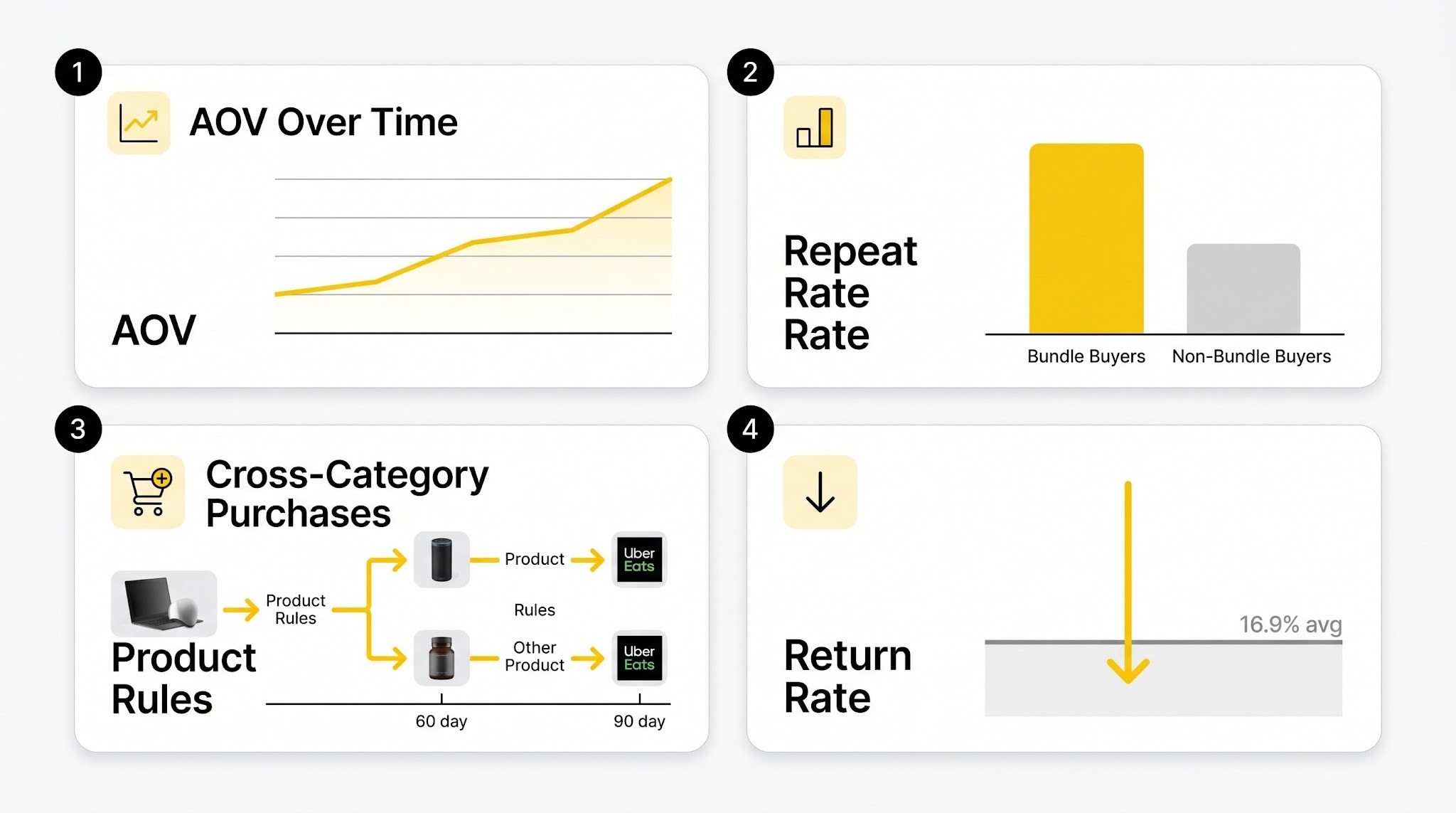
Revenue lift from a bundle promotion doesn't confirm the strategy is working. It may just confirm that promotions drive short-term volume. The metrics that actually reveal whether a bundling strategy is functioning as intended are:
- average order value trends over time (not just during bundle campaigns);
- repeat purchase rate for customers who entered through an acquisition bundle versus those who didn't;
- cross-category purchase behavior in the 60 and 90 days following bundle conversion; and
- return rates on bundled orders compared to single-item orders.
BS&Co's repeat purchase rate benchmark report, drawn from 156,000+ DTC customers across 10+ verticals, puts the average at 18.8% overall, with consumable categories like supplements reaching 22% to 44% due to natural replenishment cycles. Acquisition bundle buyers should show a meaningfully higher 90-day repeat purchase rate than single-SKU buyers in the same cohort. If that lift isn't materializing, the bundle probably isn't creating the cross-product familiarity it was designed to build.
On returns, the NRF and Happy Returns 2024 Consumer Returns report puts the average retail return rate at 16.9%, with online purchases running higher than that. Consumables sit well below that baseline while apparel runs well above it. A well-designed bundle built around genuine use-case overlap and paired with strong educational content should land meaningfully below your category baseline, not just the broad average.
Qualitative feedback adds a signal that numbers alone can't capture. When customers say they discovered a product through a bundle and it became their favorite, that's worth building on. When they say they felt pushed into buying something they didn't need, that combination needs to be revisited. The goal of any bundling strategy is to make customers feel like they got more than they expected, not that they spent more than they planned.
For a closer look at how this framework applies in practice, explore the Four Sigmatic case study and additional Pilothouse client case studies.


.jpg)
