The Win-Back Email Campaign That Doesn't Train Customers to Churn: Pilothouse's Reactivation Method
.png)
Most win-back email campaigns share the same fatal flaw: they bribe customers back instead of earning their return. The moment a lapsed buyer receives a 20% off coupon, a negotiation begins that brands rarely win. Customers learn the pattern quickly, and some begin churning on purpose just to collect the offer. The goal of a well-built win-back email campaign isn't a single click-through purchase, it's rebuilding a relationship customers actually want to return to.

Pilothouse Digital has worked with ecommerce brands across nearly every major category, and the pattern is consistent: brands that lean on discounts as their primary reactivation lever watch margins shrink while customers get quietly trained to wait for the next deal. Pilothouse's approach is different, built around intent resolution and audience precision, with content sequencing that restores trust before ever asking for a sale.
Moving Beyond the Discount Death Spiral
A win-back email built around a discount can look effective on the surface. A promotion goes out, a handful of lapsed customers buy, and revenue appears in the dashboard. The problem is what that transaction teaches: patience pays off. Skip a few purchase cycles, wait for the inevitable offer, and a better deal arrives than the one loyal buyers get.
This becomes a compounding behavioral loop, often called the "discount death spiral." When reactivation is built primarily on discounting, customers learn that disengagement is rewarded, and the brand has effectively created an incentive to churn, a point Duncan Ferguson, Senior Strategist at Pilothouse, makes in Ep 619: Stop Growth Hacking Your Brand to Death. That behavior doesn't stay isolated to win-back segments either. Active buyers notice when lapsed customers get better offers, and once that cadence is understood, the email list becomes less of a loyalty channel and more of a coupon-waiting room.
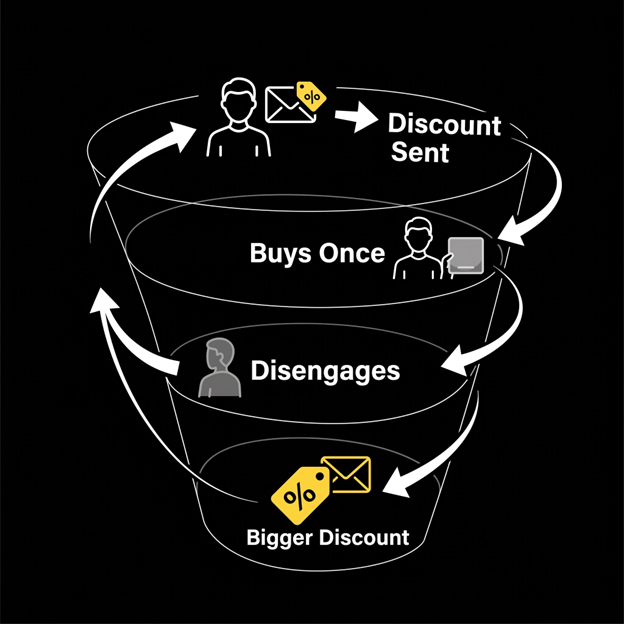
Recovering a lapsed customer through a steep discount also tends to produce a low-margin transaction that does little to rebuild the relationship itself. The customer isn't more loyal, they've simply taken the offer, and they'll disengage again until the next one appears. What brands should be chasing is recovered engagement, not just recovered revenue. Brand equity compounds over time; discounts don't.
Defining the Reactivation Audience: The Stale Repeat Buyer
Reactivation strategy shouldn't be uniform across a lapsed list, since some inactive subscribers aren't worth reactivating at all. One of the most important decisions in building a win-back email campaign is defining who the target actually is, focusing effort on buyers who've shown real purchase intent in the past.
Pilothouse uses a 95-day threshold, roughly three months, as a working benchmark for identifying a "stale repeat buyer": someone who has purchased more than once, but whose most recent transaction was over 95 days ago. This isn't a universal constant and it varies by category, but it reflects the point where purchase recency has deteriorated enough to signal a meaningful drop in engagement, as Jordan Gordon lays out in Ep 617: How to Fix a Pooched Email Account. A customer who bought three times over eighteen months and hasn't engaged in 95 days is a fundamentally different target than someone who clicked an email last week, and the 95-day mark catches them while they're still within reach of a well-crafted sequence.
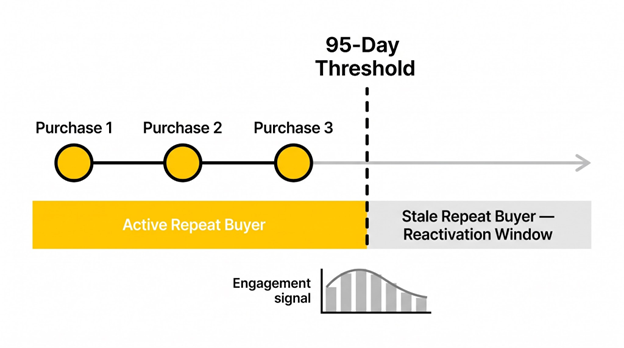
Tracking this cohort also provides a clean read on whether reactivation efforts are working. If the stale repeat buyer segment "perks up" year-over-year compared to the same month prior, the win-back strategy is successfully catching customers who were otherwise heading toward churn. Purchase interval data adds further context: a customer who historically bought every 60 days and is now at 120 is signaling something specific, whether that's product exhaustion, seasonality, or a friction point in the journey. That precision is what makes the messaging that follows actually relevant.
From Persuasion to Resolution: Pilothouse's Core Framework
Most win-back strategies are built around persuasion, convincing a customer to act through offers, urgency, or social proof. Pilothouse's framework starts somewhere else: understanding what stopped the customer from coming back, then building creative that resolves that specific barrier rather than simply pushing harder.
Customer lapses are rarely random. They cluster around a small set of "quiet anxieties," things like a neutral experience that never registered as a problem, checkout friction, a competitor's momentarily compelling pitch, or simple forgetting because the brand gave no reason to re-engage. Identifying the most common reasons a segment goes quiet, then building creative that directly addresses those concerns, transforms the win-back email from a sales push into something that actually serves the reader, an approach Daniel Sendecki, VP of Brand + Performance at Pilothouse, lays out in Ep 581: Meta Ads Aren't About Targeting Anymore: How $5–50M Brands Win with Intent-Based Creative.
This is the essence of what Pilothouse calls an "intent resolution system." Each email in a reactivation sequence has a specific job: one might reintroduce the brand's value proposition because the customer's mental model has faded, another might surface social proof to resolve doubt about quality, a third might address a common objection around shipping or returns. Each piece of creative answers a real question instead of simply filling a send slot, which is what makes the sequence feel relevant rather than generic.
Rebuilding Engagement Before Discounting
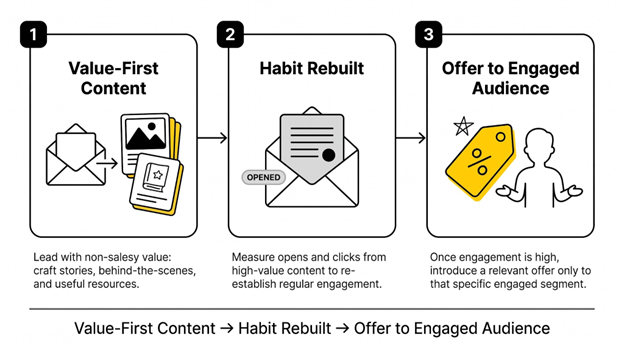
One of the more counterintuitive moves in Pilothouse's playbook is delaying the offer entirely. Before a promotional email ever reaches a lapsed customer, a content-first send goes out, aimed at restoring the habit of opening and reading rather than asking for a transaction.
This "non-performance" content might be a behind-the-scenes look at how a product is made, a roundup of usage ideas, or category-relevant editorial: a climbing brand sending bouldering tips, a founder telling the story behind a product's design. Pushing "the craft" instead of the product rebuilds the ritual of engagement. When a lapsed customer hasn't opened an email in three months, leading with a promotion sets a low-trust context, and it's often ignored, flagged, or unsubscribed from. A content email first re-establishes the relationship as worth having before anything is asked of the reader, a point Jordan Gordon, VP of Retention and CRO at Pilothouse, makes in Ep 583: Counter Intuitive Ways to Maximize Net Present Value from Your Email List.
Content sends that precede promotional sends consistently lift conversion on the sales emails that follow, since the customer has already re-engaged emotionally by the time the offer arrives. The implication for sequencing is clear: lead with value, let engagement rebuild naturally, then introduce the offer to an audience that's already paying attention.
Persona-Based Win-Back Offers That Actually Convert
Even once an offer is warranted, one-size-fits-all promotions underperform, since lapsed customers didn't all buy for the same reasons and won't respond to the same triggers. Once a customer is already inside the brand's fold, the messaging should shift from broad brand "angles" to specific "why buys," the concrete reasons someone purchases again. Lapsed buyers already understand the core brand angles, so re-blasting the same top-of-funnel messaging is wasted effort; they need a reason to act now, not a reintroduction to what the brand is, as Avery Valerio of Pilothouse explains in Ep 575: The Angle Audit: How to Break Out of the $5M "Vibes Plateau".
Some customers are motivated by novelty and disengage when the catalogue feels stale. For these customers, product news or an upcoming launch outperforms a generic discount. Others are driven by availability, having bought once when a specific SKU was in stock, and .urgency framed around scarcity or a limited restock, a "sold out in two hours, limited restock" line, speaks to them far more effectively than a flat promotional offer.
Persona-based segmentation extends to bundling as well. A "gifter" persona responds well to occasion-based bundles framed around ease of giving, while a technical or "functionality" persona wants bundles built around breadth of product or accessories, with depth and proof that the brand still understands their needs. Forcing the same offer onto both segments produces mediocre results across the board; tailoring the offer to purchase motivation produces something that feels designed for that buyer specifically.
Using Email-Only Promotions to Heal Deliverability
When a segment has low recent engagement, inbox providers are watching closely. A batch of sends to dormant addresses that generates low opens and high complaints damages sender reputation, and that damage affects the entire list, not just the lapsed segment.
Email-only promotions, deep discounts exclusive to the email channel and invisible on-site, are one of the most effective tools for managing this tension. The exclusivity itself becomes the incentive, and the resulting burst of engagement sends strong positive signals to inbox providers, helping to heal a struggling sender reputation with the mailbox providers hardest to win back, Gmail chief among them. Pairing these sends with clean destinations, such as a fast-loading PDP rather than a messy redirect, further supports inbox placement.
This approach also separates customers who are genuinely re-engageable from those who've checked out for good. A segment that doesn't respond to a compelling, exclusive offer is likely due for a sunset; continuing to send to it indefinitely only hurts deliverability for the customers who do want to hear from the brand.
Measuring What Matters Beyond Opens and Clicks
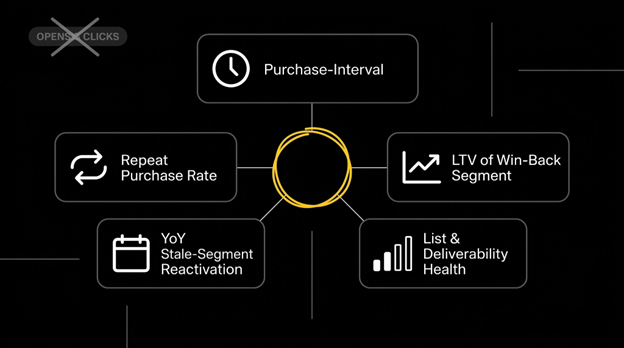
Opens and clicks are useful for in-sequence optimization, but they tell an incomplete story about whether a win-back email campaign is actually working. A more complete measurement approach tracks:
- Purchase-interval movement: whether the gap between purchases is closing or continuing to extend for the reactivated segment.
- Year-over-year stale-segment reactivation: whether the 95-day cohort is shrinking or converting faster than the prior year.
- Repeat purchase rate: whether reactivated customers buy again, rather than transacting once and lapsing again.
- LTV of the win-back segment: whether recovered customers behave like loyal buyers over time.
- List and deliverability health: whether engagement gains are holding rather than fading after the initial send.
A campaign that drives a flood of one-time reactivation purchases might look like a success in the first month, but if those customers disengage again within 60 to 90 days, the campaign has done little more than delay the inevitable. The goal is recovery that holds, not a temporary blip in the dashboard.
Partner With Pilothouse to Build a Reactivation Strategy That Scales
A win-back email campaign that avoids creating behavioral debt requires a different kind of thinking than most brands apply to email. It means resisting discount-led reactivation in favor of audience precision, intent-based creative, and persona-based offers built around why customers actually buy.
Why Brands Choose Pilothouse
Pilothouse integrates email strategy with broader performance media, creative development, and retention systems rather than treating win-back as an isolated campaign. This systems-level approach, connecting audience segmentation, persona mapping, deliverability management, and LTV tracking to the rest of a brand's retention and CRO work, is what separates a durable reactivation program from a one-off promotional push. The VSSL case study shows this value-first thinking applied in practice, with measurable results beyond a single discount send.
Start the Conversation
For brands whose lapsed buyer segment is growing while their current reactivation approach leans too heavily on discounts, a different conversation is worth having. The methodology exists, and the results follow when the strategy is built to earn loyalty rather than buy it. Pilothouse Digital works with DTC brands at every stage of scale to build that system.