


Meta Ads Learning Phase: How to Exit Faster Without Breaking Delivery

Every reset of the Meta ads learning phase costs real money. For brands spending six or seven figures a month, one unnecessary reset can mean days of inflated CPAs and a media buying team scrambling to explain volatile numbers to finance. Meta's own guidance is blunt about the mechanic: an ad set exits the learning phase after roughly 50 optimization events in a 7-day window, and significant edits push it straight back in (Meta Business Help Center). Brands stuck in repeated learning phase resets are usually dealing with a structural problem rather than bad luck.

Redefining the Meta Ads Learning Phase in the Post-Andromeda Era
The old mental model, an algorithm testing audiences and placements until it lands on something that works, doesn't reflect how Meta actually operates anymore. The system behaves less like a testing engine now and more like a matching engine.
From Reach Metric to Psychological Fingerprinting
Under Andromeda, Meta has moved targeting away from manual media buyer settings like interest stacks and onto the creative itself. The AI reads the creative's content to identify and route the message to the right audience, according to Abby Kohler, Strategist at Pilothouse, on Episode 587: Meta Andromeda Strategy: 5 Creative Testing Shifts for $5M+ DTC Brands. Every ad is now a search answer to a user's inferred psychological state, and the system continuously re-ranks creative based on predicted relevance to that state, per Pilothouse's Creative Intent Project Lead in the Creative Intent x Andromeda POV analysis.
Why 'Learning Limited' Matters Less Than It Did in 2019
Facebook ads learning phase status used to get treated as a hard failure signal. That framing hasn't aged well. Daniel Sendecki, VP of Brand and Performance at Pilothouse, notes on Episode 581, Meta Ads Aren't About Targeting Anymore, that a lower-spend ad may still be serving a specific awareness or assistance role in the customer journey that immediate purchase metrics don't capture. That said, the label still carries a real cost. Meta states that ad sets in the learning phase are less stable and usually run a higher CPA, and that they exit only once delivery stabilizes, typically after about 50 results in the week following the last significant edit (Meta Business Help Center). Treating every appearance of the label as a crisis wastes energy better spent building a structure that avoids triggering it in the first place.
How REA's Doubled Accuracy Changes What Signals Matter Most
Meta's AI engineering agent, REA, doubled its average model accuracy across six models in its first production validation. That leap changes what advertisers should optimize for. Jacob Geary, Head of Socials at Pilothouse, explains on Episode 609: The New Rules for Meta Attribution, that learning now depends heavily on whether the creative hook, especially the first three seconds, gives the algorithm a clear enough signal to find the right people.
The First Three Seconds: The Primary Learning Signal
Hook rate, calculated as three-second video views divided by impressions, is the metric most media buyers watch first, and for good reason. Creative that fails to hold attention in the opening seconds slows the accumulation of conversions, which stretches the stabilization window out and keeps costs elevated for longer. Creative teams should prioritize the opening of their videos as a key element for exiting the learning phase, rather than as an afterthought added at the end of production.
Campaign Consolidation: The Fastest Way to Exit Learning Without Resetting Delivery
Fragmented account structures are one of the most common causes behind repeated learning-phase resets. Meta needs roughly 50 optimization events within a 7-day window to stabilize deliver. Split those conversions across too many ad sets, and every one of them struggles on its own.
Fewer Campaigns, Higher Budgets, Faster Signal Resolution
The math is straightforward: six daily conversions feeding one ad set can exit learning in 8-9 days. Split that same volume across six ad sets, and each one needs its own 50 conversions, six times harder to reach. Jacob Geary points out on Episode 591: Meta Andromeda Updates: CASC + AI Assistant + Creative Testing, that consolidating campaigns allows for higher budgets on fewer campaigns, a major win under Andromeda for getting out of the learning phase more efficiently. A useful budget floor rule: multiply average cost per conversion by 50 to set a minimum weekly budget, then divide by seven for a daily figure. A $40 CPA implies roughly $2,000 per week, or about $286 per day, as the floor needed to feed the algorithm enough data.
This kind of structural fix produced measurable results for VSSL, where Pilothouse stabilized Meta performance without increasing spend, as detailed in the VSSL case study.
Building a Creative Testing Pipeline That Trains the Algorithm
Consolidation solves the budget fragmentation problem. Creative structure solves the other half: how new ideas get introduced without disrupting stable delivery.
ABO Testing Campaigns as Sandboxes for Unproven Concepts
Untested concepts need a contained environment. ABO testing campaigns, with controlled spend per ad set, let teams evaluate new ideas without risking the delivery history built up in scale campaigns. This isolates risk while still generating usable signal data.
Graduating Winners Into CBO Scale Campaigns
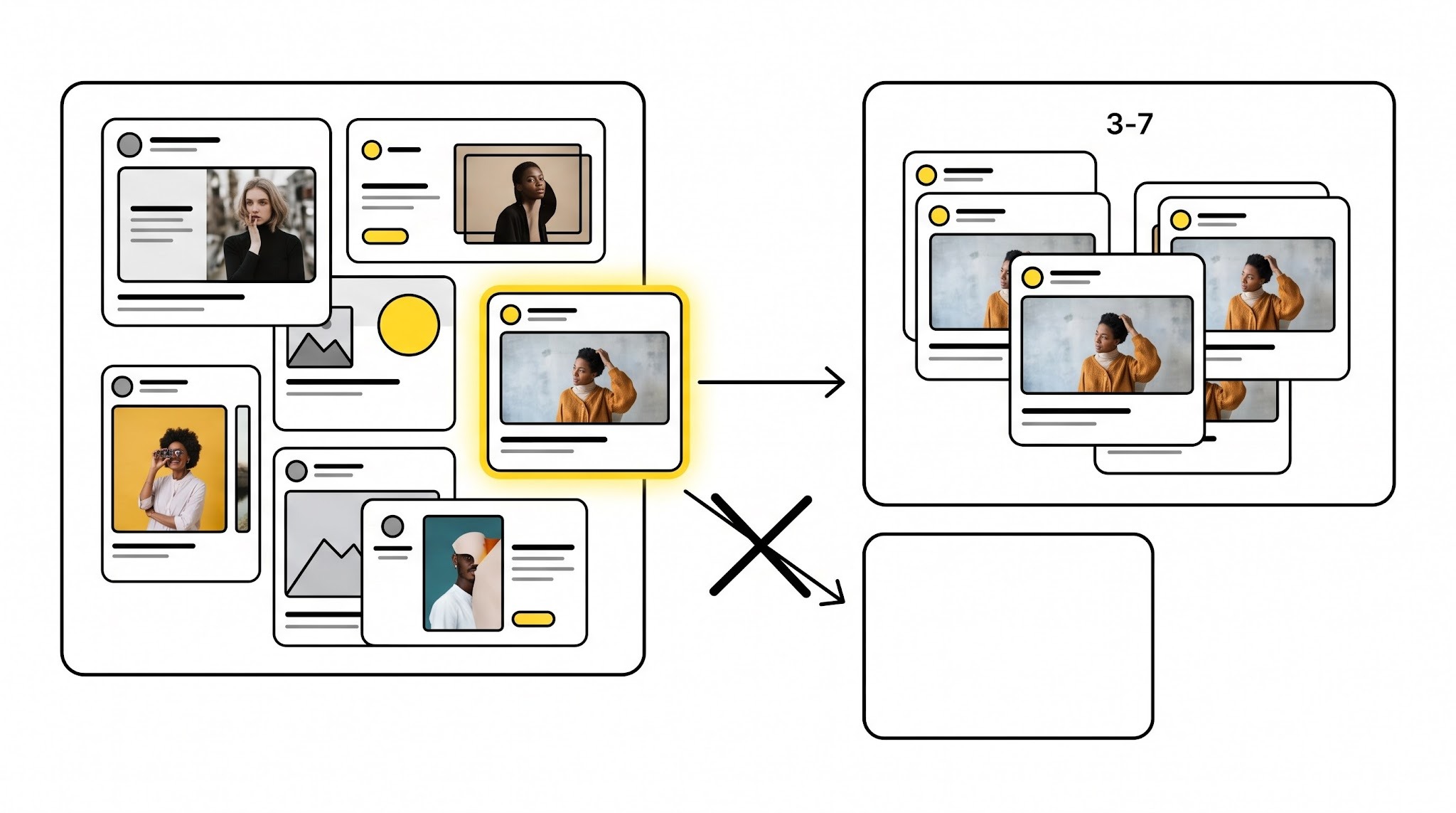
Taylor Cain, Senior Ecommerce Strategist at Pilothouse, describes on Episode 611: Velocity Isn't Strategy – Pilothouse on the Andromeda Creative Trap, a best-practice structure built around a testing campaign that graduates winners into a scale campaign, complemented by tactical breakouts like catalog campaigns to maintain consolidation while allowing controlled data input. Under this scale-campaign structure, 3-7 similar ad sets built around one creative family let Meta read the signal in 48-72 hours. Winners should get promoted into the existing scale campaign, not duplicated into a fresh one. Duplication strips the accumulated delivery history and restarts the learning phase from zero, undoing the exact consolidation work that made exiting fast in the first place.
Why Micro-Iterations Fail and Whole Shots Win
A common instinct when a creative underperforms is to tweak it: swap a color, shave two seconds off, change the CTA button. Under Andromeda, that instinct backfires.
The 70% Rule: When Variations Get Bucketed Together
Brayden Germaine, Senior Content Manager at Pilothouse, explains on Episode 589: 9 Static Ads in 2.5 Hours, that creative variety, different answers to different questions, rather than design variety like changing button colors. Meta's AI will bucket iterations that aren't at least 70% different into a single creative entity, which blocks independent learning. In practice, a large share of most advertisers' active creatives cluster around one or two concepts. Most of what gets labeled "testing" isn't testing anything at all.
Designing Whole Shots as Distinct Intent Signals
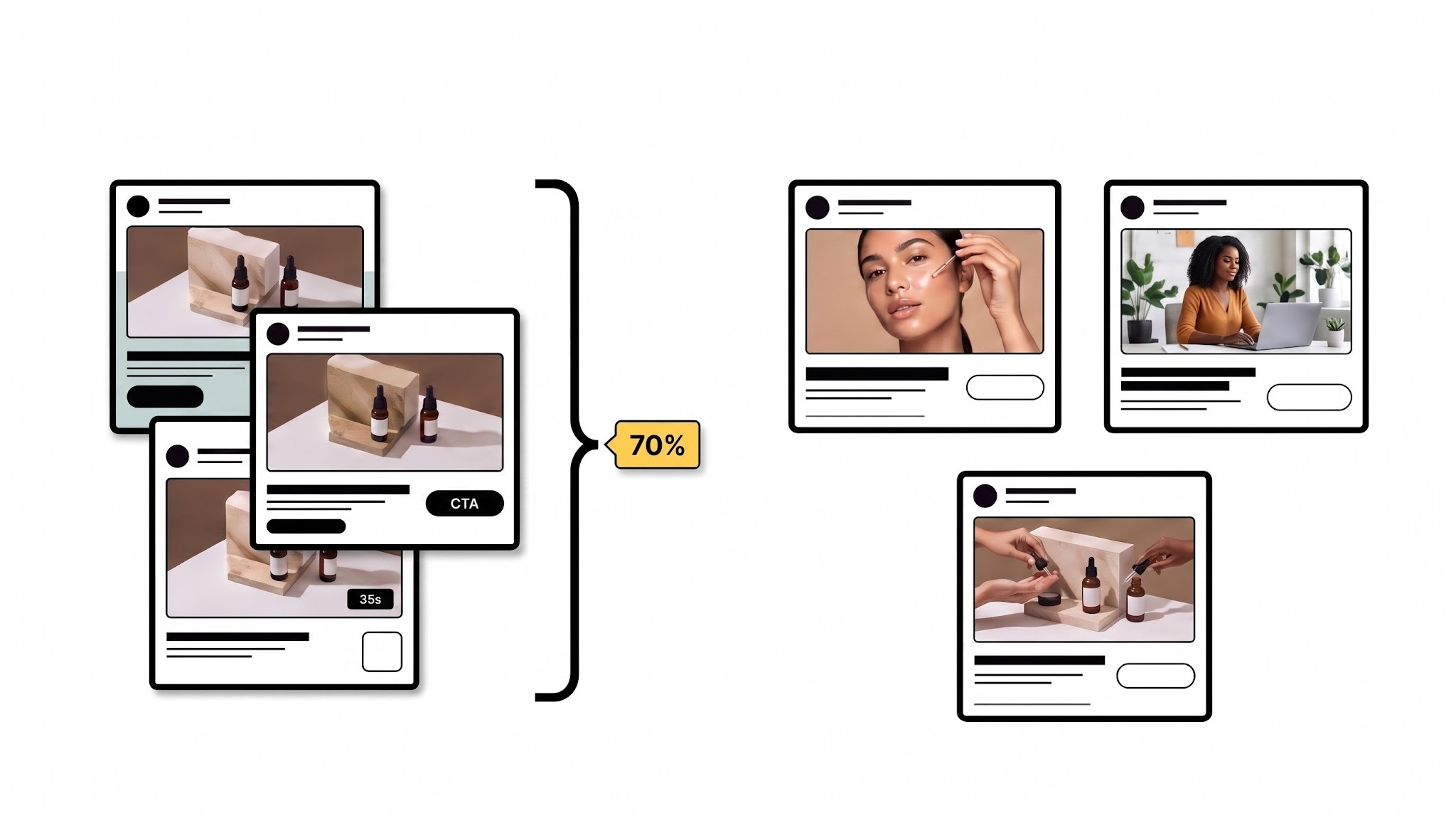
The fix is launching whole shots: fully thought-out concepts covering message, visual, and offer together, instead of micro-iterations. Abby Kohler, Strategist at Pilothouse, notes on Episode 587: Meta Andromeda Strategy that Andromeda rewards high-quality unique signals over redundancy. Before touching any live creative, teams should ask whether the edit is genuinely a new idea. A cosmetic change that stays within the same concept gets bucketed with the existing asset, which just wastes production time. A change that introduces a genuinely different psychological angle, a different question the customer might be asking, earns its own whole shot in the testing pipeline.
Patience and Precision While Attribution Stabilizes
Reacting to short-term noise while the system settles undermines the structural fixes described above.
Why Incremental Attribution Takes Weeks to Settle
Jacob Geary, Head of Meta at Pilothouse, explains on Episode 609 that new attribution settings, like incremental attribution, typically take a couple of weeks to settle and become fully accurate, since Meta runs automatic internal hold-out tests to determine true conversion lift. This instability has consequences beyond the dashboard. Inconsistent CPA reporting during this window makes it harder for media teams to defend budget internally, since numbers that swing week to week erode stakeholder confidence even when the underlying account is healthy. Recognizing this as a temporary, expected phase rather than a performance failure prevents premature edits that undo weeks of accumulated delivery history.
Using Meta AI Business Assistant to Identify Winning Intent Buckets
Meta AI Business Assistant gives operators a faster feedback loop. Jacob Geary notes on Episode 591: Meta Andromeda Updates that the assistant lets operators query the account directly for themes among top-performing ads, speeding up identification of which intent buckets are successfully exiting the learning phase. Instead of manually cross-referencing creative reports, teams can ask the assistant directly what's converting and why, then feed that insight back into the whole-shot testing pipeline.
Partner With Pilothouse Digital to Train Your Account Faster
Pilothouse diagnoses those root causes first, then rebuilds account structure around consolidation, whole-shot creative testing, and a defensible testing-to-scale pipeline, the same approach behind the stabilized results seen in the VSSL case study. More proof points are available across Pilothouse's case studies.
For brands tired of unpredictable CPAs and budget conversations that start with "the algorithm reset again," Pilothouse offers a structural alternative: faster, more defensible exits from the learning phase, tied directly to CAC efficiency and contribution margin, not just in-platform ROAS.

